I. The Siege of the Reflection
Time does not flow solely like a receding river; it often behaves like a silent creditor waiting at the bends in the road. In the song Million Years Ago, adulthood reveals itself not as the peak of development, but as a state of withdrawal and siege. The singer confesses a deep weariness: “I have too many fears to suffer,” a declaration that transforms maturity into a besieged fortress where the greatest desire is “not to hide and to be fleeting.” Childhood, described with the lightness of playing and running under a mythical light, is presented as the lost territory of intrepidity. However, the true conflict arises when escape is impossible because the pursuer is not the external calendar, but one's own reflection: “but the reflection of who I am comes for me.” The mirror ceases to be a passive witness to our physical decline and becomes an active agent demanding the truth of what we have done with our time.
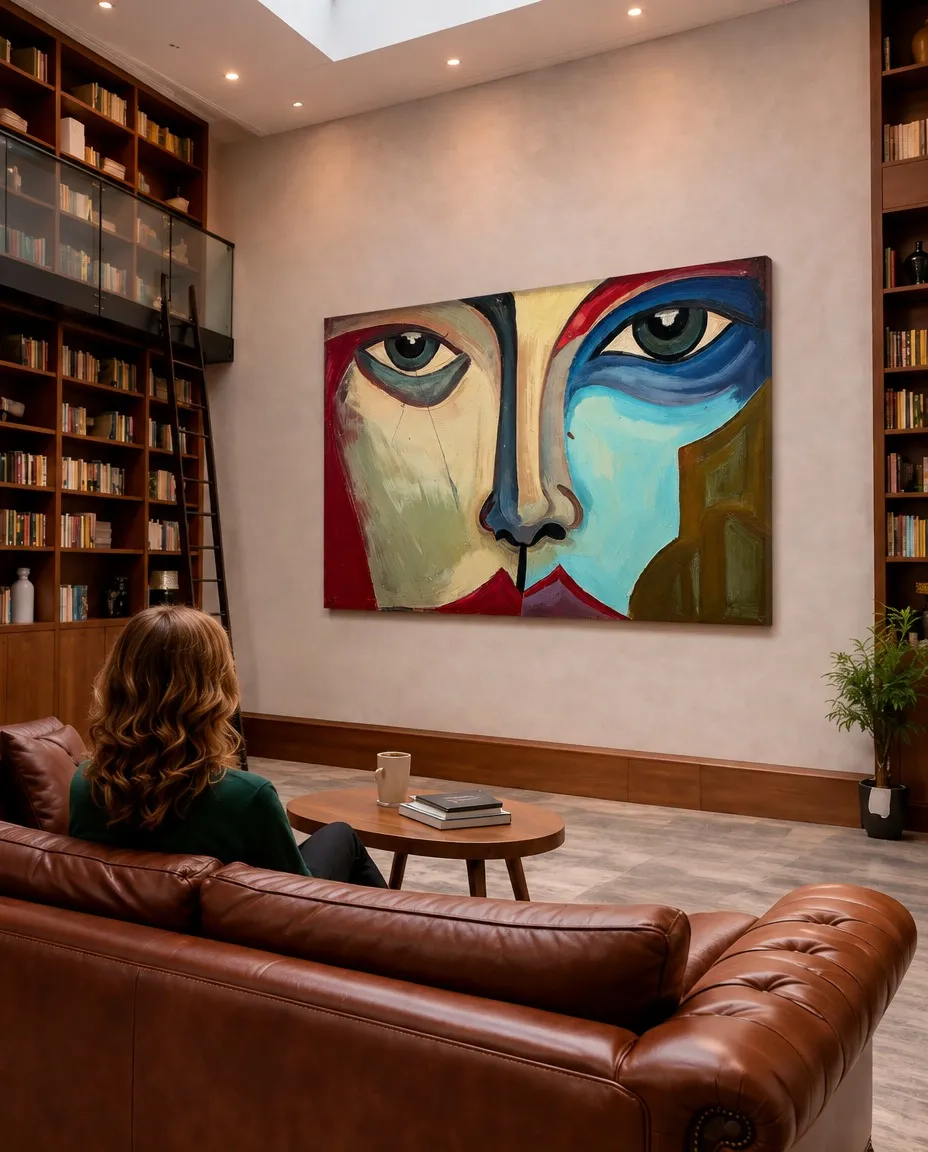
Faced with this impulse towards withdrawal and disappearance, the presence of Maurizio Valch’s work imposes an unavoidable stillness. While the musical voice seeks to dissolve, to lose itself in the speed of an era that is no longer its own, the painted face stands before us with monumental immobility. Painting suspends the possibility of hiding. What happens when we cannot flee because the gaze questioning us is our own? The artwork establishes a surface where the siege of the reflection can no longer be avoided; the divided image forces us to hold our gaze before the different eras inhabiting the same skin.
II. The Persistence of the Face
I refuse to conceive of the canvas as a mere decorative record of pain or the illustration of a loss. When the face divides in my painting, I do not seek to narrate a clinical fracture, but to capture the essential tension of existence: the impossibility of ceasing to look at ourselves. If the song laments that “time didn't wait,” my craft consists precisely in forcing that time to halt, to freeze within the delimited space of the canvas. I do not paint to decorate a wall, but to establish a place of visual confrontation where the light and shadow of a single spirit are compelled to coexist.
The division of the face is not an act of destruction, but of revelation. By drawing that line which splits the features, I force yesterday and today to look each other in the eye on the same plane. Those who flee from their reflection seek an impossible continuity—the lie of a coherence that the passing years have already destroyed. The canvas offers no consolation; it provides a stillness that resists the temptation to flee. If the musical voice fears the reflection coming to find it, my work is to construct that reflection so that, at last, the viewers stop and accept the gaze that claims them.
III. The Fear of Flying and the Temptation to Hide
There is a painful paradox in the declaration of wanting “to turn around the sun, having so much desire to fly” while noting, with a heavy resignation, a definitive “I'm still here.” The song oscillates between the yearning for absolute movement—flight, celestial rotation, the freedom of a child—and the paralysis of the present. Pain acts as an anchor fixing the body to the ground while the mind wanders through the fields of nostalgia. Growing up, in this context, is experienced as a loss of gravity; the adult is one who has forgotten how to hold themselves in the air, gazing at the sky with the suspicion that it no longer belongs to them.

Faced with this tension between the yearned-for flight and actual paralysis, Maurizio Valch’s work operates as an off-center, symmetrical resistance. There is no easy dynamism in those colossal eyes; there is an almost sacred quietude, a stillness that has absorbed all the storms of temporal passage. While the lyrics search for the lightness of the child, the painting returns the gravity of the face. Those massive eyes do not judge the cowardice of the one who hides; rather, they offer a shelter from the elements of the world. By shifting the symmetry of the face off-center, the painting suggests that true stability lies not in the perfection of an unbroken life, but in the capacity to stand upright under the gaze of our own contradiction.
IV. The Apprentice's Lesson
The most humble and yet most lucid declaration of the song is found in the line stating: “And my path is what I am: an apprentice.” As a creator, I find the core of all aesthetic search in this line. True mastery does not consist in acquiring certainty or in a nostalgic return to an untouched childhood; nostalgia is often a comfortable trap that paralyzes the brush and sweetens the pain of the present. To be an apprentice means accepting that the face is split, that identity is a territory in constant construction, and that the two halves of our history do not need to be fully reconciled to coexist.
The child we were and the tired adult we are must not battle for supremacy over the painting. On the divided surface, wonder and the scar, the clarity of color and the depth of shadow, live together. My painting does not attempt to resolve the division of the soul, but to make it habitable. The artist’s lesson is the same as the living being's: learning to look at one's own strangeness without horror, understanding that the split face is the only honest physiognomy left to us by the passing decades.
V. The Gaze as Threshold
At the end of the journey, the reflection that “comes for us” can cease to be perceived as a debt collector or an implacable pursuer. If we modify the distance and the intention of our gaze, that encounter with oneself transforms into an invitation or a threshold. Maturity does not have to be the funeral of childhood, but rather the acquisition of a double vision: the capacity to observe reality through two eyes that have seen different eras and, therefore, refuse to be deceived by the immediacy of the present.

The double gaze of Valch’s painting proposes that division is not synonymous with rupture, but with perceptive richness. Upon looking at the canvas, the viewers discover that their own cracks are the channels through which light enters. In this way, writing and image find a lighter way out, where the gravity of pain dissolves into the curiosity of continuing to observe. Growing up is the art of inhabiting a divided face, of learning to be the apprentice who walks between yesterday and today, holding their gaze steady on the horizon of what is yet to come.