Context study / VIA SOLIS
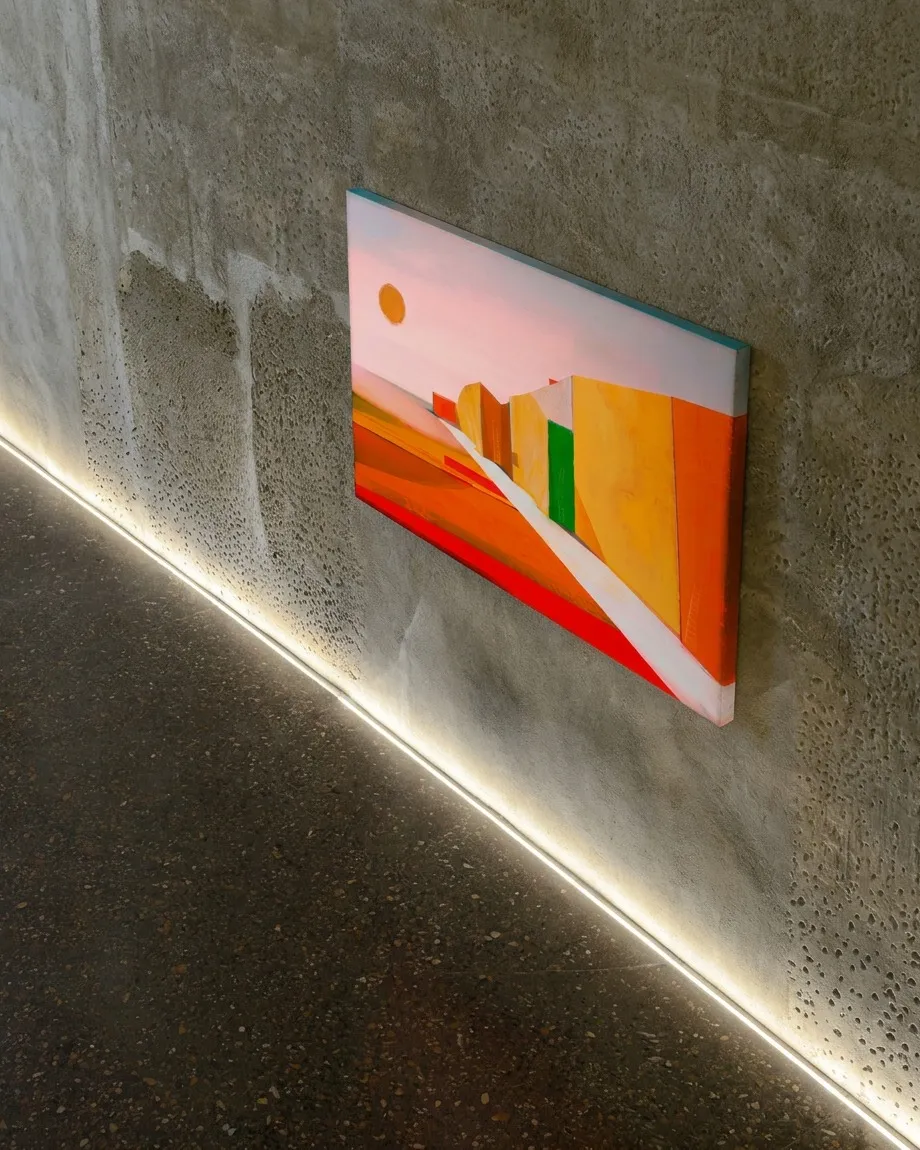
VIA SOLIS en un mockup de interior
The cavities in the concrete do not form a figure that orders them; around VIA SOLIS, by contrast, each plane seems to have been held at the exact moment before merging with the next. The oblique view heightens this decision: the 120 × 80 cm canvas physically stands apart from the wall, and its reds, yellows, and oranges maintain crisp contours against a grey surface marked by stains, pores, and wear. Yet the pictorial order is not mechanical. The white path narrows without fixing a destination, the pink sky retains a faint vibration, and the small marks across the volumes introduce an uncertain scale. In Valch’s language, divisions do not close off the territory: they establish the minimum conditions under which distance can appear.
This reserve of openness is related to an experience of transit that runs through the artist’s thinking. For him, an external path can be mapped out and still fail to resolve the inner direction of the person who follows it. The white band in VIA SOLIS makes this difference visible: it organises the ground, crosses the warm fields, and disappears among masses that could be architecture, relief, or simply pictorial presence. Its precision does not offer a psychological answer; rather, it prevents indeterminacy from dissolving into complete vagueness. The territory remains available to the eye because its boundaries do not present themselves as a doctrine or as a map to be deciphered.
In “From Dream to Territory,” Valch describes MARE SOMNIORUM as an expanse in which memory, desire, and distance alter what is visible, and where the horizon both separates and connects. VIA SOLIS condenses this condition with particular clarity and economy: the path brings together areas that the composition keeps distinct, while the small orange sun remains to one side, detached from the promise of arrival that the title might suggest. The essay also insists that the series do not progress through linear overcoming: dream persists when the ground acquires structure. Read from this perspective, the care given to the edges does not cancel the strangeness of the landscape; it gives it a precise place in which to remain without becoming an illustration of recognisable geography.
The proximity to Antoni Tàpies helps gauge the difference between the real wall and the painted territory. In both cases, the surface can be understood as something affected by time rather than as a neutral support: the concrete in the installation displays its erosion, while Valch’s practice incorporates layers, cuts, and reductions as material procedures. But VIA SOLIS departs from the tactile, closed density that this affinity might evoke. Against the wall, which accumulates traces without orienting them, the canvas sets out luminous reserves and deliberate separations. Its order does not erase the irregularity around it; with visible fragility, it sustains the possibility that the unknown may remain open.
- Original artwork
- VIA SOLIS
- Actual dimensions
- 47.2 × 31.5 in / 120 × 80 cm
- Presentation
- Digital contextual visualization
Context references
VIA SOLIS Maurizio Valch · abstract painting on a concrete wall · brutalist abstract art in warm tones · abstract landscape with white path · orange red and yellow abstract painting · contemporary painting with geometric blocks · wall art for a concrete interior · contemporary Mediterranean abstract painting
About this visualization
This visualization places the artwork within an architectural context to help collectors and viewers imagine its presence in a real space. It is an interpretive reference, not an exact reproduction: the original work remains the sole authority for scale, color, surface and material presence.