Context study / VIA SOLIS
VIA SOLIS - Original Contemporary Abstract Artwork
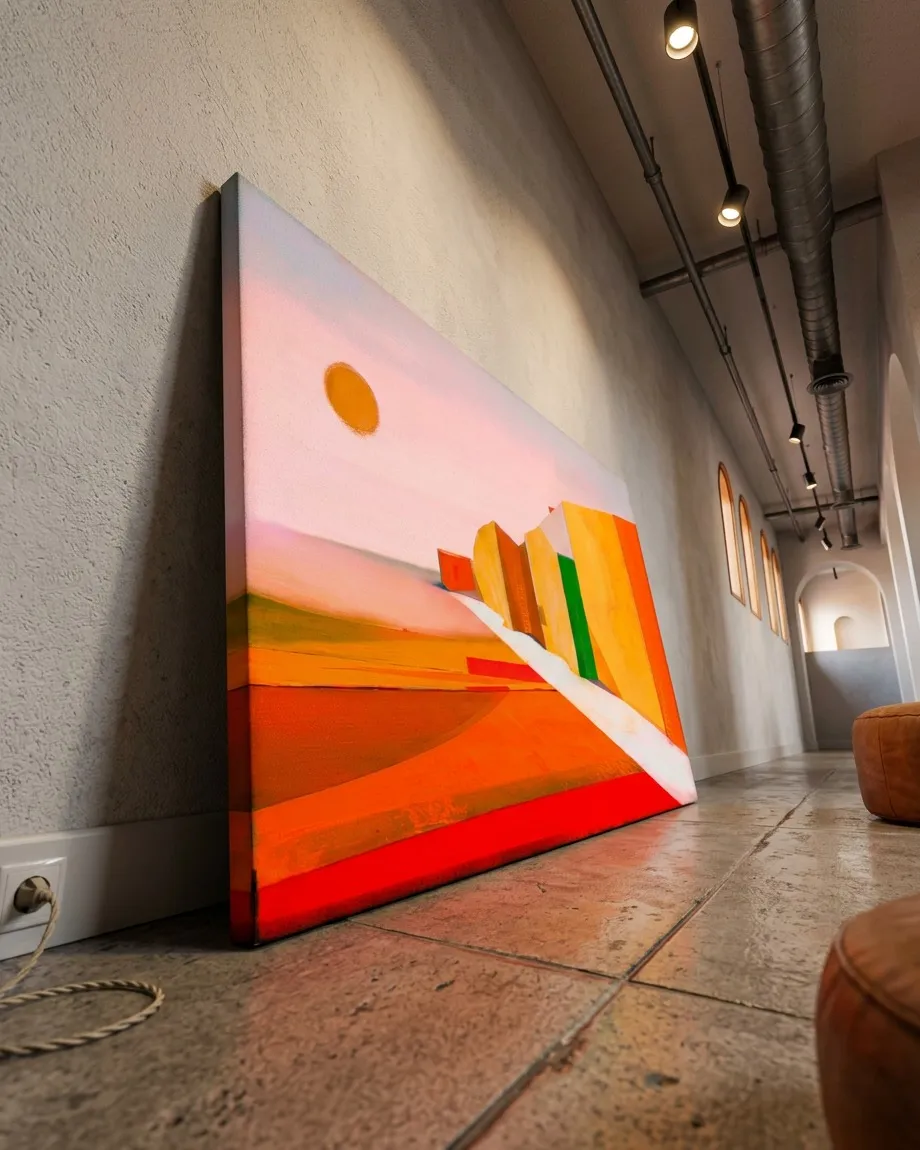
The proximity of the floor alters the hierarchy of VIA SOLIS: red and white emerge almost at eye level, while the orange circle remains above, separate and small. The path enters at the lower edge with a bodily force, yet as it narrows between yellow, ochre and green volumes, it does not provide a continuous route towards the celestial body. This displacement concentrates a decisive feature of Maurizio Valch’s language: colour fields and territorial divisions capable of suggesting a passage without fixing a geography or an outcome. Small incisions and shifts in plane restore scale to a territory that, despite its clarity, retains resistance.
From this low position, the viewer does not command the landscape: they share the point of departure of the white band. The sun no longer fulfils the reassuring function of orientation; it remains suspended outside the axis of movement, at a distance the body cannot measure or overcome. Valch’s experience of journeys, departures and long intervals between one place and another helps explain the importance of this reserve, without turning it into the painting’s confession. An outer path may be mapped and yet fail to resolve an inner direction. The painting holds both conditions without turning them into a closed allegory.
In “Fresh Earth for the Hero,” Valch questions the habit of turning every journey into a test that must culminate in recognition or victory. VIA SOLIS gives visual form to that suspicion: the visible path does not lead towards a solar coronation, and the blocks alongside it do not celebrate progress, but interrupt it and make it available for thought. The extreme, near-ground camera angle sharpens this renunciation of the triumphant traveller’s panoramic view. Between the physical foreground and the high light, a persistent distance opens up: not an absence to be filled, but the condition of still being on the way.
The affinity with Richard Diebenkorn helps us recognise how abstraction can retain a memory of ground, passage and depth through organised planes. Yet where Diebenkorn often opens space into a more aerial breathing room, Valch compresses the scene into a warm frontality, with weighty edges and structures that do not allow themselves to be fully crossed. Nor does the isolated sun complete the perspective: it remains lateral, remote, almost indifferent to the direction set in motion by the path. The painting thus offers not a landscape to possess through looking, but a simple and demanding measure: the immediate ground beneath the viewer, and that which remains far away even as it illuminates.
- Original artwork
- VIA SOLIS
- Actual dimensions
- 47.2 × 31.5 in / 120 × 80 cm
- Presentation
- Digital contextual visualization
Context references
VIA SOLIS Maurizio Valch · abstract painting with white path · abstract landscape in red and orange tones · abstract art with orange sun · abstract Mediterranean landscape painting · large horizontal abstract painting · contemporary abstract wall art
About this visualization
This visualization places the artwork within an architectural context to help collectors and viewers imagine its presence in a real space. It is an interpretive reference, not an exact reproduction: the original work remains the sole authority for scale, color, surface and material presence.