Context study / VIA SOLIS
VIA SOLIS — Context Study
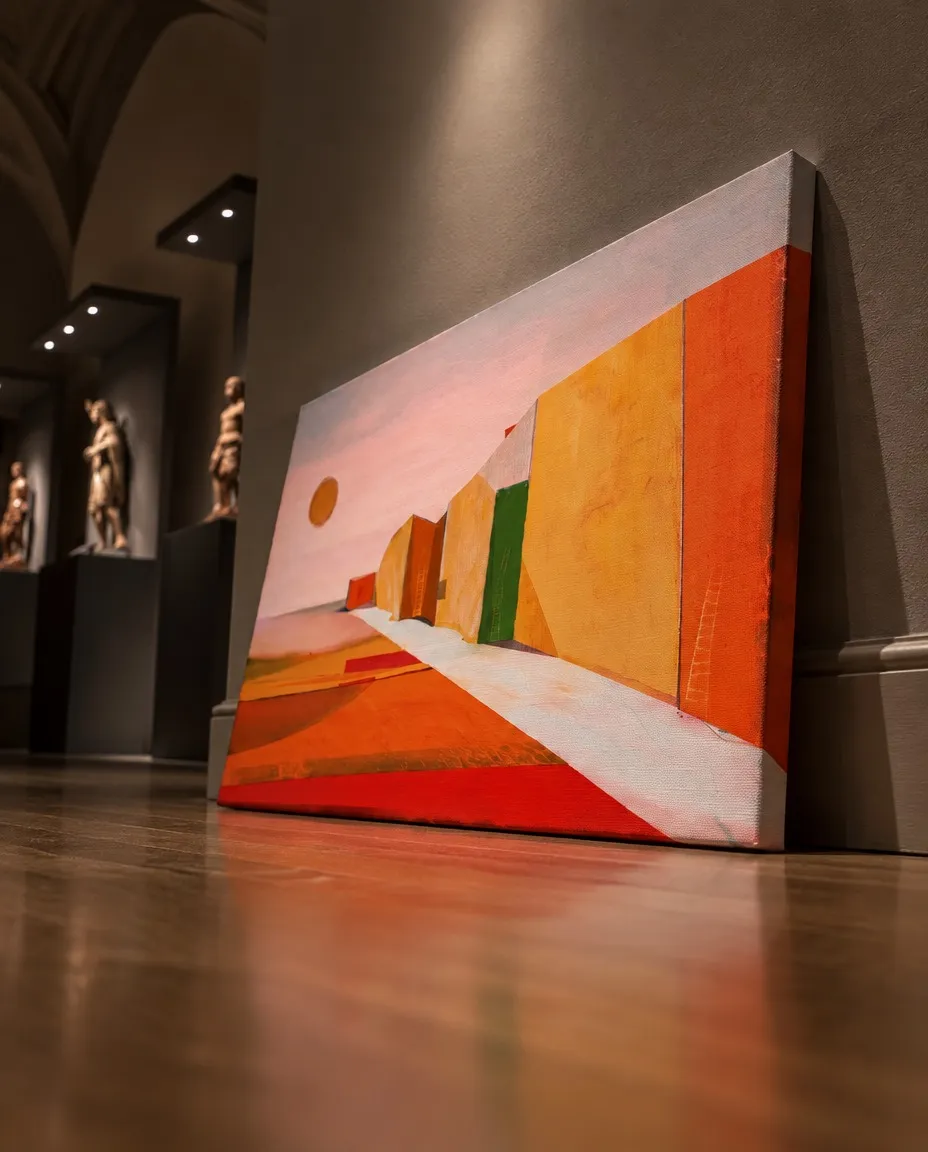
At this level, almost blending with the floor, the red along the lower edge ceases to read as a distant landscape and takes on the immediacy of a surface that would have to be stepped on with care. The low camera angle makes decisive a quality already visible in VIA SOLIS: the ochre, red, and white fields do not form a continuous plain, but rather zones that overlap, break apart, and shift in inclination. This instability belongs to Maurizio Valch’s territorial language, built through divisions, contained horizons, and large chromatic masses capable of oscillating between matter and place. In this 120 × 80 cm canvas, the white path enters from below but does not consolidate the ground; it cuts across it and narrows between yellow, orange, and green volumes whose scale is never fully fixed. Small incisions on some of the vertical forms introduce a fragile, almost human measure within an expanse that resists being mastered by sight.
Standing before ground does not yet mean knowing where to place oneself. The experience of transit occupies a documented place in Valch’s thought, for whom an external path may be legible without resolving the direction of an inner movement. This distance helps explain why the white band should not be reduced to a promise of arrival. It offers a route, although the orange sun, suspended and shifted to the left, does not ratify it as a destination. The painting keeps open an interval between the body seeking support and the gaze attempting to orient itself: the land appears close, even physical, yet its oblique bands undo any immediate certainty. There is no need to turn this condition into a psychological narrative; it is enough to note that orientation appears as a sensory task rather than a certainty.
The essays From Dream to Territory and When the Ground Appeared make it possible to clarify this condition without closing it down. Valch writes that the appearance of ground does not eliminate the dream: it gives it weight, divisions, and a position from which something can begin to organise itself. VIA SOLIS belongs to MARE SOMNIORUM, yet it makes precisely this passage visible: the greyish pink of the sky and the uncertain distance retain a suspended quality, while the warm foreground demands a new gravity. According to this reflection, the ground is never neutral; it precedes those who inhabit it and conditions their possible directions. The presentation intensifies this idea by bringing the base of the painting visually close to the actual floor of the room: the painting is not offered as a panoramic view possessed from outside, but as terrain whose consistency must be measured before moving forward.
Richard Diebenkorn offers a pertinent affinity through his ability to retain a memory of landscape within abstract planes and organised distances. Yet while the gaze in his compositions often retains a certain aerial breadth, Valch compresses the experience towards the edge and the frontal presence of the path. The blocks do not organise an available geography; they hold back the passage and force it to divert between their luminous masses. This difference makes VIA SOLIS distinctive: the territory does not unfold to be contemplated from a secure position, but appears as an initial condition—close at hand and still uncertain—where looking already means seeking support.
- Original artwork
- VIA SOLIS
- Actual dimensions
- 47.2 × 31.5 in / 120 × 80 cm
- Presentation
- Digital contextual visualization
Context references
VIA SOLIS Maurizio Valch · abstract landscape with path · red ochre and white abstract painting · abstract painting with orange sun · abstract art with architectural forms · 120 x 80 cm horizontal abstract painting · contemporary geometric landscape painting · warm contemporary abstract wall art · abstract painting with incised lines
About this visualization
This visualization places the artwork within an architectural context to help collectors and viewers imagine its presence in a real space. It is an interpretive reference, not an exact reproduction: the original work remains the sole authority for scale, color, surface and material presence.