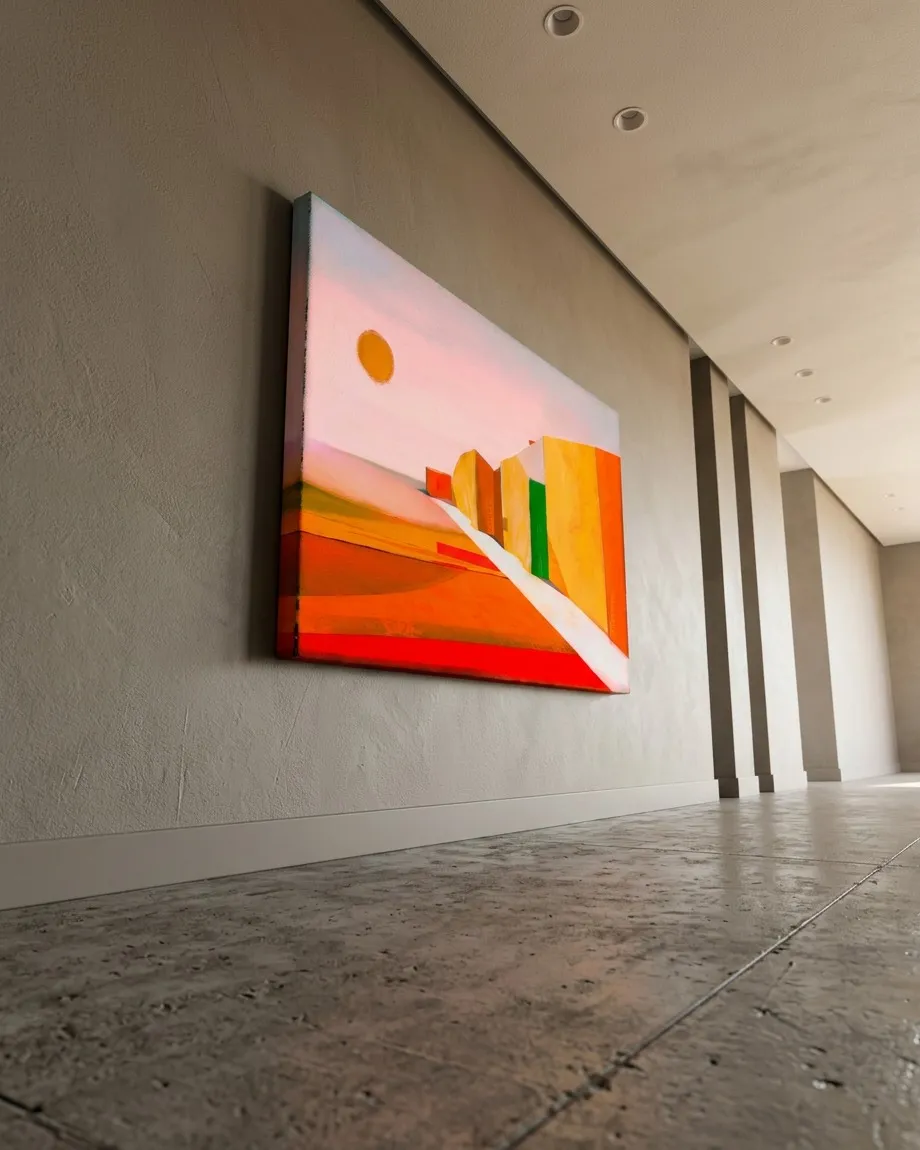
Context study / VIA SOLIS
VIA SOLIS en un mockup de interior
The corridor offers a clear vanishing line to the right, but the white band in VIA SOLIS resists following it: it begins near the lower-right edge and draws inward towards the centre of the canvas, among yellow, orange, and green masses that prevent any simple continuity. This discrepancy makes a decisive feature of Maurizio Valch’s language perceptible: his territories are organised through chromatic fields, divisions, and compact forms that suggest passage without stabilising a geography. The 120 × 80 cm canvas appears in foreshortening and physically follows the length of the wall; yet its path does not extend onto the actual floor. The architecture facilitates the body’s movement forward, while the painting retains a direction of its own—shorter, oblique, and difficult to transfer to the surrounding space.
This separation between moving and being oriented finds a precise echo in the experience of transit that runs through the artist’s thought. He has distinguished between an external path, traceable on a map, and an inner movement whose direction may remain unknown. This relation does not turn the white path into autobiography or a fixed symbol; rather, it helps explain why its clarity does not amount to instruction. The lateral volumes, small marks of scale, and the sun set apart on the left sustain a scene in which there are enough signs to keep looking, but no guarantee of arrival. Moving along the corridor and following the painted route are different actions: one has physical continuity; the other requires accepting that orientation may remain suspended.
In “From Dream to Territory,” Valch describes MARE SOMNIORUM as an expanse where memory, desire, and distance alter the shape of the visible, and where the horizon both connects and separates. VIA SOLIS condenses this condition in its path: the route joins the near edge to a possible distance, though the warm blocks interrupt every linear reading. “Fresh Ground for the Hero” shifts the question further by rejecting the obligation for every journey to culminate in victory. The painting need not oppose movement; rather, it deactivates the idea that a visible direction must justify a heroic quest or lead to a reward. Beneath the orange star, which remains to one side and serves no function as a destination, the journey retains its question without turning it into an imperative.
The affinity with Richard Diebenkorn helps recognise how abstraction can retain a memory of landscape through planes, depth, and territorial relations. But where Diebenkorn’s constructions often open onto a more aerial view of the field, Valch concentrates the experience at the edge of a compressed route. Seen from this side, the difference becomes especially clear: the painting does not offer a territory to be mastered by the eye, but an orientation that folds back within its own limits. The viewer leaves the corridor knowing that the body can continue forward even when the image has chosen not to indicate where to.
- Original artwork
- VIA SOLIS
- Actual dimensions
- 47.2 × 31.5 in / 120 × 80 cm
- Presentation
- Digital contextual visualization
Context references
VIA SOLIS Maurizio Valch · abstract painting with white path · abstract landscape in reds and oranges · geometric abstract art with orange sun · contemporary painting of territory and horizon · abstract painting for a modern hallway · Mediterranean abstract painting · minimalist wall art in warm tones
About this visualization
This visualization places the artwork within an architectural context to help collectors and viewers imagine its presence in a real space. It is an interpretive reference, not an exact reproduction: the original work remains the sole authority for scale, color, surface and material presence.