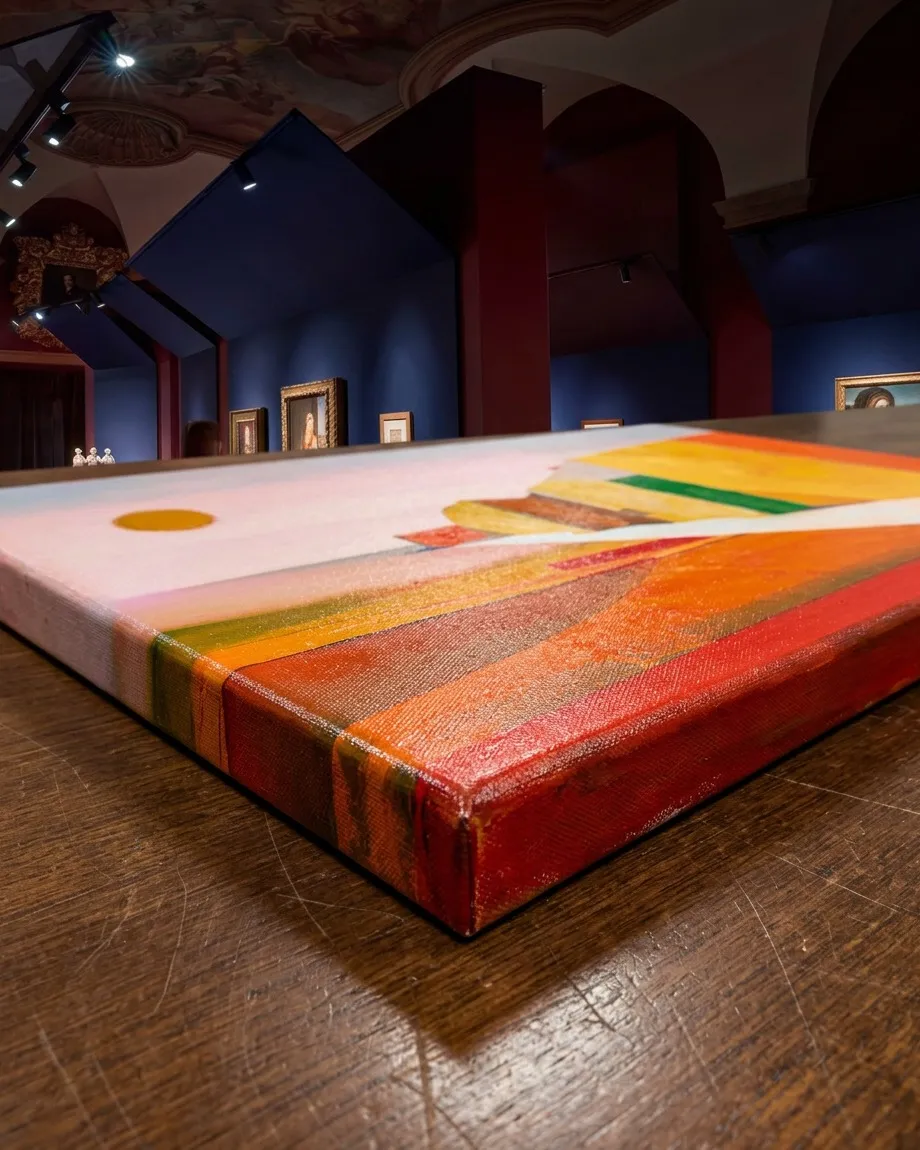
Context study / VIA SOLIS
VIA SOLIS en un mockup de interior
The sun has descended to tabletop height. Seen so closely, the small orange circle in VIA SOLIS no longer dominates a sky: it is held against a pink expanse whose horizontality becomes almost tangible. The low viewpoint requires the viewer to read the canvas edge first—its three-centimetre depth, visible weave, and the continuation of red, ochre, and orange over the side—before the promise of a landscape. This material resistance is central to Maurizio Valch’s language, which is usually sustained by colour fields, divisions, and elemental forms that oscillate between territory and surface. The white path and warm volumes retain a suggestion of distance, but they do not detach from the fabric that supports them.
This proximity also shifts the idea of the path. In the artist’s thinking, an external route can be drawn and yet fail to resolve the inner direction of the person who follows it. The painting’s white band moves forward through reds, yellows, and greens without reaching the suspended disc; at tabletop level, its function as a route weakens further, acquiring the immediate presence of spread pigment. There is no need to turn this relation into allegory: it is enough to notice that light offers no destination. It remains close, bounded, and silent, while the passage continues open within a surface that does not promise transparency.
In “From Dream to Territory,” Valch describes MARE SOMNIORUM as an expanse in which memory, desire, and distance alter what is visible, and where suspended lights do not close off mystery. This presentation makes that condition concrete: the orange circle does not recede into atmospheric depth, but remains compressed against the pink plane, almost within reach of the hand. The horizon, reduced to a faint band, no longer acts as a line inviting passage through the image; it simultaneously connects and separates the colour fields. The painting retains the impulse to look far away, while making perceptible that this distance depends on a finite, woven, and weighty support.
The affinity with Richard Diebenkorn helps recognise how abstraction can retain the spatial memory of a landscape through planes, paths, and distances. But VIA SOLIS departs from the aerial openness associated with that territorial construction. In contrast to the room, where the historical paintings in the background call for frames, grounds, and illusionistic depths, Valch’s canvas appears as a low object, displayed from its edge. Its yellow and orange masses do not fully recede: they gather on the skin of the canvas. The sun is thus deprived of astronomical distance and becomes a warm measure of proximity.
- Original artwork
- VIA SOLIS
- Actual dimensions
- 47.2 × 31.5 in / 120 × 80 cm
- Presentation
- Digital contextual visualization
Context references
VIA SOLIS Maurizio Valch · abstract painting with white path · red and orange abstract landscape · geometric abstract art with orange sun · contemporary Mediterranean landscape painting · warm-toned abstract painting · horizontal abstract wall art · Maurizio Valch MARE SOMNIORUM painting
About this visualization
This visualization places the artwork within an architectural context to help collectors and viewers imagine its presence in a real space. It is an interpretive reference, not an exact reproduction: the original work remains the sole authority for scale, color, surface and material presence.