Context study / VIA SOLIS
VIA SOLIS — Context Study
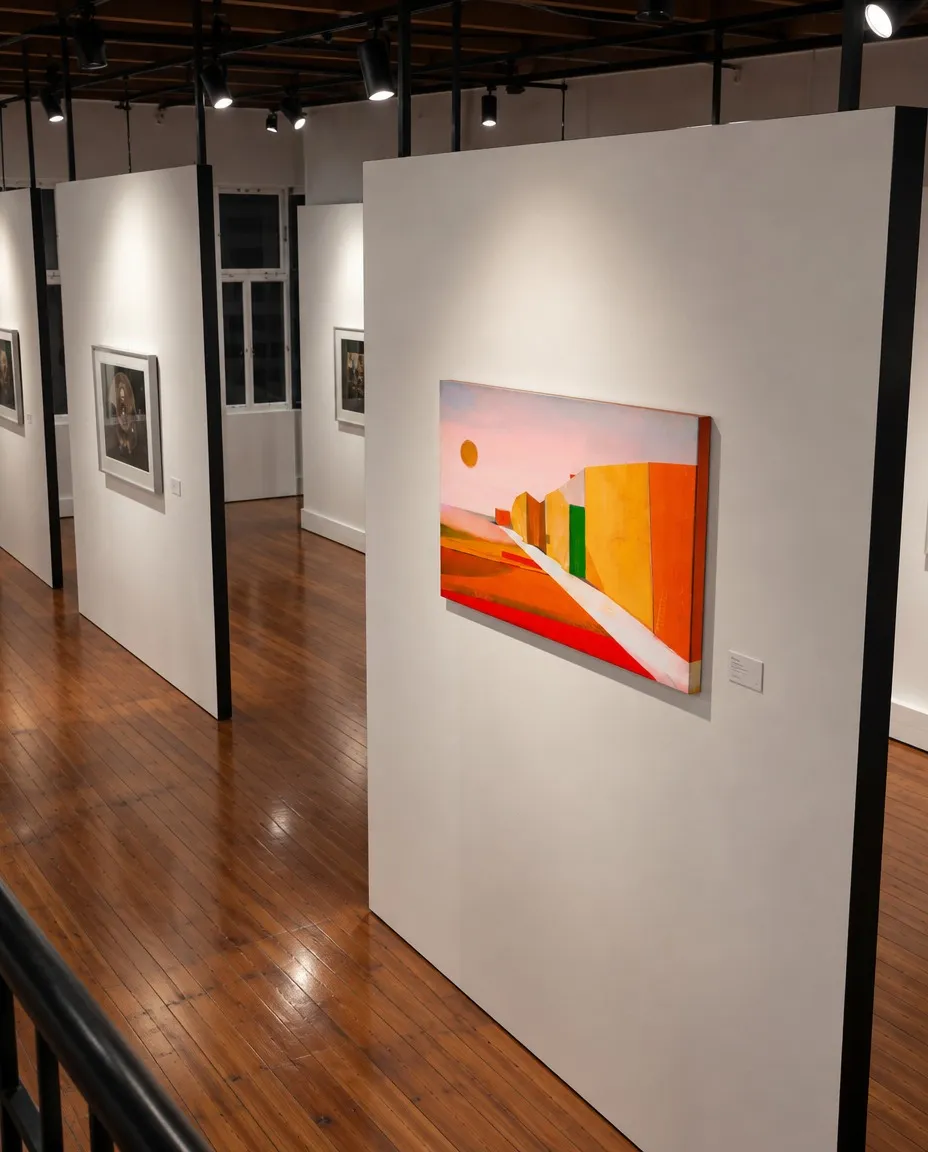
The route through the gallery is divided by panels that require images to be discovered in sequence; against this management of the gaze, the canvas concentrates an immediate, warm expanse. VIA SOLIS, measuring 120 × 80 cm, brings together a pink sky, red and ochre ground, a white path, and yellow and orange vertical bodies in a plane whose frontality resists the order of the corridors. The repeated partitions find a formal echo in these volumes, but their function changes: the gallery panels separate works and routes; Valch’s forms do not fully organise a habitable place. Within his language of colour fields, contained horizons and spatial divisions, this concentration is decisive: the path introduces depth, while the lateral blocks make it uncertain and deny any resolved geography.
Brightness does not erase distance. In Valch’s experience and thought, transit is associated less with arrival than with the interval between a place left behind and another not yet possessed; this condition helps us look at the white band without turning it into a closed allegory. It advances from the lower edge, narrows, and seems to seek passage between the luminous masses, yet the orange sun remains displaced, without taking on the role of a destination. The small staircases lightly incised into some planes suggest possible access without guaranteeing continuity. The painting thus sustains a visible direction and, at the same time, caution towards any orientation that is too conclusive: a territory may offer a path without promising belonging.
In “From Dream to Territory,” Valch describes MARE SOMNIORUM as an expanse in which memory, desire and distance alter the visible, and where constructions never fully belong to the landscape. The installation makes this condition especially precise. While the building distributes its walls as instruments of classification, the painting gathers within itself divisions that remain ambiguous: wall, vestige, mineral body or mere chromatic presence. The essay warns that dream does not disappear when territory acquires structure; VIA SOLIS preserves this coexistence. Its forms have weight and edges, but never fully establish scale or use. Light exposes the distances between them without translating them into a fully available scene.
The affinity with Richard Diebenkorn makes it possible to understand how abstraction can retain the memory of a journey without describing it. There, too, planes construct a territorial sensation; yet Valch moves away from a more aerial and panoramic openness to bring distance into a compact frontal plane. Seen from the corridor, the painting does not simply extend the architecture around it: it introduces its own temperature and discontinuity. The greyish pink cools the glow of yellows, oranges and reds; the white path both joins and separates. For a moment, the regular movement of the gallery is altered by a distance that fits entirely within the surface, though it still cannot be fully traversed.
- Original artwork
- VIA SOLIS
- Actual dimensions
- 47.2 × 31.5 in / 120 × 80 cm
- Presentation
- Digital contextual visualization
Context references
VIA SOLIS Maurizio Valch · abstract painting with white path · abstract landscape in red orange and yellow · contemporary Mediterranean abstract art · abstract painting with geometric blocks · large horizontal abstract painting · wall art for contemporary gallery · territorial abstract painting
About this visualization
This visualization places the artwork within an architectural context to help collectors and viewers imagine its presence in a real space. It is an interpretive reference, not an exact reproduction: the original work remains the sole authority for scale, color, surface and material presence.