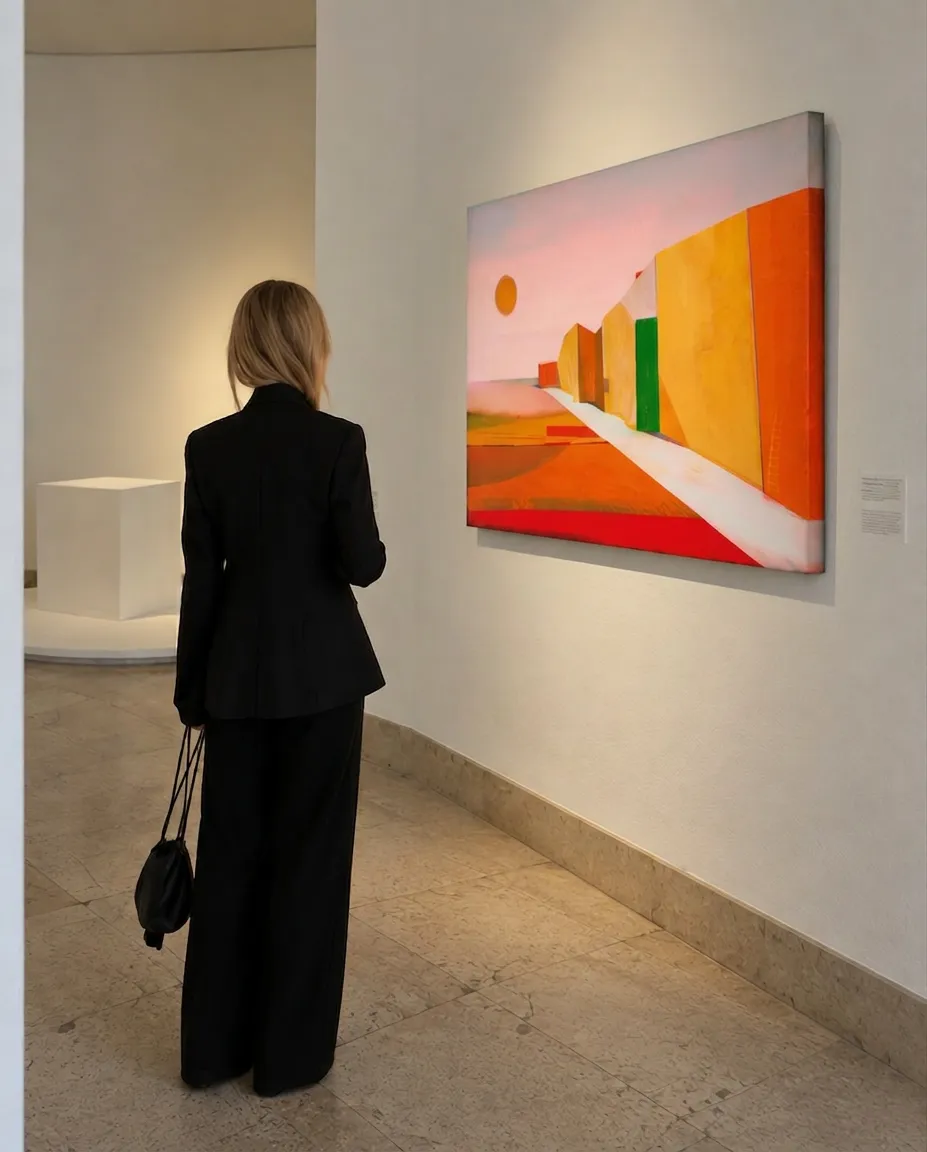
Context study / VIA SOLIS
VIA SOLIS — Context Study
The painting maintains its distance precisely where it seems to offer an entry. Seen from the side, VIA SOLIS’s white band begins at the lower edge and recedes toward the warm-toned structures, finding no continuation in the gallery’s tiled floor. This interruption makes visible a central feature of Maurizio Valch’s language: his territories are organised through planes, horizons, and divisions that can suggest passage without becoming available geography. Yellow, orange, and red give the volumes an almost architectural presence, yet their varying sizes prevent them from being measured; the lightly incised small stairways promise passage without ensuring access. The painting does not extend the room: it establishes a boundary of its own before it.
The separation between the walkable floor and this painted path finds a sober echo in a recurring aspect of the artist’s experience: the difference between a route that can be traced and an inner movement whose direction remains uncertain. His extended journeys have made him attentive to fatigue, pauses, and transitional places, not only to arrival. This experience does not turn the path into a biographical confession; it does, however, make it possible to sense why the canvas’s direction refuses to become a slogan. The visitor remains before it, not within it, and this mismatch preserves a question: seeing an orientation is not the same as possessing it, or knowing what it asks of us.
In “From Dream to Territory,” Valch describes MARE SOMNIORUM as an expanse in which memory, desire, and distance alter the visible, and understands the stairways and blocks as signs rather than closed symbols. VIA SOLIS maintains this reserve: its volumes might be façades, vestiges, or still bodies, but none yields a verifiable interior. “The Keel in the Desert” further shifts travel from the conquest of a port to the stillness of a stranded vessel; read from this gallery, the white path takes on something of that suspension. Its course activates the impulse to follow it, even as the painting retains the autonomy of a dry harbour: a direction that does not accept being traversed by proxy.
The sculptural figure in the adjoining room clarifies the nature of this refusal by contrast. Its dark body occupies a pedestal, projects weight, and shares the same space as the viewer; Valch’s luminous blocks, by contrast, do not yield their scale or thickness to the architecture. Here one may recognise a specific affinity with Richard Diebenkorn, whose arrangements of planes retain the memory of landscape and movement. Yet where that construction can open onto a more aerial perspective, Valch concentrates the edges and keeps the progression alongside a series of masses that cannot be crossed. The result does not close off the path: it leaves the eye on the threshold of a distance that remains its own.
- Original artwork
- VIA SOLIS
- Actual dimensions
- 47.2 × 31.5 in / 120 × 80 cm
- Presentation
- Digital contextual visualization
Context references
VIA SOLIS Maurizio Valch · abstract painting with a white path · red and yellow abstract landscape · Mediterranean-inspired abstract art · contemporary painting with horizon · warm-toned geometric abstract painting · minimalist wall art in red and ochre tones · abstract painting with architectural blocks · 120 x 80 cm horizontal artwork
About this visualization
This visualization places the artwork within an architectural context to help collectors and viewers imagine its presence in a real space. It is an interpretive reference, not an exact reproduction: the original work remains the sole authority for scale, color, surface and material presence.