Context study / VIA SOLIS
VIA SOLIS — Context Study
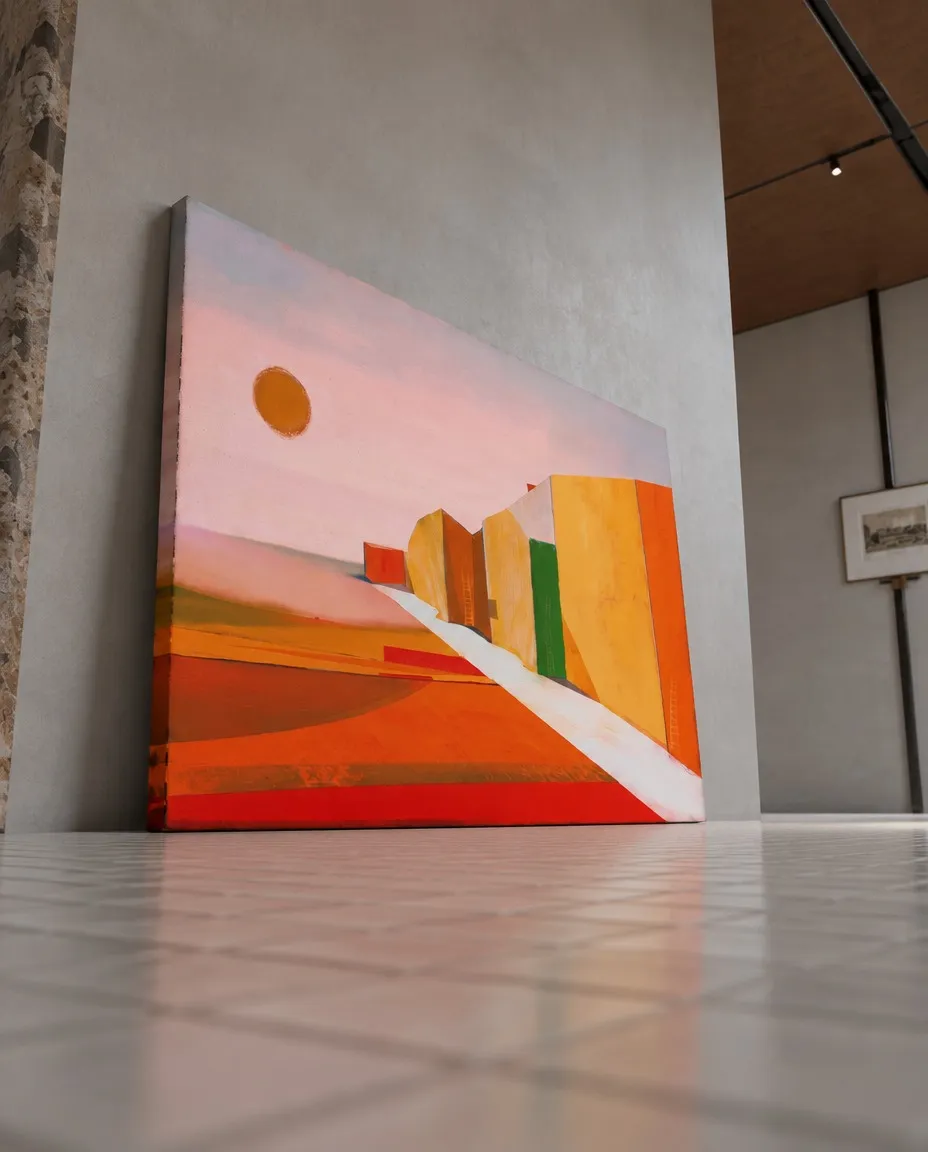
From floor level, the yellow and orange forms can no longer be arranged as a row of buildings. The red foreground edge appears with an almost tactile proximity; behind it, the white path narrows and the upper planes follow one another through cuts, changes in width, and incompatible heights. The oblique view makes this mismatch decisive: the 120 by 80 centimetre canvas presents itself as a field whose scale shifts with every movement of the eye. In Maurizio Valch’s language, blocks, divisions, and horizons do not establish a literal geography; they organise a territory in which form can remain at once structure, presence, and distance. The small incisions visible in some volumes introduce a possible scale, but do not restore inhabitable architecture. Rather, they indicate that all measure is suspended.
The path offers direction without guaranteeing orientation. This condition touches on a recurring experience in Valch’s thought: the external route can be drawn, while the movement that passes through the walker does not admit the same map. There is no need to turn the white path into an allegory of a particular experience to see how the painting sustains this difference. Its lateral progression does not lead to the orange sun, which remains isolated in the sky, nor does it resolve the distance between the planes. Before it, the viewer standing very low does not command the whole: they are subject to variations of proximity, height, and separation. The place offers enough points of reference to be traversed, but not enough to be possessed.
In “From Dream to Territory,” Valch describes MARE SOMNIORUM as an expanse in which memory, desire, and distance alter the visible without turning landscape into stable geography. VIA SOLIS gives concrete form to that idea through an organisation that seems recognisable while at the same time refusing to consolidate. The blocks could be constructions, vestiges, or forms held still beside the passage; none fully assumes a definitive identity. The essay suggests that this indeterminacy is not a lack of definition, but a quality of dreamed territory: the horizon connects and separates, while exterior space retains something of the experience that has passed through it. The low viewpoint intensifies this perceptual condition; rather than allowing the forms to be observed from a safe distance, it requires a continual renegotiation of what is near, what carries weight, and what remains far away.
Richard Diebenkorn offers a precise affinity for reading this construction of depth through abstract planes that retain a memory of landscape. In VIA SOLIS, too, the passage depends on oblique relations and fields that suggest expanse without describing it. Valch departs, however, from a more aerial openness: his volumes advance with greater compactness, and his path does not order the territory from an elevated viewpoint. Seen from below and from the side, the painting does not offer a dominant perspective; it offers a shifting measure. Each mass recalibrates the one before it, and the landscape remains available to the eye without ever fully becoming a verifiable place.
- Original artwork
- VIA SOLIS
- Actual dimensions
- 47.2 × 31.5 in / 120 × 80 cm
- Presentation
- Digital contextual visualization
Context references
VIA SOLIS Maurizio Valch 120 × 80 cm · large horizontal abstract painting · abstract painting with path and blocks · orange yellow and green abstract landscape · contemporary Mediterranean painting · abstract art with lateral perspective · territorial painting with incised lines · abstract artwork for a large wall
About this visualization
This visualization places the artwork within an architectural context to help collectors and viewers imagine its presence in a real space. It is an interpretive reference, not an exact reproduction: the original work remains the sole authority for scale, color, surface and material presence.