Context study / VIA SOLIS
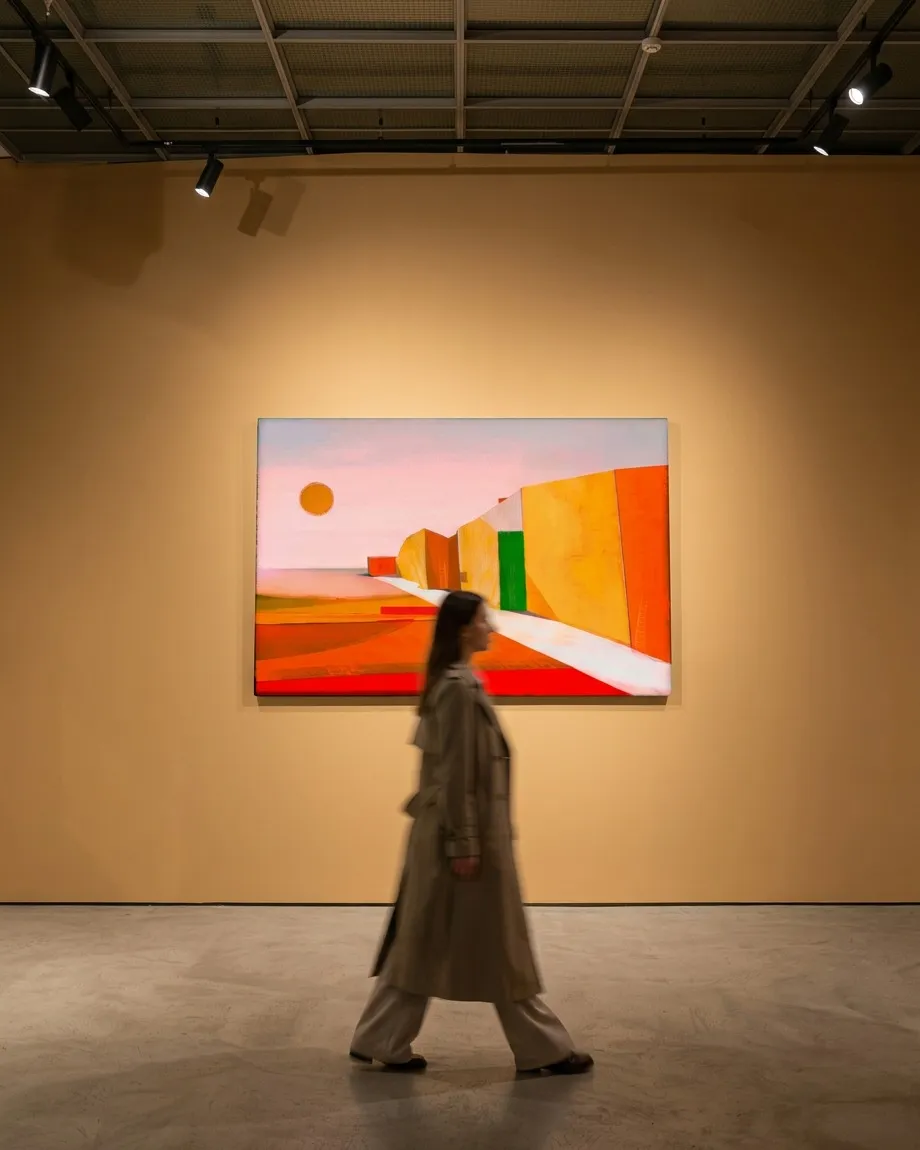
VIA SOLIS en un mockup de interior
The expanse of the wall does not extend the landscape; it sharpens the boundary that contains it. Within the 120 centimetres of VIA SOLIS, the white band, red ground, yellow blocks, and pink sky are gathered into a chromatic architecture of high intensity. Maurizio Valch’s practice often constructs territories through color fields, divisions, and elemental forms that hover between landscape and structure; in this work, that formal economy prevents the path from becoming a panoramic view. Even the small stairways only faintly suggested within the volumes retain a sense of access without resolving the territory’s scale. The broad margin of the room does not become a continuation of the canvas: it preserves its concentration and makes color appear as a contained climate.
Anyone passing before the painting introduces an everyday measure, yet does not become an inhabitant of that distance. Valch’s experience has repeatedly distinguished between an external path, traceable on a map, and an inner movement whose direction is not known in advance. This difference makes it possible to understand the white path without turning it into a fixed allegory: it offers visible orientation without yielding a geography that can be possessed. The passing body, seen at the scale of the work, confirms precisely this reserve. It can cross the room; it cannot verify where the path leads or extend the earthly red or lateral yellows with its passage. The painting holds distance as a perceptual condition rather than a promise of arrival.
In “From Dream to Territory,” Valch describes MARE SOMNIORUM as an expanse in which memory, desire, and distance alter the visible, and where the horizon both separates and connects. VIA SOLIS makes this double function perceptible in a particularly restrained register: the pale sky does not open onto immensity, and the luminous blocks do not establish a recognisable place. Isolated on the wall, the composition reads less as a fragment of a larger world than as a preserved region of Mediterranean experience: clarity, dryness, silence, and remoteness reduced to precise relationships. What has been lived does not return as a description of a place; it persists as a light that retains intact its impossibility of being traversed.
The affinity with Richard Diebenkorn helps us recognise how abstract planes can retain a memory of territory and movement. In VIA SOLIS, too, depth is organised through bands, inclinations, and boundaries that make a route conceivable. Yet where Diebenkorn’s construction may open into a more aerial spaciousness, Valch concentrates the scene into a compact frontality. The broad architectural emptiness around the canvas heightens this difference: it does not extend the path, but leaves it suspended—whole and remote—as a climatic condition that accompanies the viewer without becoming available to them.
- Original artwork
- VIA SOLIS
- Actual dimensions
- 47.2 × 31.5 in / 120 × 80 cm
- Presentation
- Digital contextual visualization
Context references
VIA SOLIS Maurizio Valch · contemporary abstract painting in gallery · large horizontal abstract painting · warm-toned abstract wall art · red yellow and pink abstract landscape · abstract painting with white path · contemporary geometric wall art · abstract Mediterranean landscape painting
About this visualization
This visualization places the artwork within an architectural context to help collectors and viewers imagine its presence in a real space. It is an interpretive reference, not an exact reproduction: the original work remains the sole authority for scale, color, surface and material presence.