Context study / VIA SOLIS
VIA SOLIS — Context Study
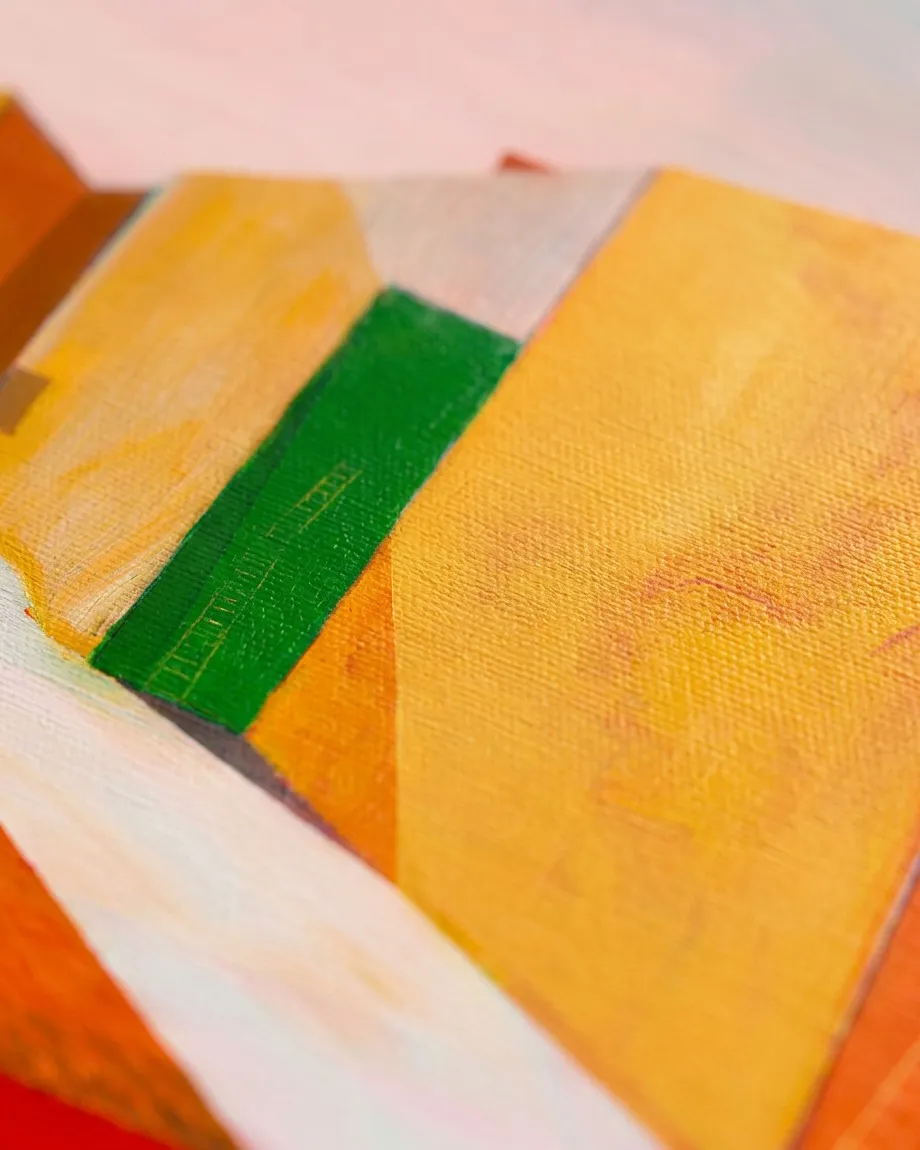
A nearly erased stairway is enough to unsettle the authority of the large planes. Between the white path and the yellow masses of VIA SOLIS, a sequence of incised steps emerges in the green band, so small that one must move close to the canvas to make it out. The close presentation makes this condition perceptible: the weave of the canvas, the layers of colour, and the slight indentation restore physical thickness to what, from a distance, might read as closed architecture. In Maurizio Valch’s language, the incision is not added to the surface as drawing; it passes through it and becomes a trace. Here it neither assigns a function to the volumes nor organises secure access: it introduces a fragile human measure within a geography governed by blocks of uncertain scale.
This lack of assurance resonates with an experience of movement that, in his thought, cannot be reduced to a destination. Valch has distinguished between a path that can be traced on a map and an inner movement whose direction remains unknown; this distinction allows these steps to be seen without turning them into emblems of overcoming. They suggest the possibility of ascent, but offer neither a summit nor any clarity about which side of the structures might be inhabited. Beneath the distant sun and beside the path narrowing into the background, ascent loses any heroic gesture. The painting holds a visible direction while preserving the vulnerability of someone who must decide the next step without a confirmed arrival.
The essays “From Dream to Territory” and “The Ascent Without a Stairway” place the stairways of the early series as signs of passage and responsibility, rather than automatic promises of salvation. VIA SOLIS qualifies that formulation through its own visual economy: the steps are almost absorbed by the green and yellow, while the large façades—or forms that might be façades—retain the leading role. The stairway does not dominate the territory; it barely interrupts it. The ascending gesture is therefore perceived less as a conquered elevation than as a question sustained within matter: what can a minimal action do before structures that never fully reveal whether they protect, obstruct, or simply remain.
The affinity with Richard Diebenkorn helps to recognise how abstract planes can retain a memory of passage and landscape without describing an identifiable place. Yet where his compositions often open onto a more aerial distance, Valch concentrates the experience at the edge of the path: luminous blocks advance toward the gaze, while the small stairway remains almost hidden at their side. The proximity of the mockup intensifies this reversal of scale; the territory no longer presents itself as a panorama that can be mastered, but as a surface that compels the viewer to search for its points of access. The direction persists, but its meaning remains suspended in the discretion of a single step.
- Original artwork
- VIA SOLIS
- Actual dimensions
- 47.2 × 31.5 in / 120 × 80 cm
- Presentation
- Digital contextual visualization
Context references
abstract painting detail with canvas texture · painting with incised lines · detail of an incised staircase in a painting · layers of colour in abstract canvas painting · VIA SOLIS Maurizio Valch detail
About this visualization
This visualization places the artwork within an architectural context to help collectors and viewers imagine its presence in a real space. It is an interpretive reference, not an exact reproduction: the original work remains the sole authority for scale, color, surface and material presence.