Context study / VIA SOLIS
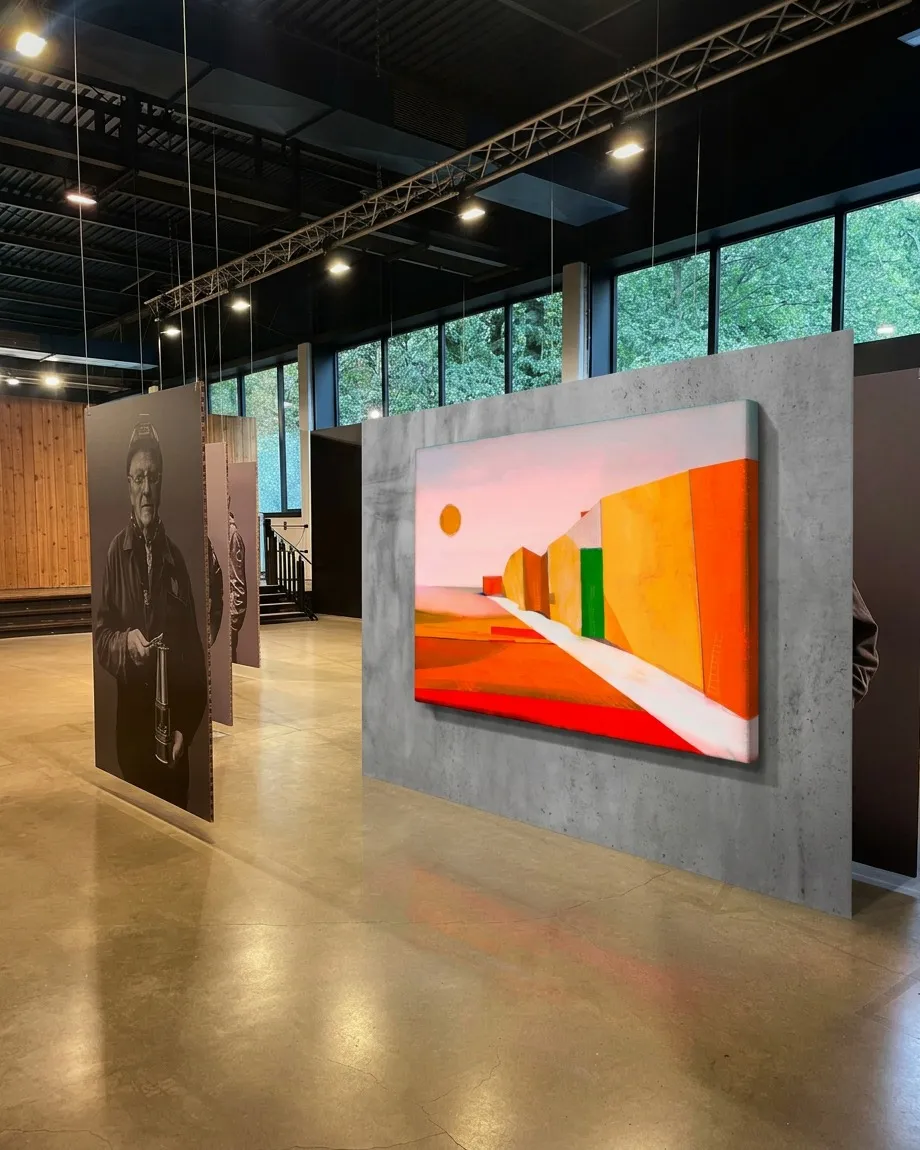
VIA SOLIS en un mockup de interior
The suspended portraits restore a body to a territory that had chosen to do without figures. Beside these faces and torsos of workers, recognisable through their scale and the weight of their tools, VIA SOLIS ceases to be read solely as a remote expanse: the wavering width of the white path and the small incised stairways on the yellow blocks acquire a possible measure for a step, a hand or an ascent. In this detail lies one of the most precise operations in Maurizio Valch’s practice. His incisions do not add drawing over colour; they physically interrupt the surface. In this canvas, they barely alter the compact presence of the volumes, yet they are enough to make them accessible without making them descriptive. No one occupies the steps or travels the path. This reserve prevents the painting from becoming an illustrated social scene.
Visible direction does not guarantee arrival, and this distinction runs through the artist’s thinking about travel. His experience has sustained an enduring attention to routes, fatigue and the intermediate state of someone who has already left one place without yet belonging to the next; it also distinguishes between a path that can be traced on a map and an inner movement without secure orientation. In VIA SOLIS, this intuition does not become confession or psychological symbol; rather, it makes it possible to perceive why the white path and the minute points of access retain such ambiguity. Before the portraits, the absence of walkers becomes more active. Humanity has not disappeared from the landscape; it remains held in elemental conditions of passage, pause and possible ascent.
In “From Dream to Territory,” Valch places the early stairways of MARE SOMNIORUM among the signs that introduce an interior dimension into exterior space without reducing them to a code. “The Ascent Without a Staircase” specifies that climbing does not amount to a promise of salvation or automatic progress, but to the need to leave a previous position and take responsibility for one’s own gaze. The installation qualifies that formulation: the photographed workers do not illustrate this responsibility, but they make tangible the fact that every position involves a body situated in a shared world. The stairways of VIA SOLIS do not lead to a verifiable height; seen near concrete bodies, they cease to be a minute motif and become a silent question about conditions of access, who may pass, and where they may be going.
An affinity with Richard Diebenkorn helps explain how abstract planes can retain a memory of journey and landscape without describing a specific place. In VIA SOLIS, too, the path organises a possible depth between terrestrial bands and vertical masses. Valch, however, compacts that opening: his blocks rise almost like a wall of colour, and the orange sun remains to one side, detached from any destination. In front of the photographic panels, this partial closure takes on a new singularity. The painting offers no people to explain its forms, but it does not need them: it lets a human scale emerge in the stairway, the width of the path, and the distance that still separates each point of access from the viewer.
- Original artwork
- VIA SOLIS
- Actual dimensions
- 47.2 × 31.5 in / 120 × 80 cm
- Presentation
- Digital contextual visualization
Context references
VIA SOLIS Maurizio Valch installation · abstract painting in an exhibition space · contemporary abstract painting installation · abstract landscape with white path · Mediterranean abstract art · contemporary territorial painting · abstract painting with colour blocks · abstract painting with incisions
About this visualization
This visualization places the artwork within an architectural context to help collectors and viewers imagine its presence in a real space. It is an interpretive reference, not an exact reproduction: the original work remains the sole authority for scale, color, surface and material presence.