Context study / VIA SOLIS
VIA SOLIS — Context Study
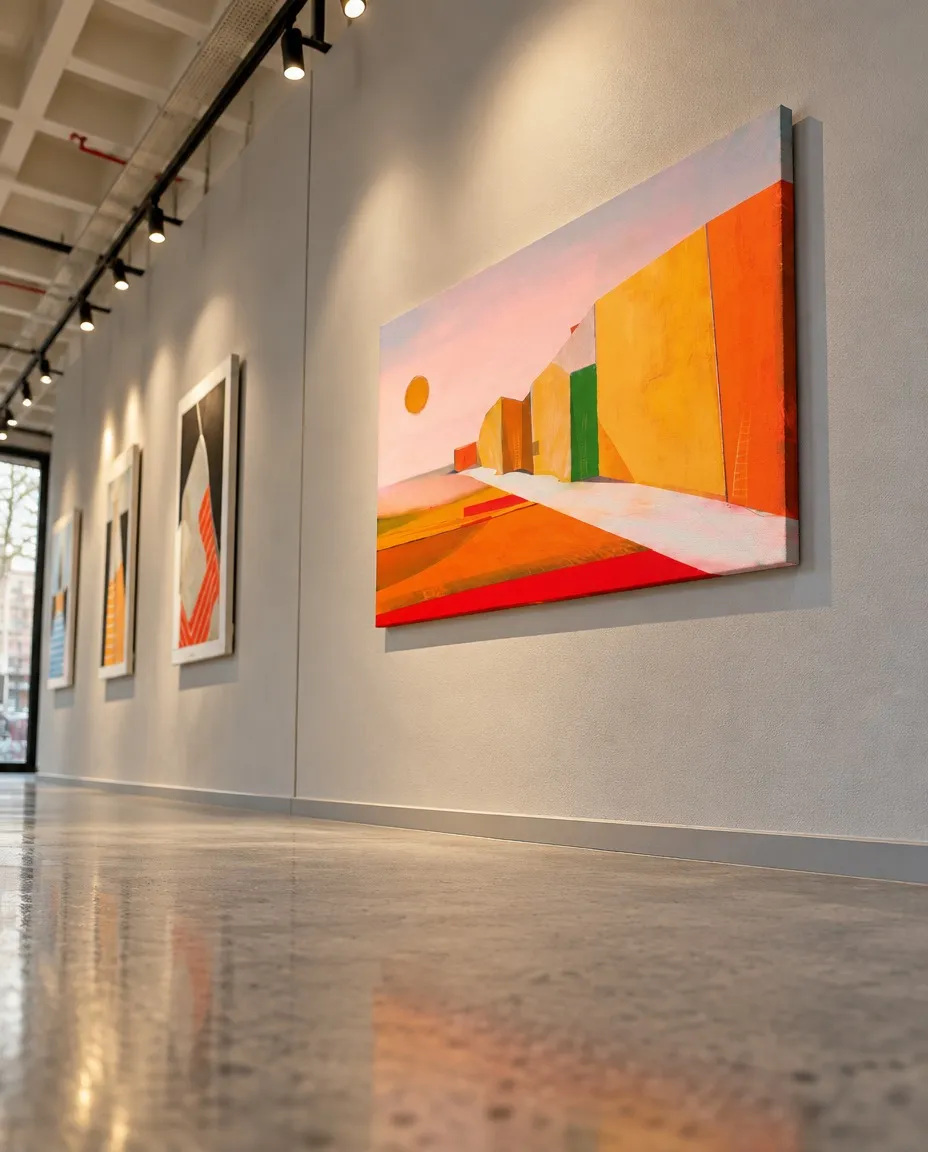
White does not break through as a conquest: from its very beginning, it is hemmed in by the yellows, oranges and reds rising to its right. In VIA SOLIS, this pale band starts in the foreground and narrows as it recedes into the distance, yet the large lateral planes do not accompany it like orderly façades; they grow, fracture and shift in scale, imposing continuous resistance. This way of organising territory belongs to Maurizio Valch’s language of colour fields, contained horizons and monolithic forms whose function is not exhausted by any recognisable equivalence. The small incisions appearing in some blocks offer only the slightest human measure against their weight. Seen from the low angle of the installation, the path lies even closer to the ground and beneath this band of volumes: one walks alongside them, not towards a space already cleared.
In Valch’s experience, transit occupies a place that cannot be confused with arrival. His extended journeys have left him with a sustained attention to intervals: fatigue, provisional places, the moment when one has left somewhere without yet belonging to the next place. This sensibility makes it possible to read the painting’s visible direction without turning it into a promise. The orange sun, set apart to the left of the route, does not ratify a destination either; it illuminates a scene whose orientation remains incomplete. The path may suggest forward movement, but the compact bodies along its edges retain an irreducible opacity. The painting does not translate this condition into closed psychology: it makes perceptible a movement that must adjust to what it encounters.
In “From Dream to Territory,” Valch describes MARE SOMNIORUM as an expanse in which memory, desire and distance unsettle the stability of the visible; the blocks are presences that never fully belong to the landscape. VIA SOLIS sustains precisely this spatial uncertainty. The volumes might be walls, vestiges or constructions, though their relation to the path prevents them from settling into a fixed geography. “Fresh Ground for the Hero” rereads the same painting against the demand for a heroic march and its final reward. The lateral arrangement of the blocks gives form to that critique without illustrating it: they require one to continue without culmination, accepting that the route does not master the terrain it crosses. The brightness of the path does not amount to a victory over what remains at its margins.
The affinity with Richard Diebenkorn helps us recognise how abstraction can retain the memory of a traversable expanse through planes and oblique depths. Yet where that territorial construction may open towards a more aerial view, Valch concentrates the body of the viewer at the edge of the route. In this installation, the painting rises on the wall while the polished floor visually extends its low perspective: a situation that reinforces the feeling of moving alongside a mass rather than flying over a landscape. The singularity of VIA SOLIS lies in this restricted yet persistent direction. The passage is accompanied by forms that cannot be fully crossed or explained.
- Original artwork
- VIA SOLIS
- Actual dimensions
- 47.2 × 31.5 in / 120 × 80 cm
- Presentation
- Digital contextual visualization
Context references
VIA SOLIS Maurizio Valch · 120 x 80 cm abstract painting · horizontal abstract painting · abstract painting with a path · Mediterranean abstract landscape · orange and yellow abstract wall art · contemporary painting with geometric blocks · minimalist abstract painting for living room · MARE SOMNIORUM abstract painting
About this visualization
This visualization places the artwork within an architectural context to help collectors and viewers imagine its presence in a real space. It is an interpretive reference, not an exact reproduction: the original work remains the sole authority for scale, color, surface and material presence.