Context study / VIA SOLIS
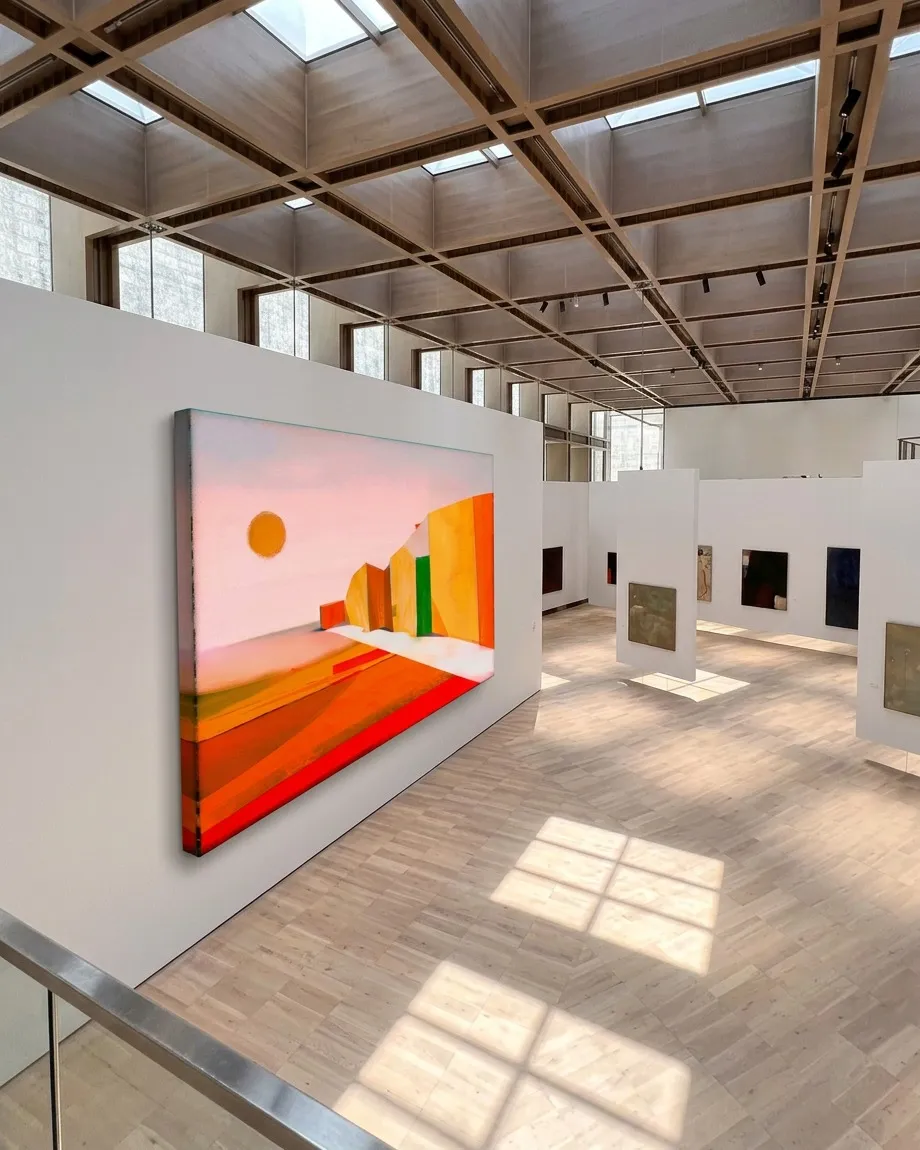
VIA SOLIS en un mockup de interior
The regularity of the ceiling makes a quiet anomaly more apparent: the path in VIA SOLIS refuses to become an axis. Beneath skylights, beams, and partitions that divide the room into verifiable modules, the 120 × 80 cm canvas opens its white band diagonally from the lower edge, allowing it to narrow between reds, ochres, and yellow masses of uncertain scale. The orange sun, set apart to the left, does not organise the route either. In Maurizio Valch’s territorial language, chromatic fields, blocks, and small incisions do not establish a geography: they sustain a space in which structure appears alongside its own insufficiency. The painting’s frontal clarity offers no measure; it intensifies what cannot yet be calculated.
This lack of coordinates finds a concrete echo in an aspect of the artist’s experience shaped by movement: he knows the difference between a path that can be traced on a map and a movement whose inner direction cannot be anticipated. The white path should not be turned into a confession, nor the volumes into personal allegories. Yet the distance it proposes takes on another density in light of this sustained attention to transit, departure, and the condition of being between places. The painting shows a visible direction without promising that seeing it is enough to possess it. The small incised staircases on the lateral planes heighten this reserve: they suggest access and a change of level, yet do not explain what height they reach or from where the territory might be traversed.
In “From Dream to Territory,” Valch places MARE SOMNIORUM in a region where memory, desire, and distance alter the visible, and specifies that the horizon both connects and separates. VIA SOLIS retains exactly this double operation, though it replaces the dominant horizon with an oblique perspective: white links foreground and distance, while the warm blocks interrupt any continuous reading of depth. The essay understands staircases, lights, and constructions as signs rather than closed symbols; the installation makes clear why. Against an architecture that renders every passage and interval legible, these pictorial signs remain deliberately incomplete. They do not oppose the building; they make palpable that the imagined territory holds a memory of place without being subject to its systems of orientation.
Richard Diebenkorn offers a precise affinity for reading this territorial construction: in both cases, abstract planes can retain the experience of landscape and passage without describing them. Yet where Diebenkorn’s spatial organisation often allows for a more aerial openness, Valch concentrates the field in a warm, compact proximity. From the elevated angle of the room, the painting is set within an expansive network of straight lines, but its path extends none of them. It remains inclined, narrow, and available, like a distance that architecture makes more visible precisely because it cannot resolve it.
- Original artwork
- VIA SOLIS
- Actual dimensions
- 47.2 × 31.5 in / 120 × 80 cm
- Presentation
- Digital contextual visualization
Context references
VIA SOLIS Maurizio Valch · abstract landscape with diagonal path · red yellow and white abstract painting · contemporary Mediterranean-inspired art · abstract territorial painting · large abstract painting for gallery · minimalist geometric art · abstract painting with colour blocks
About this visualization
This visualization places the artwork within an architectural context to help collectors and viewers imagine its presence in a real space. It is an interpretive reference, not an exact reproduction: the original work remains the sole authority for scale, color, surface and material presence.