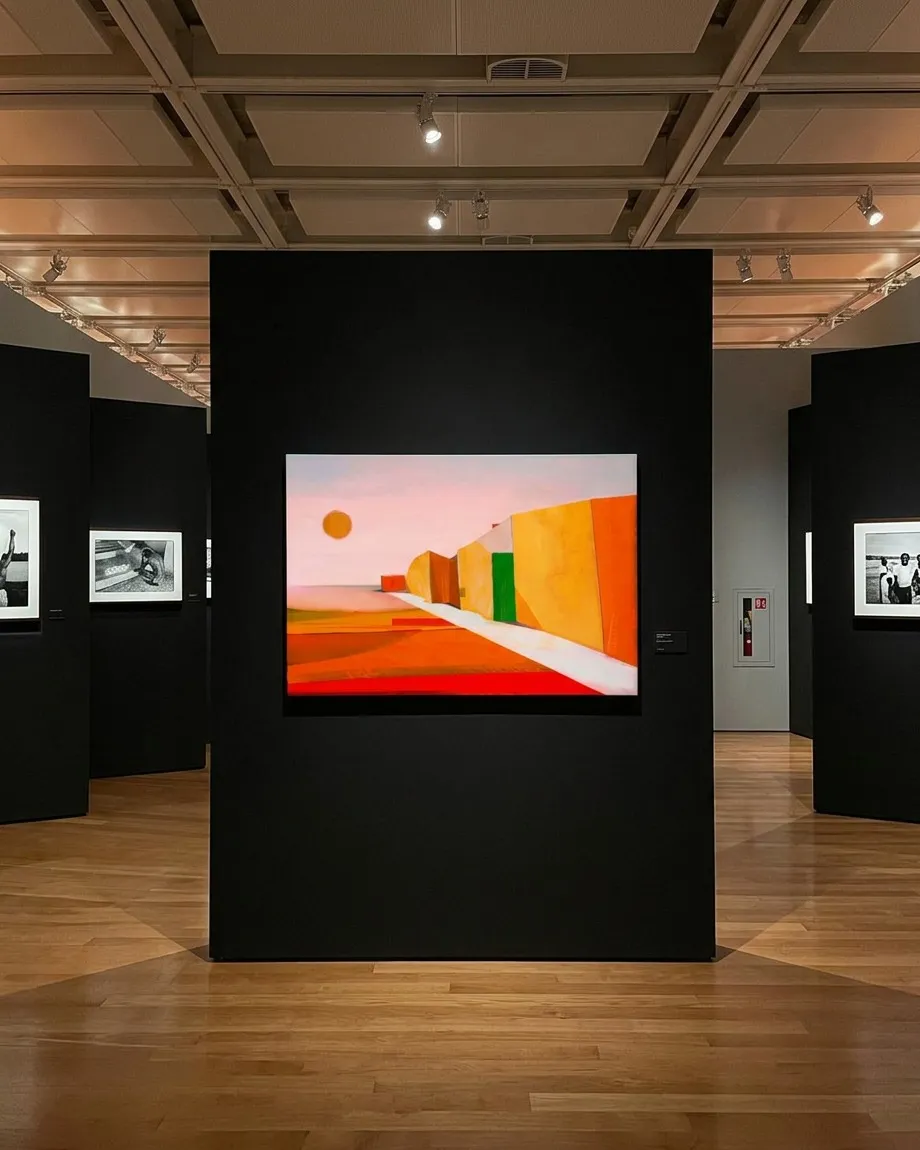
Context study / VIA SOLIS
VIA SOLIS en un mockup de interior
The sun does not usher in a morning: it remains suspended at the left, small and orange, while the white path narrows between red, yellow, and green planes that never quite settle into buildings or features of the land. Against the frontal blackness of the panel, the colours of VIA SOLIS acquire an almost physical autonomy; they do not receive the room’s half-light, but sustain their own clarity. This condition belongs to Maurizio Valch’s territorial language, built through chromatic fields, divisions, and elemental forms that may retain a memory of landscape without describing it. The incisions and small stairways visible in some blocks diminish the monumentality of these masses, yet they do not establish a verifiable scale or action. Everything remains legible and, at the same time, outside of time.
This suspension may be related to an experience of movement that runs through the artist’s life and thought: his documented interest in paths, departures, and the in-between time in which one belongs neither fully to the place left behind nor to the place of arrival. The path in VIA SOLIS retains this ambivalence. It marks a specific direction, yet it neither promises progress nor turns the sun into a reward. Clarity, then, does not amount to certainty. It may be felt as the open time of a journey without a heroic narrative, where the present need not be justified by a destination and the landscape persists before the mind turns it into chronology.
In “From Dream to Territory,” Valch writes that MARE SOMNIORUM presents the Mediterranean as an imagined region made of memory, desire, and distance, and that the landscapes it traverses lose their date as they merge into structures. VIA SOLIS makes this operation visible: the greyish-pink sky, warm earth, and line of the path retain a Mediterranean intensity, yet they do not restore a recognisable coast, season, or hour. The essay also places the horizon in a dual role: it separates and connects the known with that which has not yet acquired form. In this painting, that boundary does not rise as a stable line; it diffuses through the continuity of the planes, allowing the day to become a condition rather than an episode.
The affinity with Richard Diebenkorn helps clarify the question without exhausting the work. In both, abstraction can retain movement and expanse through the relationship between fields, edges, and depth; landscape survives as an organisation of distances. Valch, however, compresses this openness into a quieter frontality: luminous blocks draw close to the surface, and the path does not offer the panoramic view of a territory under command. Surrounded by monochrome photographs and isolated on the dark panel, VIA SOLIS does not become a window onto a place: it remains as a fragment of day that continues to unfold beyond any calendar.
- Original artwork
- VIA SOLIS
- Actual dimensions
- 47.2 × 31.5 in / 120 × 80 cm
- Presentation
- Digital contextual visualization
Context references
VIA SOLIS Maurizio Valch · abstract painting with white path · abstract landscape in red and yellow · contemporary colour field painting · Mediterranean abstract art · geometric abstract wall art · abstract painting with orange sun · minimalist art for interiors
About this visualization
This visualization places the artwork within an architectural context to help collectors and viewers imagine its presence in a real space. It is an interpretive reference, not an exact reproduction: the original work remains the sole authority for scale, color, surface and material presence.