Context study / VIA SOLIS
VIA SOLIS — Context Study
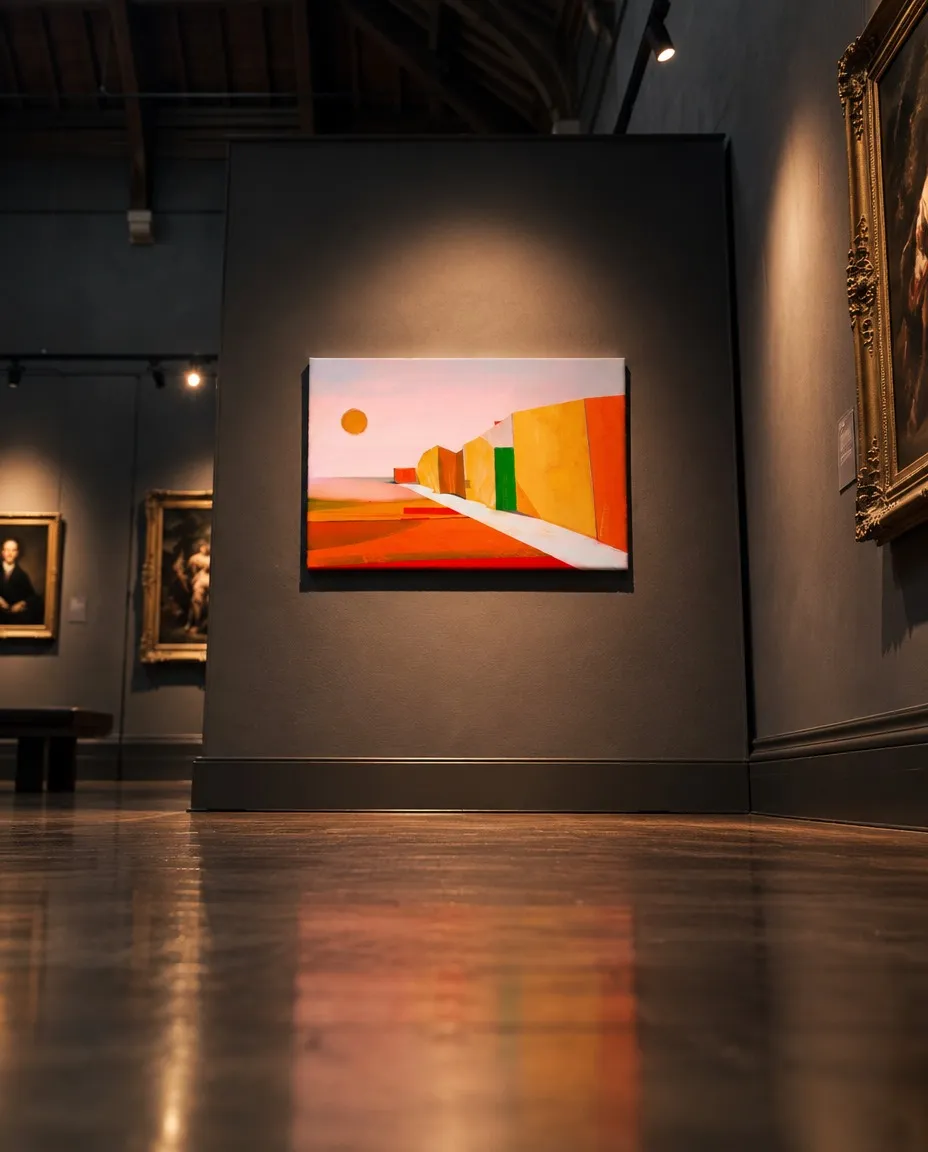
Among dark portraits and the low sheen of the floor, the canvas retains a warmth that does not spill into the room. Suspended on a black partition wall, VIA SOLIS gathers within its 120 by 80 centimetres a red ground, an oblique white path, yellow and orange masses, a green band, and a low-horizon pink sky. Distance is organised within this compact field: the path narrows, yet the orange sun remains to one side, without taking on the role of a destination. This concentration belongs to Maurizio Valch’s territorial language, built through fields of colour, divisions and elemental presences rather than recognisable places. The polished floor reflects the room’s lights, not the landscape; that discontinuity prevents the painted clarity from becoming environmental decoration and preserves it as a separate exposure to the elements.
For Valch, an outward path does not necessarily amount to an arrival: in his experience of transit, walking has also meant inhabiting an interval, no longer fully belonging to the place left behind and not yet possessing the next one. This experience allows the path in VIA SOLIS to be approached without reducing it to biography or allegory. Its whiteness opens a visible direction, but does not resolve what awaits at the far end; the volumes alongside it sustain an almost architectural proximity and yet refuse to settle into buildings. In the museum’s dim light, this lack of conclusion takes on particular precision: the painting does not compete with the narratives already preserved in the surrounding portraits, but holds a dry, exposed and silent present.
In “From Dream to Territory,” Valch describes MARE SOMNIORUM as a region where memory, desire and distance alter what is visible without stabilising a geography. The essay suggests that the condensation of VIA SOLIS does not amount to a reduction of the world: the Mediterranean landscape returns not as a view, but as a perceptual condition. The small incised stairways on the lateral blocks suggest access and a change of level, though they remain almost absorbed by colour; the text insists that these elements are not closed symbols, but signs within a territory that retains an interior dimension. The room, devoted to safeguarding images and genealogies, makes this reserve more perceptible: the canvas holds a memory of place without turning it into an archive or a narrative.
An affinity with Richard Diebenkorn helps clarify how planes can retain the memory of a journey without abandoning abstraction. In VIA SOLIS, too, the relations between path, horizon and vertical masses sustain a territorial depth; yet Valch departs from a more aerial or panoramic openness. From the low vantage point imposed by this presentation, one does not contemplate a territory that can be mastered: one encounters a frontal band of heat, bounded and autonomous, whose path remains open without asking the viewer to complete it.
- Original artwork
- VIA SOLIS
- Actual dimensions
- 47.2 × 31.5 in / 120 × 80 cm
- Presentation
- Digital contextual visualization
Context references
VIA SOLIS Maurizio Valch · abstract painting with white path · abstract landscape in red yellow and orange · contemporary Mediterranean abstract art · territorial abstract painting · abstract painting with horizon · geometric landscape painting · warm-toned abstract wall art
About this visualization
This visualization places the artwork within an architectural context to help collectors and viewers imagine its presence in a real space. It is an interpretive reference, not an exact reproduction: the original work remains the sole authority for scale, color, surface and material presence.