Context study / VIA SOLIS
VIA SOLIS — Context Study
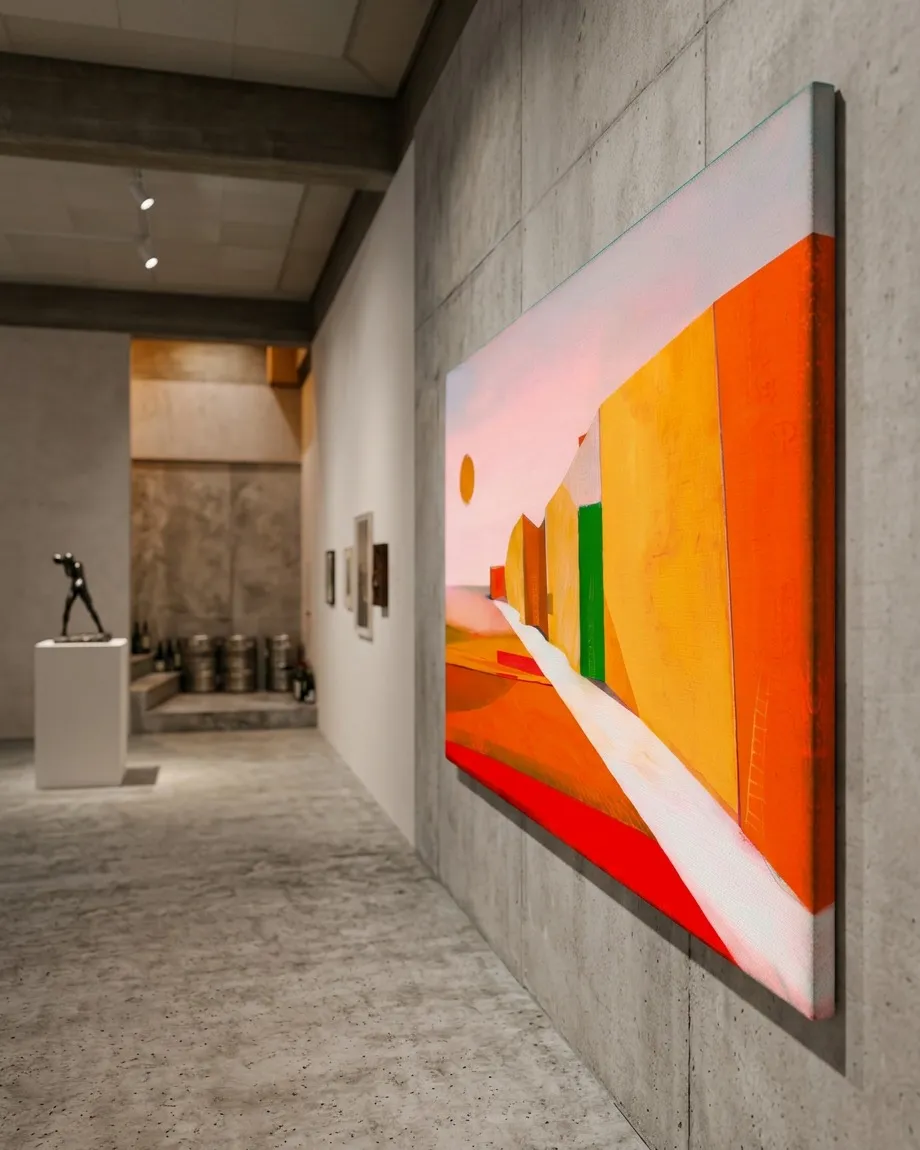
The movement of the body alters the direction proposed by the white band. Seen from the side, VIA SOLIS no longer offers a contained path and takes on an unexpected continuity with the corridor: it begins at the lower edge of the canvas, narrows into the distance between yellow and orange volumes, and accompanies the viewer’s progress obliquely along the wall. This correspondence does not erase the difference between architecture and painting; it makes it more distinct. In Maurizio Valch’s language, fields of colour, blocks, and divisions do not establish a recognisable geography, but organise a territory that may be traversed. The small incisions visible on the lateral planes reinforce this condition: they do not illustrate a route, but introduce traces and scales that prevent the large blocks from becoming merely decorative masses.
To approach the work is to lose the comfortable position of someone viewing a landscape from outside. The artist’s life, marked by movement and long walks, helps explain why a visible direction does not necessarily amount to an arrival; this experience does not justify reducing the painting to biographical memory, but it does make his reserve toward conclusive destinations relevant. The path in VIA SOLIS retains a precise orientation while the orange sun remains separate, suspended to the left. Distance, then, is not situated only in the background of the painting: it appears between the step the viewer takes and what they expect to find. The outward route may be straight; the experience of passing through it is not.
In “From Dream to Territory,” Valch describes MARE SOMNIORUM as an expanse in which memory, desire, and distance alter the visible, and where the horizon both separates and connects. This presentation makes that double operation perceptible at full scale: the wall guides one’s advance, while the painting opens a direction that cannot be physically traversed. “The Keel in the Desert” adds a decisive image to this suspension: the journey comes to a halt without being annulled, released from the obligation to reach a harbour. In VIA SOLIS, the white path promises neither conquest nor culmination. Its narrowing between the blocks and its uncertain exit turn proximity into a form of attention: moving toward the work is to notice that the landscape retains a margin that cannot be occupied.
The affinity with Richard Diebenkorn helps clarify the spatial problem, not resolve it. In both cases, abstract planes can retain the memory of an expanse and direct the eye through oblique relationships; Valch, however, condenses the field and hardens its edges. Where Diebenkorn’s territorial construction often opens into an airy spaciousness, VIA SOLIS concentrates passage within a pale band flanked by compact presences. The lateral angle intensifies this difference: the blocks seem to close off transit from the right, while the path persists without becoming a panorama. The painting does not offer a commanding view of territory; it makes distance begin within the movement of the person looking at it.
- Original artwork
- VIA SOLIS
- Actual dimensions
- 47.2 × 31.5 in / 120 × 80 cm
- Presentation
- Digital contextual visualization
Context references
VIA SOLIS Maurizio Valch · abstract painting with white path · yellow and orange abstract landscape · abstract art with geometric blocks · contemporary territorial painting · abstract painting with incisions · large abstract wall art · Mediterranean abstract painting
About this visualization
This visualization places the artwork within an architectural context to help collectors and viewers imagine its presence in a real space. It is an interpretive reference, not an exact reproduction: the original work remains the sole authority for scale, color, surface and material presence.