Context study / VIA SOLIS
VIA SOLIS — Context Study
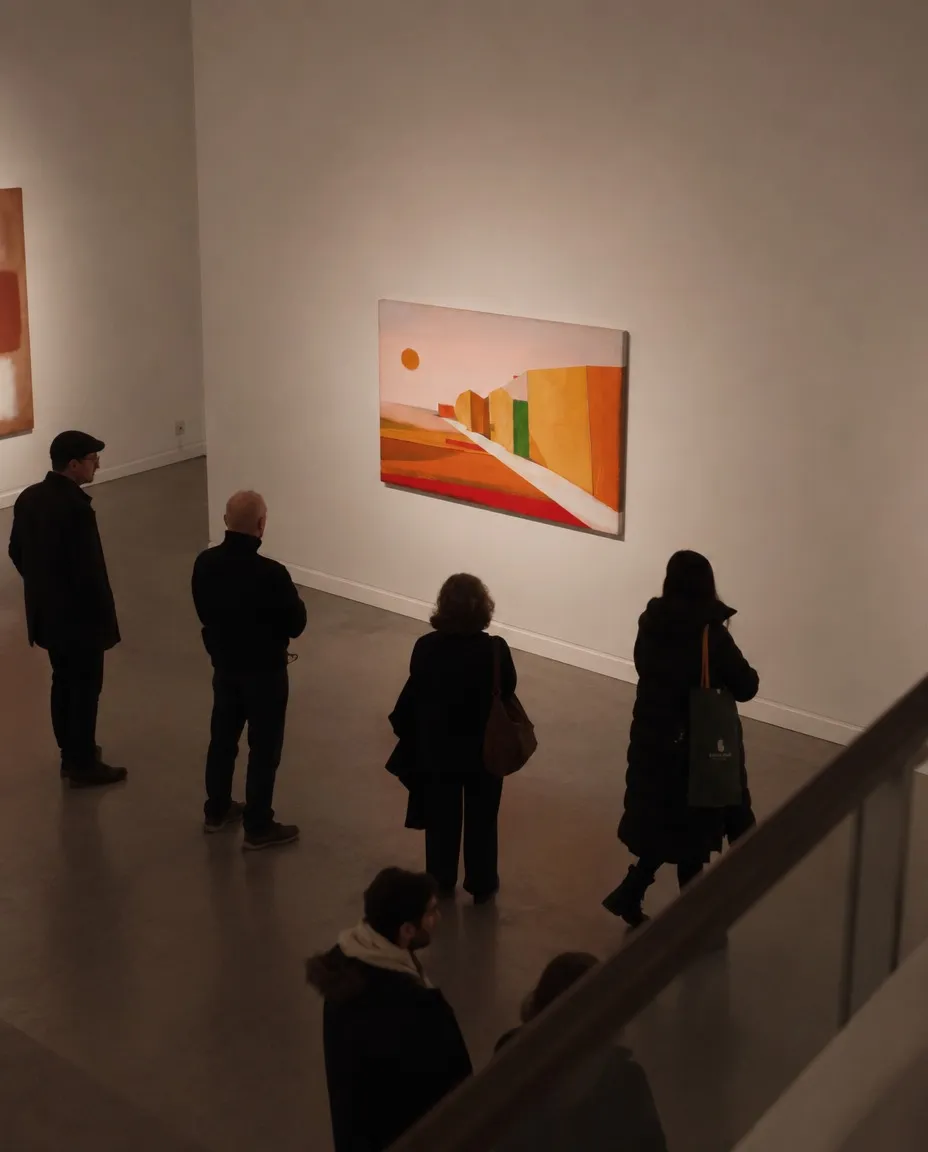
The direction of the path does not bring every gaze to the same destination. Seen from the staircase, VIA SOLIS appears surrounded by visitors who maintain their own rhythms and separations: some pause before the canvas, while others cross the room or stand partly outside its axis. This arrangement makes the painting’s structure especially legible. The white band enters from below and narrows between red and ochre fields, yet the yellow and orange blocks alongside it do not allow it to arrive at a shared opening; the orange sun, suspended to the left, remains apart from its course. In Maurizio Valch’s vocabulary, colour fields, divisions, and compact forms organise territories without turning them into recognisable geography. Here, the path gives depth to the 120 × 80 cm plane, though its promise of passage remains deliberately incomplete.
This incompleteness approaches an experience documented in the artist’s thinking: the difference between an outer path, which can be drawn, and an inner movement whose direction remains unknown. His extended journeys have made him attentive to fatigue, intervals, and the condition of being between departure and arrival, without allowing the painting to be reduced to a biographical anecdote. In this presentation, the figures standing at different distances from the painting make that condition visible without illustrating it: they share the same room, yet none occupies the others’ perspective. The silence of VIA SOLIS is therefore not the absence of others; it arises from a proximity that does not erase distance, nor require everyone to resolve the territory before them in the same way.
In “From Dream to Territory,” Valch writes that MARE SOMNIORUM retains a suspended landscape in which memory, desire, and distance alter what is visible, and notes that the horizon both separates and connects. VIA SOLIS carries this double operation into the path: the white band connects the near edge with a possible distance, while the lateral constructions, the small green strip, and the isolated celestial body prevent that connection from becoming certainty. The essay also notes that the staircases and blocks are not closed symbols, but signs within a space where exterior and interior may touch. From the elevated viewpoint of the scene, this openness takes on a collective dimension: looking together does not produce a single interpretation, but a momentary coexistence before a direction that still belongs entirely to no one.
The affinity with Richard Diebenkorn helps us recognise how abstraction can retain a memory of landscape through planes, routes, and relations of depth without describing an identifiable place. Yet where Diebenkorn’s territorial construction can open into a more aerial sense of breathing space, Valch condenses the field: the warm volumes weigh upon the passage, while the greyish-pink sky barely cools their intensity. This greater compactness explains why the gathering of visitors does not turn the painting into a spectacle or a consensus. Each body remains before a surface that allows for different approaches; the path remains visible, but no one can occupy it for anyone else.
- Original artwork
- VIA SOLIS
- Actual dimensions
- 47.2 × 31.5 in / 120 × 80 cm
- Presentation
- Digital contextual visualization
Context references
VIA SOLIS Maurizio Valch · abstract painting with white path · abstract landscape in red and yellow · contemporary territorial painting · geometric abstract art with colour blocks · Mediterranean abstract painting · artwork in a museum gallery · horizontal abstract painting 120 x 80 cm
About this visualization
This visualization places the artwork within an architectural context to help collectors and viewers imagine its presence in a real space. It is an interpretive reference, not an exact reproduction: the original work remains the sole authority for scale, color, surface and material presence.