Context study / VIA SOLIS
VIA SOLIS — Context Study
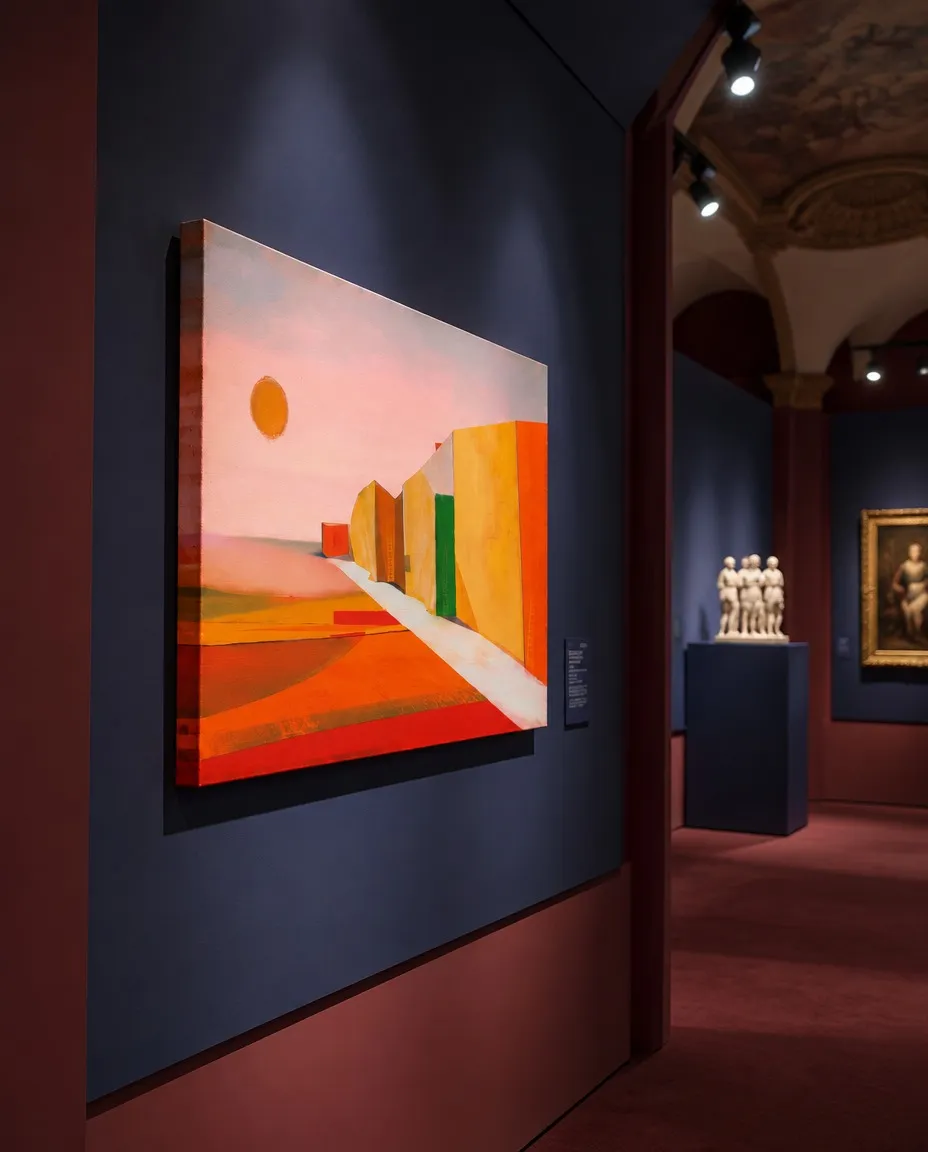
The history surrounding VIA SOLIS cannot fix the age of its forms; by contrast, it makes it more evident that they belong to a time without archive. Seen from the side, the canvas asserts its three-centimetre depth and lets the white road enter from the lower edge towards a distance that remains unresolved. The yellows, oranges, and greens may suggest façades or walls, yet their shifts in scale prevent the recognition of inhabitable architecture. This displacement of the recognisable responds to Maurizio Valch’s territorial language: colour fields, divisions, and compact presences do not illustrate a place but construct a reality of their own. The orange sun, isolated in the pink sky, neither crowns the route nor dates it; it remains a presence separate from what it illuminates.
The road retains direction without becoming a narrative of progress. This condition finds a cautious echo in an experience of transit that holds a sustained place in the artist’s thinking: the difference between a route that can be traced and a movement whose inner orientation is not assured. In the painting, the white band offers the eye a tangible route, while the small stairways lightly inscribed in the blocks open possibilities of access without explaining their purpose. There is no need to turn these elements into psychological emblems to recognise that they resist conclusion. Among nearby historical figures, sculptures, and portraits that point to specific bodies, periods, and narratives, VIA SOLIS preserves the strangeness of a territory in which memory operates without becoming document.
In “From Dream to Territory,” Valch defines MARE SOMNIORUM as an expanse in which memory, desire, and distance alter the visible, and maintains that traversed landscapes lose their date as they merge and become structures. This presentation makes that idea tangible. Beyond the opening of the room appear gilded frames, a figurative sculpture, and an ornamented vault: forms bearing a recognisable tradition. The painting neither competes with nor quotes that historicity. Its smooth sky, burning planes, and silent blocks persist outside any verifiable chronology. Its antiquity, then, is not that of a ruin: it is a suspended duration, prior and subsequent to whoever travels the road.
The affinity with Richard Diebenkorn helps clarify the spatial question, rather than assign a genealogy. In both cases, abstraction retains a memory of territory through planes that organise distance and passage. Yet where Diebenkorn may open the field towards a more aerial perception, Valch concentrates the gaze at the edge of a road and among vertical bodies that never quite become buildings. In this installation, the difference becomes clear: against the historical architectures extending through the room and promising a date, the volumes of VIA SOLIS hold as presences without provenance. The road remains there, visible and white, leading neither towards a recoverable past nor towards an arrival, but between forms that continue to accompany it.
- Original artwork
- VIA SOLIS
- Actual dimensions
- 47.2 × 31.5 in / 120 × 80 cm
- Presentation
- Digital contextual visualization
Context references
VIA SOLIS Maurizio Valch · Maurizio Valch contemporary abstract painting · abstract painting with white path · abstract landscape with yellow blocks · Mediterranean abstract art · horizon and path painting · orange and yellow abstract painting · MARE SOMNIORUM Maurizio Valch · abstract wall art
About this visualization
This visualization places the artwork within an architectural context to help collectors and viewers imagine its presence in a real space. It is an interpretive reference, not an exact reproduction: the original work remains the sole authority for scale, color, surface and material presence.