Context study / VIA SOLIS
VIA SOLIS — Context Study
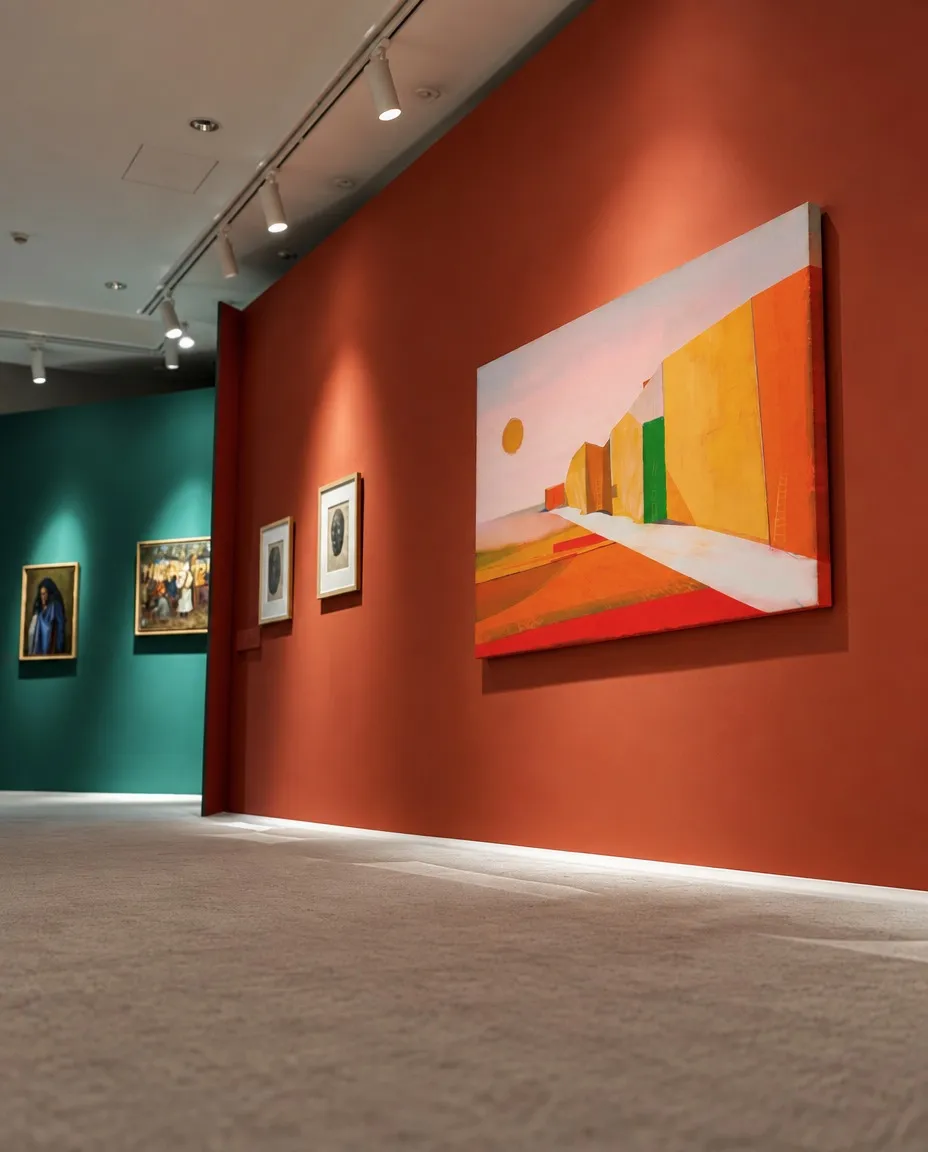
The chromatic continuity that might dissolve the canvas into the wall produces the opposite effect: it makes the white reserve rising from the lower edge more legible. In VIA SOLIS, the reds and ochres of the ground find a thermal extension in the wall, while the path retains an almost physical clarity, untouched by that absorption. The arrangement makes it possible to see that the path does not simply organise a recession into the background: it cuts across the terrestrial field, separates the yellow and orange masses, and leaves between them an interval that no form fully closes. This function belongs to Maurizio Valch’s territorial language, constructed through chromatic fields, divisions, and elemental presences rather than descriptive geography. The small staircases incised into the lateral blocks introduce a fragile scale, but do not turn the route into a resolved itinerary.
For an artist whose experience of movement has distinguished between the traceable path and a less certain inner direction, this band can be read as a suspension of the promise of arrival. The work does not illustrate a biography or fix a psychology of travel; it nevertheless proposes an experience akin to walking when the next step exists but its meaning remains open. The orange sun, shifted to the left, does not crown the movement either. It remains outside the path’s axis, and that distance prevents the white clarity from becoming an emblem of conquest. What persists is a minimal measure of separation: enough space to keep the territory from becoming a single block of heat, weight, and certainty.
In “From Dream to Territory,” Valch describes MARE SOMNIORUM as a region where the horizon divides and connects at once, and where forms act as signs rather than closed symbols. VIA SOLIS makes this ambivalence perceptible through a very precise gesture: the path links foreground and distance, but its whiteness also interrupts the continuity of the planes it touches. The proximity of the red wall intensifies this condition. By extending beyond the painting a temperature close to that of the painted earth, the room makes the white preserve its difference more insistently. It does not offer an exit from the territory; it keeps open a relation within it, where the masses might otherwise have closed in upon themselves.
Richard Diebenkorn offers a useful affinity for considering how abstraction can retain a memory of landscape through planes and routes without describing a recognisable place. In Valch, too, depth arises from the distribution of surfaces rather than from a panoramic view. Yet VIA SOLIS departs from the more aerial sense of breathing space associated with Diebenkorn: its large volumes advance, compactly, compelling the path to brush against them. The white band does not lead the gaze from a secure height; it holds it at the edge of chromatic bodies that remain silent. Its clarity functions less as a promised horizon than as a necessary interruption: that which keeps the earth, possible architecture, and the gaze itself from becoming permanently adhered to one another.
- Original artwork
- VIA SOLIS
- Actual dimensions
- 47.2 × 31.5 in / 120 × 80 cm
- Presentation
- Digital contextual visualization
Context references
VIA SOLIS Maurizio Valch · territorial abstract painting · red ochre and yellow abstract painting · painting with a white path · Mediterranean abstract landscape · contemporary geometric art · abstract painting for a red wall · horizontal abstract artwork 120 x 80 cm
About this visualization
This visualization places the artwork within an architectural context to help collectors and viewers imagine its presence in a real space. It is an interpretive reference, not an exact reproduction: the original work remains the sole authority for scale, color, surface and material presence.