Context study / VIA SOLIS
VIA SOLIS: abstract painting on canvas | Maurizio Valch
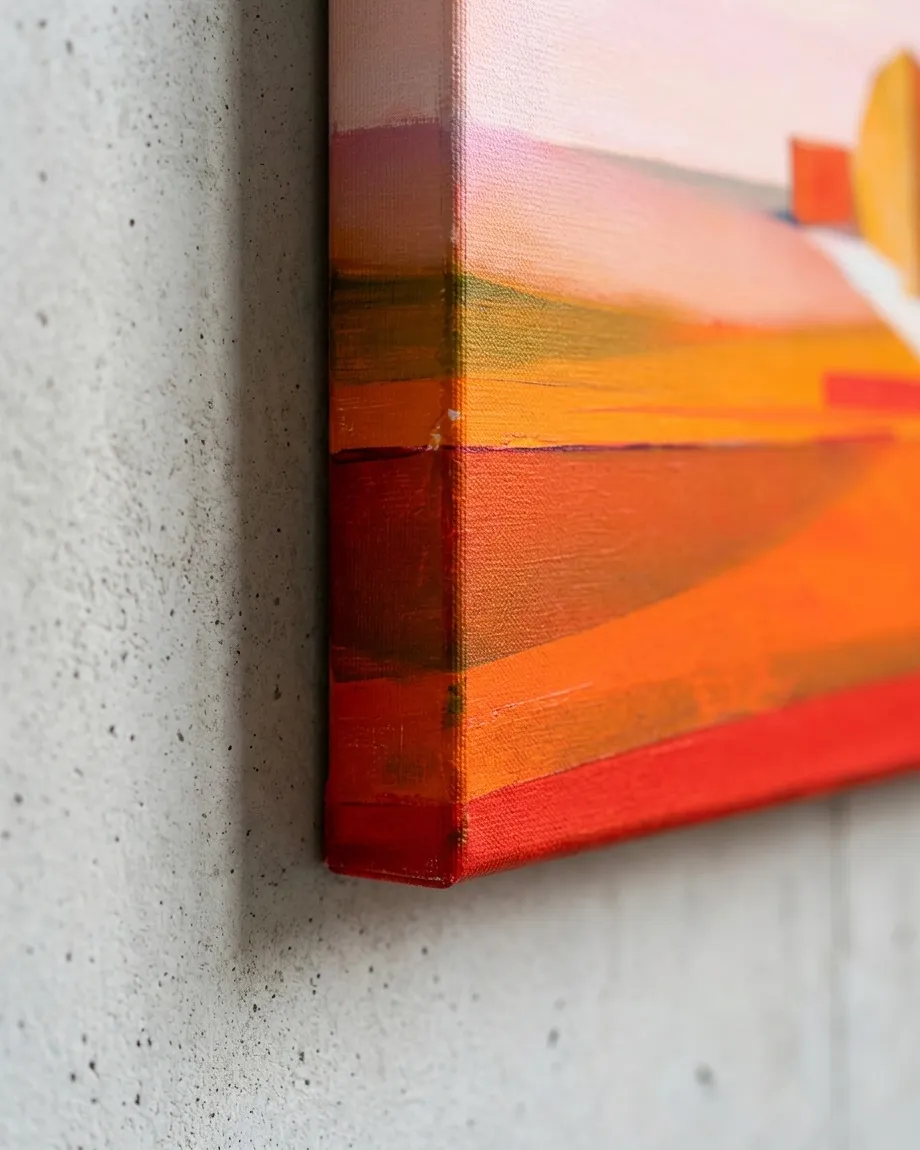
The landscape loses its promise of transparency at the very point where it should open out. Seen up close, the oranges, reds, and ochres of VIA SOLIS turn around the edge of the stretcher and continue across its three-centimetre depth; the dark band of ground also extends, though it can no longer be read as distance. This material detail changes the status of the white path crossing the front: it still suggests a route, but the support simultaneously asserts its thickness and its halt. Maurizio Valch’s practice places chromatic fields, divisions, and horizons in a sustained friction between surface and depth. In this work, that friction does not depend on spatial illusion: the edge turns the canvas into a concrete portion of territory, suspended and separated from the concrete wall by a minimal shadow.
The experience of the path occupies a documented place in Valch’s life, although his thought carefully distinguishes between a journey that can be traced on a map and an inner movement with no known direction. VIA SOLIS preserves that difference. The path does not extend into the exhibition space or offer the viewer an easy entry; it meets the physical limit of the canvas, where chromatic continuity is exposed as a construction. This can be read as a reserve toward the need to turn every direction into a destination. The painting keeps the desire to move forward visible, but first requires recognition of the material that supports it and the simple obstacle of its own edge.
In “The Tactile Shore,” the artist questions the boundary understood as a line of exclusion and proposes thinking of the limit as a zone of contact. This idea finds a precise translation in this lateral presentation. The edge does not function as a neutral frame or a hidden reverse of the image: it receives the same fields of colour and turns the front towards real space. The rough grey wall neither extends nor explains the landscape; by contrast, it makes its condition as an object more distinct. Between concrete and pigment lies a small but decisive interval: a distance that does not entirely separate the imagined geography from the physical presence of the canvas.
The affinity with Antoni Tàpies helps explain this insistence on the edge as a site of material reality. In both cases, the surface may claim the density of a wall rather than the neutrality of a window. Valch departs, however, from the enclosed and almost earthen erosion that characterises many of Tàpies’s works: in VIA SOLIS, the colours retain a warm clarity, and the path keeps a possible orientation open. Its singularity lies in the fact that this opening does not overcome the support. The path reaches the margin, continues over it, and instead of vanishing into an imagined distance, returns the gaze to a painted body that occupies the same world as the person contemplating it.
- Original artwork
- VIA SOLIS
- Actual dimensions
- 47.2 × 31.5 in / 120 × 80 cm
- Presentation
- Digital contextual visualization
Context references
VIA SOLIS Maurizio Valch · side detail of a painting on canvas · canvas with painted edges · orange and red abstract painting · 120 x 80 cm abstract canvas painting · abstract art with colour fields · contemporary territorial painting · large abstract wall art
About this visualization
This visualization places the artwork within an architectural context to help collectors and viewers imagine its presence in a real space. It is an interpretive reference, not an exact reproduction: the original work remains the sole authority for scale, color, surface and material presence.