Context study / VIA SOLIS
VIA SOLIS — Context Study
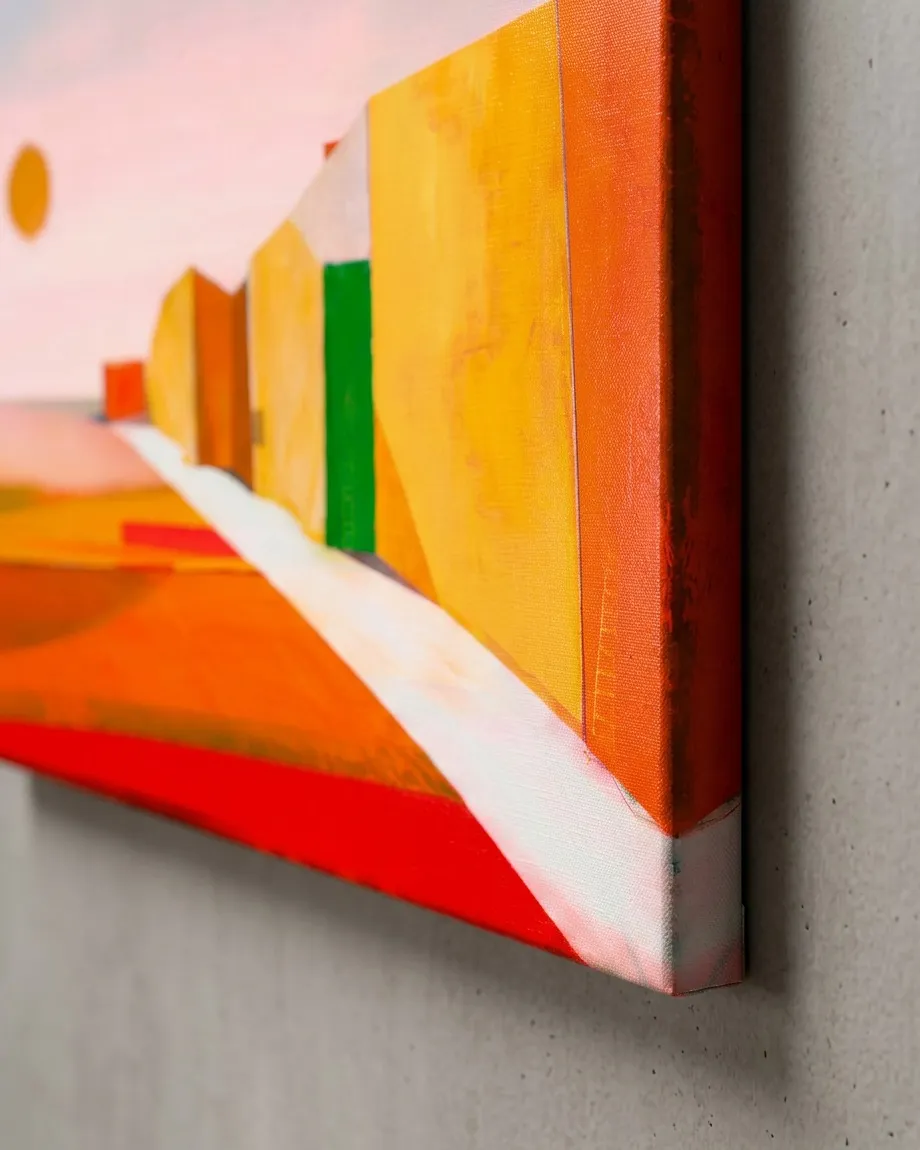
At the right edge, the apparent solidity of the large yellow forms becomes uncertain: the canvas weave emerges beneath the pigment, the oranges shift in density, and the red continues around the three-centimetre-deep edge. Moving closer does not undo the image of a row of façades; it returns it to its precise condition as a worked surface. This oscillation belongs to Maurizio Valch’s language, built from colour fields, divisions, and material subjected to layers, cuts, and reductions. In VIA SOLIS, the green band and white road still organise an imaginable depth, yet the angle reveals that this geography depends on a vulnerable canvas, exposed to the touch of light and to close looking.
The dreamed distance is not negated by this physical evidence; rather, it acquires a human fragility. In Valch’s experience, the outer path and inner movement do not necessarily coincide: there can be direction without a clear arrival. The white path retains this ambivalence as it passes between the volumes without reaching the orange sun, set apart to the left. At the edge, however, the journey ceases to be only a spatial promise. The eye registers a concrete action—deposited pigment, supporting weave, painted edge—before rushing to turn it into a narrative. The painting thus sustains a territory open to memory and imagination, while resisting any attempt to close it under a single explanation.
An essay published by the artist on VIA SOLIS understands its path as an interruption of the heroic march towards a goal. This presentation makes it possible to shift that intuition: the pause occurs not only in the represented landscape, but in the act of approaching it. From a distance, the warm planes may take on the weight of a silent architecture; beside the edge, their authority depends on subtle modulations and a material continuity that might otherwise go unnoticed. The white road continues to separate the reddish ground from the lateral blocks, though it no longer leads exclusively into the distance: it draws attention towards the edge where image becomes object. The finitude of the support does not diminish the imagined territory; it gives it a condition of presence and limit.
The affinity with Antoni Tàpies is relevant here, not because of a general formal resemblance, but because it allows the surface to be read as both wall and skin. In Valch, the large yellow plane may retain a frontal, almost architectural appearance, while the visible weave and the pigment folding over the side prevent it from becoming a closed façade. He departs from Tàpies’s earthy, eroded gravity through a drier, more territorial clarity: colour retains the radiance of a Mediterranean distance. Yet close looking reveals a decisive convergence: every visual structure depends on a surface that has been made, that has depth, and that remains exposed.
- Original artwork
- VIA SOLIS
- Actual dimensions
- 47.2 × 31.5 in / 120 × 80 cm
- Presentation
- Digital contextual visualization
Context references
abstract painting detail on canvas · canvas with painted edges · contemporary abstract painting texture · yellow orange and green abstract painting · abstract art with a white road · contemporary territorial painting · abstract painting with visible canvas texture
About this visualization
This visualization places the artwork within an architectural context to help collectors and viewers imagine its presence in a real space. It is an interpretive reference, not an exact reproduction: the original work remains the sole authority for scale, color, surface and material presence.