Context study / VIA SOLIS
VIA SOLIS — Context Study
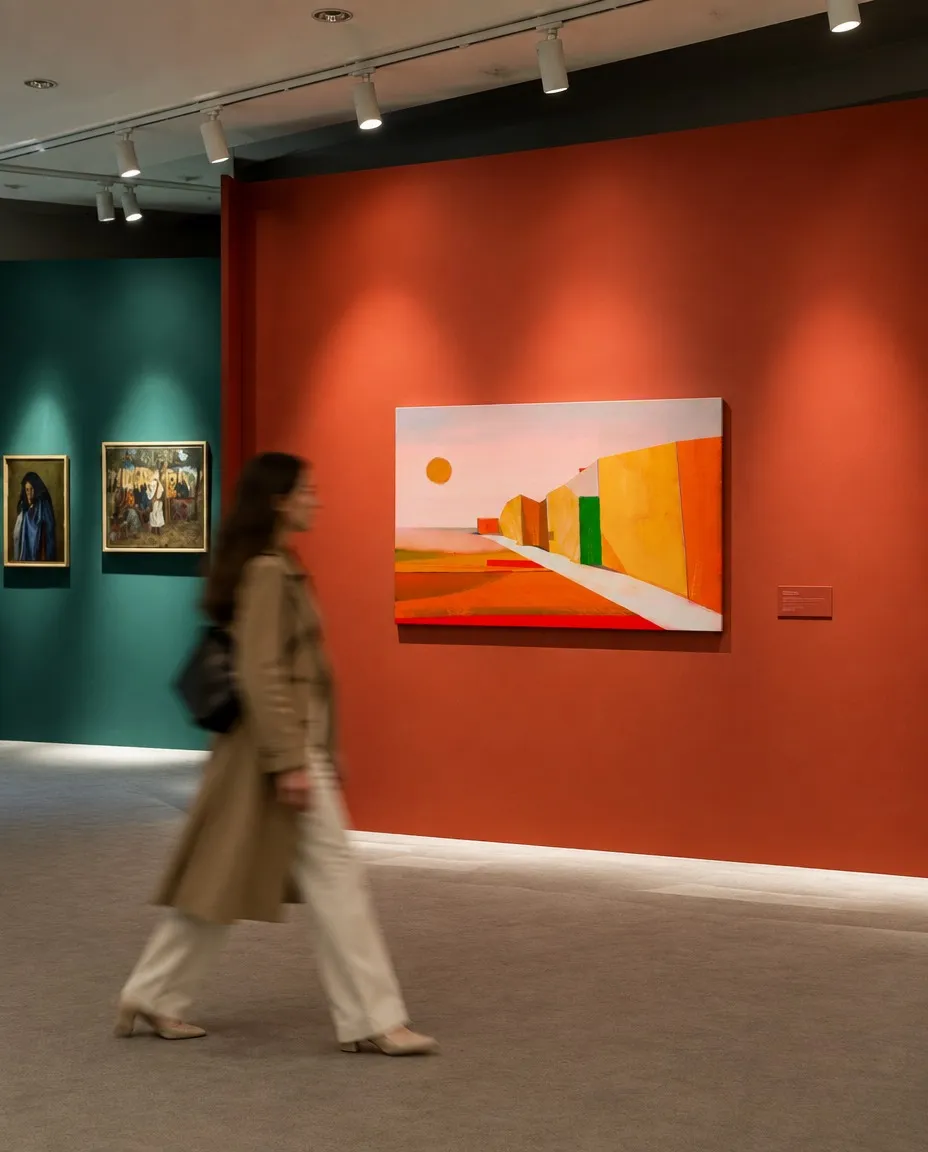
The hurried passage does not turn the white path into an itinerary. As a figure blurred by motion moves sideways in front of the canvas, VIA SOLIS maintains its own duration: the orange circle remains suspended, the yellows and oranges rise unchanged, and the path narrows towards a distance that promises no arrival. In Maurizio Valch’s practice, colour fields, divisions, and incisions organise territories that remain between landscape and matter; in this work, small linear marks across the broad planes introduce a fragile, almost human measure without making the place narrative. The passing body confirms the painting’s structural stillness by contrast: it does not activate it through its movement, but reveals how much it resists haste.
That difference touches on an experience that runs through Valch’s thinking: an external path can be traced, but inner movement guarantees neither direction nor resolution. His extended journeys have left him with a documented attentiveness to fatigue, departures, and intervals in which apparently nothing happens. Far from turning VIA SOLIS into biographical illustration, that attentiveness helps explain why the visible path does not demand to be followed. The passer-by occupies the ordinary time of a gallery; the painting sustains another kind of time, closer to waiting. Its Mediterranean memory does not appear as a recognisable view, but as an expanse where clarity, dryness, and distance persist even as someone passes before it.
In “From Dream to Territory,” Valch writes that MARE SOMNIORUM preserves a suspended landscape altered by memory, desire, and distance, and observes that paths introduce direction without ensuring a destination. VIA SOLIS makes that condition palpable in very concrete terms: the white diagonal enters between warm fields, yet the sun remains separate from it and the lateral blocks do not arrange themselves as stages in a narrative. The presentation scene intensifies this lack of synchrony. The visitor’s sideways movement does not align with the depth suggested by the path; her presence does not complete the image, but brushes against it. A double temporality emerges: that of someone crossing a room, and that of a territory that retains its forms and silences without explanation.
The affinity with Richard Diebenkorn is relevant in the way abstraction can retain a memory of passage through planes, horizons, and relations of depth. Yet Valch departs from a more aerial openness: the volumes of VIA SOLIS form a compact front, and the route does not invite the viewer to command the space from above. Seen from a certain distance against the red wall, the painting asserts itself as a stable rectangle within continuous circulation; its scale makes clear that the human passage is contingent, not the measure of what occurs there. The path remains available, though it neither asks to be travelled nor resolved before the body moves on.
- Original artwork
- VIA SOLIS
- Actual dimensions
- 47.2 × 31.5 in / 120 × 80 cm
- Presentation
- Digital contextual visualization
Context references
VIA SOLIS Maurizio Valch · abstract painting with white path · Mediterranean abstract landscape · abstract art in orange and red tones · contemporary painting with geometric blocks · contemporary territorial abstraction · abstract landscape painting with horizon · warm abstract wall art
About this visualization
This visualization places the artwork within an architectural context to help collectors and viewers imagine its presence in a real space. It is an interpretive reference, not an exact reproduction: the original work remains the sole authority for scale, color, surface and material presence.