Context study / VESTIGIA
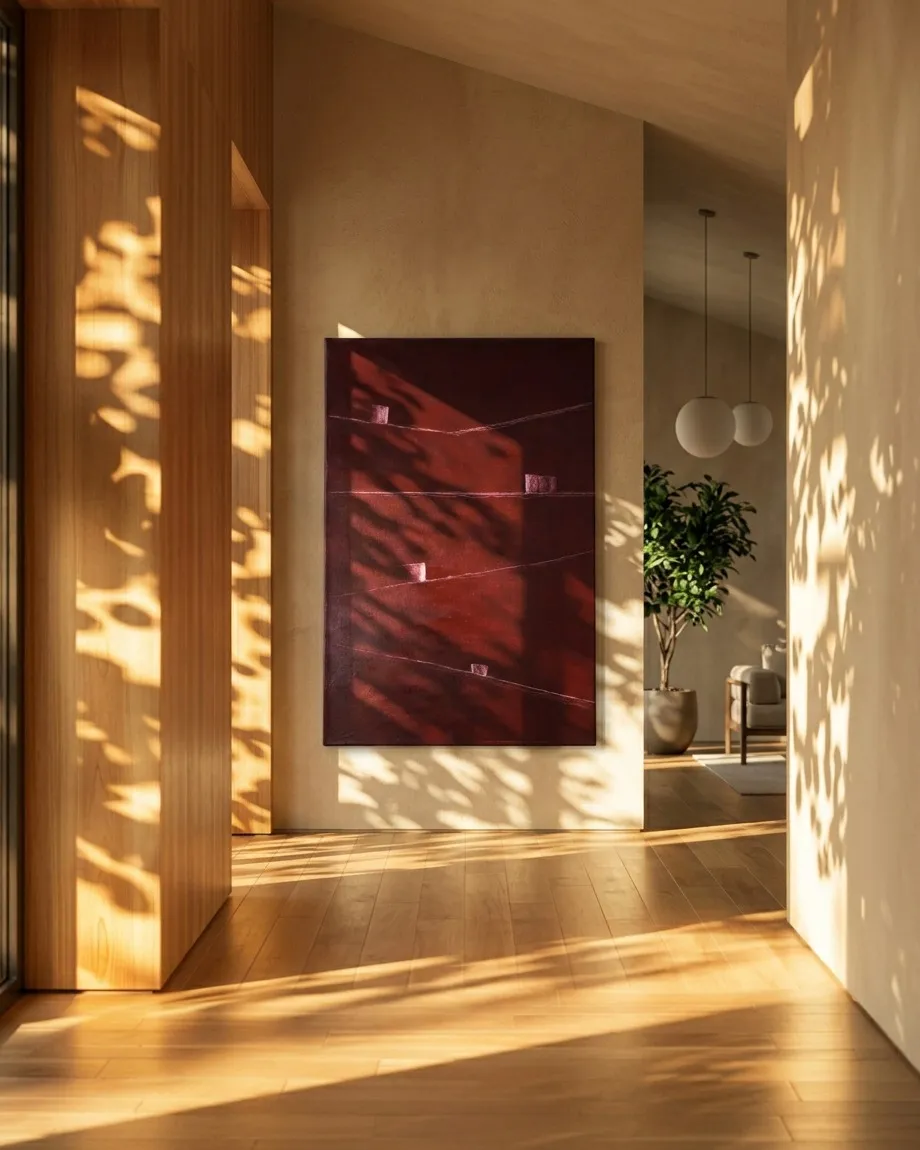
Red Abstract Painting in Wooden Entryway | VESTIGIA by Maurizio Valch
The highest line does not inaugurate a horizon: it barely manages to sustain itself over the red. Step back mentally a couple of paces; the dark field then ceases to seem like a background and acquires thickness, as if behind its surface there were a compressed extension. Nicolas de Staël, a painter attentive to the weight and distance of color masses, would find a difficulty here: how much a red can weigh when it does not only occupy a wall, but seems to occupy the air in front of it. The small light area next to the first stroke does not rest on a line; the red pushes it from all sides, making it too light for the space it occupies. It is not yet a house or a stone: it is the minimal proof that a thing can appear without having found ground.
The second line calls that first support into question. It is no longer enough to think that the red presses and the shape resists. Trace the stroke slowly with your gaze, from left to right, without following it as one follows a handrail: its slant changes your breathing, forcing you not to trust the eye completely. The two small light interruptions could be marks of distance, but they do not coincide with each other either; one seems to have arrived late, the other to have stayed stopped before starting. The line does not divide the painting: it measures a separation that fails to stabilize.
In VESTIGIA I try to approach these bands and they pull away from me. I feel they ask for a landscape reading, but when I follow it, the red becomes too close and the distance dissolves. I cannot decide if the lines support the small shapes or if the shapes force the lines not to fall. The more I fix my gaze, the less obedient the surface becomes.
In the third line, the body enters, not to turn the painting into a stage, but to discover that walking here would be a continuous negotiation. Trisha Brown, a choreographer who turned walking, falling, and leaning into forms of bodily imagination, would not see secure paths in those lines. An imaginary foot would have to land sideways, correct its weight, accept that the next support is not guaranteed. The small light shapes would then begin to look like minimal bodies in an infinitely slow fall: they are not simply placed, they are arguing with the slant.
A child might ask: why don't those little things slip off if the lines are tired? The question forces us to look again. One notices that none of the four lines falls in the same way; some seem to tighten, others to loosen, as if their slant were a precarious decision rather than a rule. One also notices that the pale shapes do not weigh the same: one is visually embedded in the darkness, another barely touches the stroke, another seems suspended at a distance so small that the eye cannot measure it. Brown would accept falling as a condition; Staël would perhaps insist that it is the red keeping them at bay. Neither can completely concede to the other's way of seeing.
Now I recognize that the artwork has separated itself from what I thought I asked of it. The light shapes return a question to me that I do not know how to resolve: they do not ask what they are, but from where they are resisting. I would like to fix them, but every time I try to give them weight they become almost invisible, and every time I let them float, the red seems to lean toward them.
The fourth line returns the gaze to the beginning, but the red can no longer be just a mass. It has become a sort of nameless place: not landscape, because it does not offer a habitable extension; not pure abstraction, because it forces the body to lean; not a stage, because no one can enter it without losing their balance. It is a zone where an almost non-existent line can alter the gravity of everything around it.
Look for the last time at the lower band. There, next to a pale stretch that seems about to erase itself, remains a minimal shape: it could be falling, it could be nailed in the air, it could be the one supporting the entire weight of the red.
- Original artwork
- VESTIGIA
- Actual dimensions
- 31.5 × 47.2 in / 80 × 120 cm
- Presentation
- Digital contextual visualization
Context references
wooden hallway paintings · red minimalist abstract art · red contemporary abstract painting · modern wood entryway decor · large elegant entryway paintings
About this visualization
This visualization places the artwork within an architectural context to help collectors and viewers imagine its presence in a real space. It is an interpretive reference, not an exact reproduction: the original work remains the sole authority for scale, color, surface and material presence.