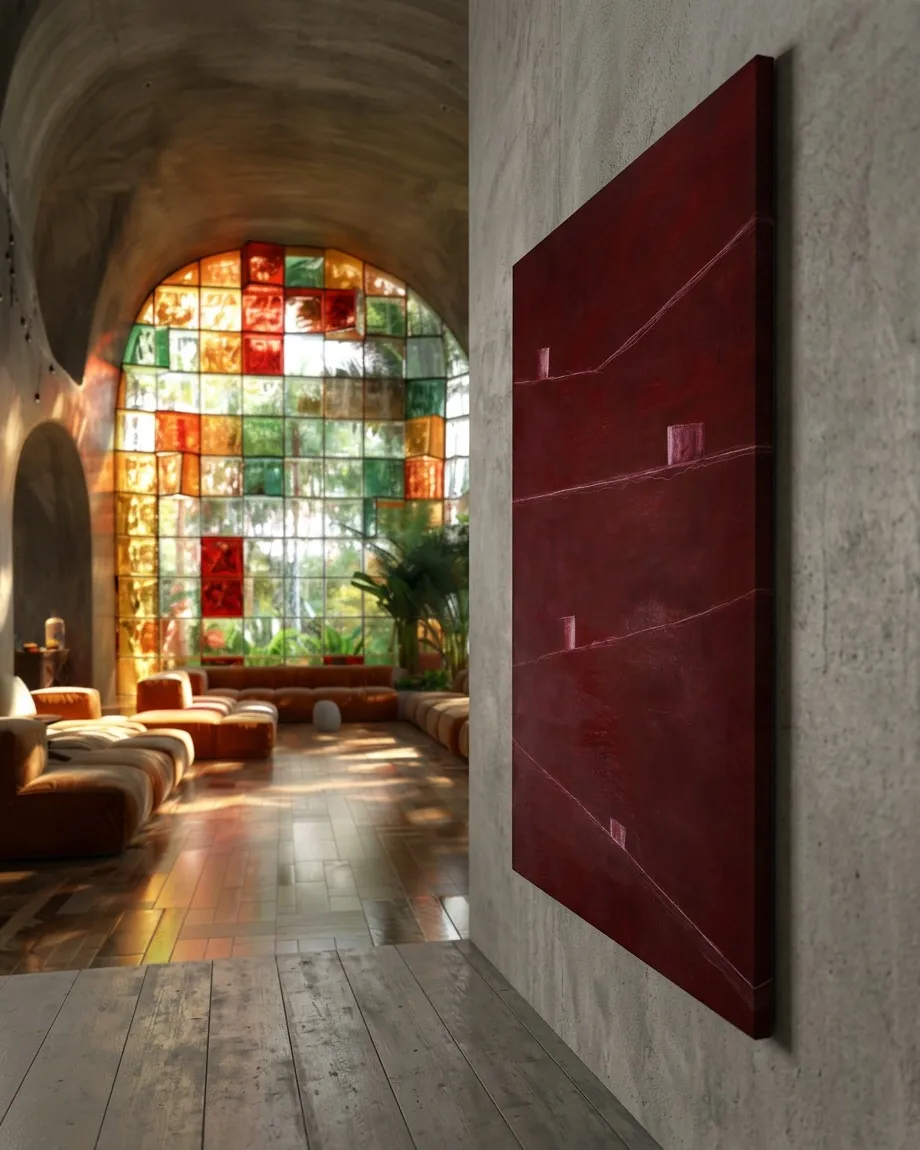
Context study / VESTIGIA
VESTIGIA Painting in Brutalist Space with Stained Glass
VESTIGIA
—at the distance where color begins to breathe—
The burgundy rectangle does not receive the gaze as an available surface. It lingers. It feels like dark wine seen against scarce light, a wall that has kept its warmth after someone has left, a night still dense with matter. There is no background upon which things later occur: the burgundy is already occurring. It absorbs the eye, barely letting it in, and returns a temperature that is neither warm nor cold. Its depth does not open up like a landscape; rather, it folds back, as if behind it there were another wall, and behind that, a reserve.
The first line crosses this reserve without fully securing its direction. Almost horizontal, yes, but not obedient: it advances with a slight hesitation, a breath that makes it difficult to call it straight. Near it, a minimal clarity interrupts the field. It does not occupy much; precisely for that reason, it alters so much.
Ella Fitzgerald was a jazz singer capable of turning the voice into rhythm, play, precision, and improvised surprise.
With her way of listening, the line stops being a division and acquires something of a phrase looking for a place to rest. The small, clear form does not arrive as an answer. Rather, it enters like a syllable that barely anticipates the breath of the one waiting for it. It is not out of time: it invents a tiny time within the burgundy. The eye, which before could traverse the expanse without obstacles, stops there with a strange obedience. What changes in the body when a minimal mark forces a pause in an expanse that seemed empty? Perhaps the shoulders drop a little. Perhaps the gaze discovers that the void was not empty, but attentive.
The line continues. Or seems to continue. The clear form does not dominate it, but manages to ensure that everything before and after is measured from it. The large field becomes larger because now there is something that cannot be ignored.
—lowering the head slightly, as if before an edge—
The second line appears lower down, and the descent modifies the scale. It is no longer just a matter of listening to the deflection of a trajectory: one must calculate what portion of the world is excluded by the framing. The new clear form remains close to its line, but does not repeat the first; it has another solitude. It seems more isolated because the burgundy around it has learned, from above, to weigh.
Graciela Iturbide is a Mexican photographer whose gaze knows how to find mystery, dignity, and strangeness in the apparently everyday.
Her presence casts suspicion on the measure of these small appearances. It does not allow them to be treated as self-sufficient objects. If they were traces, from what expanse would they come? If they were fragments, what edge would have separated them from the rest? The gaze searches for an off-camera space that the painting does not grant. Each clarity seems to ask for an architecture, a floor, a distance to be understood; but the more it is granted, the less it explains itself.
Then a small question arises, with the mischievous seriousness of someone who has not yet learned to pretend they understand: how do those little things manage to stay still on such thin lines without slipping off? The question does not reduce the painting; it makes it more demanding. Because it forces us to look at the gravity that the lines do not represent and yet seem to summon. It forces us to think that a mark can sustain itself not by weight or support, but by the way the space tenses around it. Perhaps they are not supported. Perhaps we are the ones who need them to be.
I look at this painting and distance appears before forms. Not as a hollow to be filled, but as a presence that begins to work against me. Each time one of those small clarities seems to say too much, I want to withdraw it; each time it seems to say nothing, I want to bring it closer. I do not know where the reserve ends and where the explanation begins. What I recognise is that space can become more active than what it contains, and then a small form stops being small.
—not following the line: letting it turn away—
The third trajectory receives this doubt. Now the burgundy no longer seems an initial expanse, but a place that tolerates interruptions with some difficulty. The third clear form does not offer itself as a stable presence. It is felt, above all, as a cut in the continuity of the gaze: something that has made the field halt with itself.
Fitzgerald’s intelligence wants to find there a repetition with variations: four entries, four pauses, four ways of delaying the support. But Iturbide resists. There is no secure sequence, her way of framing seems to say; there is an image that refuses to surrender its order. The third form should not be read as the next moment of something. It may be, on the contrary, a resistance to the eye converting everything into succession.
And yet, in that resistance, a rhythm appears. Not a rhythm that organizes things, but one that makes them incapable of remaining entirely motionless. The line seems to advance and correct itself; the clarity seems to wait; the burgundy seems to approach from both sides. Nothing moves visibly, but the gaze changes speed. What above was an intake of air and then a suspicion of a scene, here becomes a more difficult interruption: a pause that does not rest.
The four lines resemble each other without reaching the same place. The four forms correspond without falling under the same rule. This third presence makes it evident that repetition does not guarantee familiarity. Sometimes repeating only succeeds in making what had already been seen more strange.
—tilting the body slightly, without correcting yet—
The fourth line is below, near the area where the eye feels the weight of the rectangle. Its curve, or its faint drop, alters the balance. There is no collapse, but there is a physical insinuation: the need to adjust the feet, to accompany with the neck a drift that the painting does not fully complete. The small form near it seems to concentrate that tilt, as if it had stopped for an instant something that was sliding.
First the body responds. Only later does thought arrive, always somewhat delayed: where does this line tilt? what holds this form? why does the space below seem more unstable than the one above? The question does not find a clear figure. The curve does not become a path; the block does not become a sign; the field does not transform into a stage. But the tilt persists, small and obstinate, in the muscles that try to straighten the gaze.
Fitzgerald could hear a brief fugue here, an exit that avoids closure. Iturbide could ask for silence and more edge: looking at the low form without turning it into a final gesture. Between both demands remains a third, less comfortable attention. It does not only listen, nor does it only frame. It measures how a minimal deviation can modify the entire weight of a space.
Now that the painting is finished, one of those forms is more unfamiliar to me than before. Not because it hides a secret that I must discover, but because it has learned to keep something without asking my permission. Sometimes I hear it as a pause; other times it seems like something seen from very far away; other times, neither of the two readings is enough. The painting has preserved a distance that I no longer control, and that distance forces me to look at it as if it had arrived after me.
—staying an instant before returning to the top—
The four appearances do not form a staircase. Nor a story of ascent or descent. They let themselves be traversed, but they do not let themselves be easily gathered together. Above, a clarity seemed to enter the field; lower down, another demanded an outside that does not appear; the third made all repetition suspicious; the last tilted the body without falling. What at first could seem ordered by successive lines now disperses: each trace pushes the rest towards a different scale.
Perhaps one of those small presences is a room without walls. Perhaps a window looking out to an impossible place. Perhaps an error in measurement that no one has corrected because, thanks to it, the burgundy breathes in another way. No possibility lasts long. The painting lets them approach and then leaves them without ground.
When seeing it again, it is best not to look for which of the four forms explains the others. It is enough to check if the lowest one remains where it was, if the third continues to interrupt, if the second still asks for a world off-camera, if the first preserves its brief intake of air. Perhaps one has shifted in perception. Perhaps the large field, far from containing them, has begun to depend on them.
- Original artwork
- VESTIGIA
- Actual dimensions
- 31.5 × 47.2 in / 80 × 120 cm
- Presentation
- Digital contextual visualization
Context references
abstract art on concrete walls · brutalist decor with paintings · stained glass and contemporary art · modern art gallery interiors
About this visualization
This visualization places the artwork within an architectural context to help collectors and viewers imagine its presence in a real space. It is an interpretive reference, not an exact reproduction: the original work remains the sole authority for scale, color, surface and material presence.