Context study / VESTIGIA
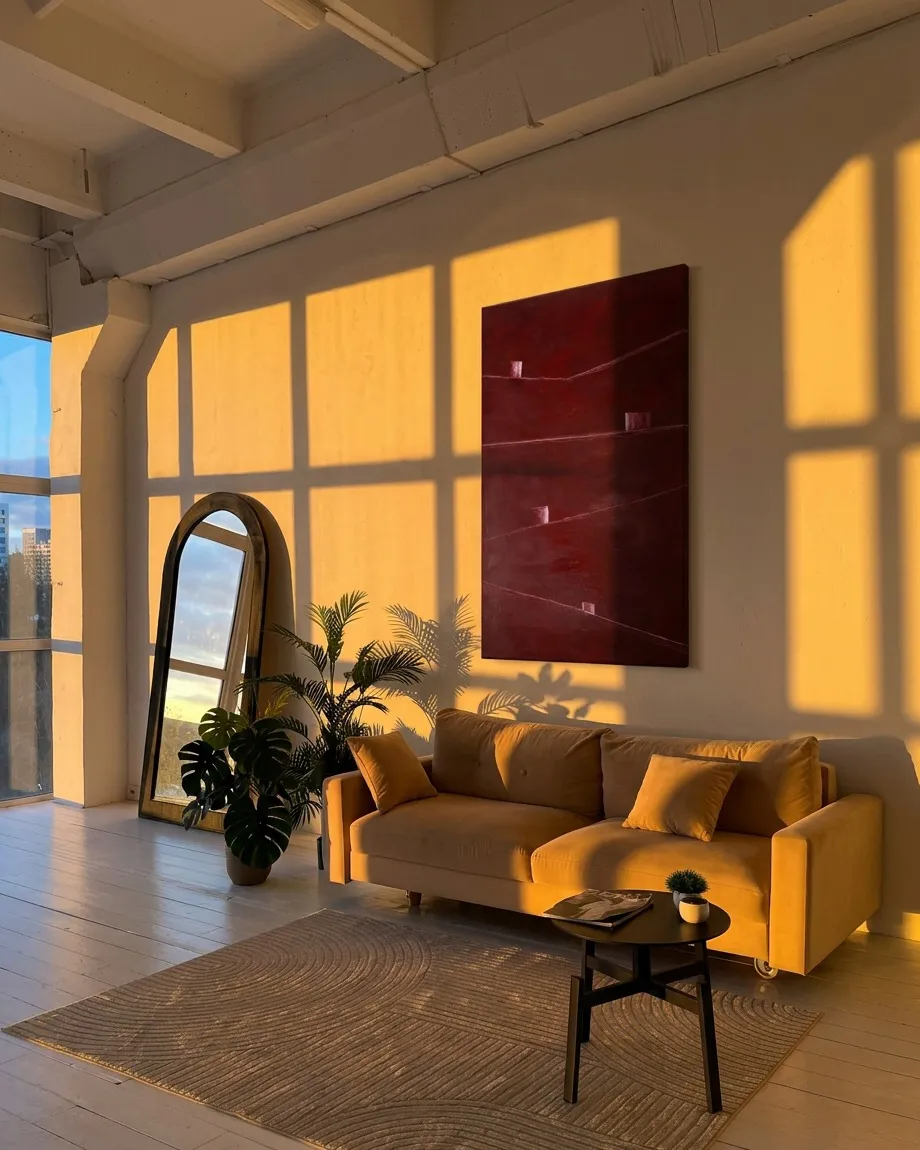
VESTIGIA Painting in Modern Living Room under Sunset Light
Audition for Four Things that Do Not Quite Fall
At first, it seems like a territory viewed from very far away: a vertical field of dark, thick, almost nocturnal red, where the eye searches for ground and finds depth. There is no horizon to organize the gaze. The red does not remain identical to itself; it sinks, opens, seems to breathe in sheerer or denser areas. Across this expanse, four pale lines cross the surface without the certainty of a ruler. One arches slightly; another lingers in an almost-horizontality that is not quite rest; another escapes to the side as if remembering too late that it had to exit; the last approaches the edge, leaving the impression that the painting continues beyond its frame.
Beside these lines, four small pale forms appear. They are so small they could be lost, yet they force everything to be measured anew. The red field becomes vast because they are minimal; the lines seem immense because they must pass near them. Each form seems to rest on, or to have grazed, or to be on the verge of abandoning its line. None has enough stability to become an unquestioned object. Blocks, signs, reduced houses, remains: each name lasts a second before being contradicted by the next tilt.
I look at these lines and feel I do not know where the painting is being viewed from: whether from above, from very far away, or from within a surface that has lost its orientation. I move closer, and the small bodies do not become more secure; they become more exposed. I would like to say they rest on something, but each line deviates just enough to strip away that comfort. The work does not grant me ground: it leaves me with my head slightly tilted, as if my own body had to correct a fall that never quite finishes happening.
Then a child’s question appears, precise and difficult to dismiss: why don't they fall if the lines are so thin?
The question changes the scale of the work. One is no longer looking at a landscape: one is watching a balance. The first line, at the top, seems to carry a pale form like an interruption of light; but it is not exactly above it nor exactly below. Lower down, another line opens with a softness that could be a minimal ripple in the terrain, though it also feels like a sustained breath. The third tilts with greater resolve, forcing the eyes to follow; there, the small pale form seems less settled than arrested. The fourth, near the bottom edge, does not offer an arrival: it approaches the boundary like a rule that has decided to stop obeying.
Gaston Bachelard was a philosopher who paid attention to the imagination of matter, intimate spaces, and images that think before concepts. Before these four pale bodies, he would attempt to offer them hospitality. He would want to ask if each contains an interior: if there is in them a room reduced to a minimal stubbornness, a doorway without a facade, a shelter that persists even though the world around has turned red and too wide. But VESTIGIA resists that sweetness. Those forms do not seem capable of protecting anyone. They lack habitable thickness; they might be mere pale cuts, small roomless interruptions, without a roof, without anyone waiting inside. One of them might even be waiting for a bus that never arrives, but there is not even a street to justify the joke.
Claude Debussy was a composer capable of turning timbre, pause, and suggestion into a form of musical thought. His listening would not convert the lines into melody: rather, he would notice they are pitches that never quite find a fixed relation. The first line arches like a breath held too long. The second seems almost flat, but contains a hesitation that prevents us from calling it a pause. The third escapes with a lighter gesture, as if brushing aside its own weight. The fourth, as it nears the edge, functions less as an ending than as a sound held back before vanishing. The four pale forms would then be notes that have forgotten the music that sustained them: they do not know what tone to occupy or what duration belongs to them.
Here the friction is born. Where Bachelard seeks shelter, Debussy hears suspension. Where Debussy would recognize a sequence of breaths, Bachelard notices a void no tempo could accommodate. The painting grants victory to neither. The small forms need not be houses, nor notes. The lines are not necessarily supports either: they could be faults, threads, edges of terrain, pulses too thin to sustain even the idea of a body. Yet the eye insists on holding them responsible for the gravity of those four presences.
Now that the work is finished, I still do not fully recognize an area of the red, especially that interval where a line seems to withdraw before reaching the form it might support. I look there and find something smaller than a figure, yet more persistent than a detail. I cannot decide if that distance is a waiting, a separation, or a resistance of the paint itself to being fixed in a single reading.
The initial question is no longer exactly the same. If those forms were notes that forgot the music, the gravity of VESTIGIA would not be the force pushing them downward, but that which prevents them from falling entirely. A gravity of postponement, perhaps: the line does not support because it is firm, but because it leaves a delay open. Each of the four lines changes the others. The one that seemed an arch makes the next appear more tense; the almost flat one makes the escape suspicious; the escape intensifies the edge; the edge makes the first arch look no longer like a curve but a retreat.
The dark red participates in this postponement. It does not serve as a passive background. It surrounds the minimal bodies, distances them from one another, and exposes them. It has an almost tactile visual density, an earthy darkness that seems to retain wear, depth, and breaths without revealing what produces them. Against it, the pale lines have a fragile delicacy: they do not impose an order, they barely propose it. The small light blocks receive this precarity with a strange tenderness. They seem vulnerable not because they will break, but because no one can verify what keeps them there.
In the end, the gaze returns to the pale form near the escaping line: it does not quite touch, it does not quite separate. Below it remains an interval of red, minimal yet unfathomable, and in that space the line seems to tilt a little more than was visible at the beginning.
- Original artwork
- VESTIGIA
- Actual dimensions
- 31.5 × 47.2 in / 80 × 120 cm
- Presentation
- Digital contextual visualization
Context references
large painting living room decor ideas · abstract paintings for modern living room · decorating with red abstract art · art display in residential interiors
About this visualization
This visualization places the artwork within an architectural context to help collectors and viewers imagine its presence in a real space. It is an interpretive reference, not an exact reproduction: the original work remains the sole authority for scale, color, surface and material presence.