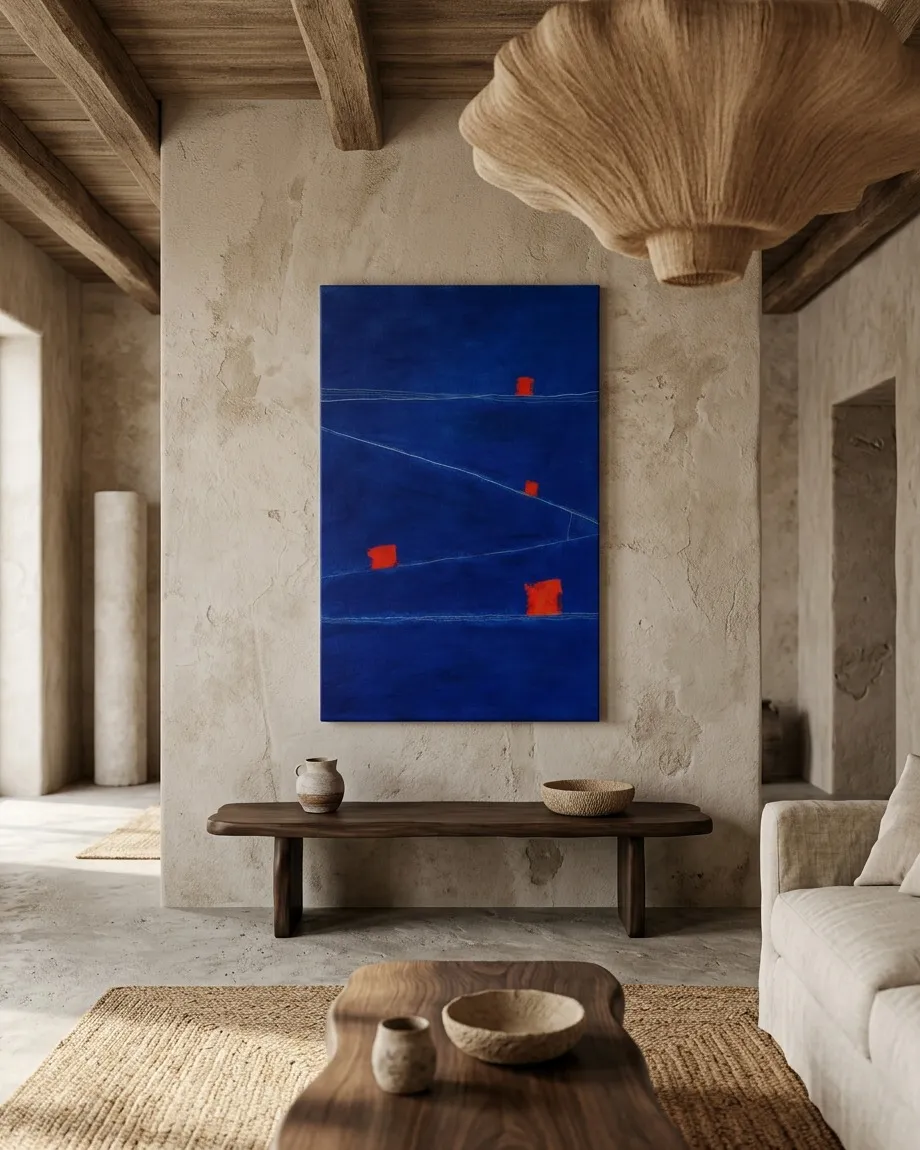
Context study / SUBMERSA
SUBMERSA Abstract Painting on Wooden Bench | Maurizio Valch
First Red Call
One enters SUBMERSA through the blue, but the blue does not receive: it displaces. Its density shifts from one edge to another, as if the surface had layers of distance rather than a single depth. At the top, an almost horizontal white line seems to want to support the painting; yet, following it with the eyes, it trembles. Is it a measure, a seam, a note that has lost its pulse? Above it—or barely separated from it—appears the first red call: small, vertical, too precise to be tranquil.
**Yasunari Kawabata** knows that a minimal distance can contain an entire event without stating it. For him, between that high red and the line brushing against it lies an unbearable intimacy: something has occurred, but the painting refuses to deliver the narrative. The red does not ask to be interpreted; it remains like someone who has arrived late to a room and still does not know whether to speak.
I look at the finished work and feel that the blue is not behind the reds, but in front of me. I cannot decide if the lines support them or if the reds have forced them to appear. The small upper mark makes me catch my breath slightly, as if I were about to touch a surface that does not let itself be reached; then the line stops looking like a separation and becomes a doubt passing through my body.
The question begins to shift in weight: how can something so small and red alter the gravity of such a vast blue without ever explaining itself? Here it does not seem a matter of strength. It seems a matter of misalignment. The high red dominates nothing; it merely introduces a small disobedience where the eye expected to find stability.
Breathing under a line.
Second Red Call
Further down, toward the right, another red intrusion appears alongside a white curve that falls and deflects. The first call seemed suspended; this second one seems to have been displaced by an unseen current. The curve could be a border, a prolonged note, a fissure in the blue continuity. But it soon contradicts any of those possibilities: it does not clearly separate two zones, it does not lead to a secure point, it does not behave like a line made to orient.
**Wolfgang Amadeus Mozart** understands that an exact interruption can change the mood of everything that follows. He does not hear a melody in the painting; instead, he detects a system of measures that refuses to obey. The upper line would have initiated a measure; this curve displaces it. The second red enters before its place, or after, and precisely for that reason forces the blue to reorganize. Where Kawabata requested silence, Mozart finds a kind of physical play: an untimely entry that prevents gravity from becoming solemn.
Then a child's question interrupts all expert vocabulary:
Why is the top red standing up if the white line is moving?
It is better not to answer it yet. The question alters the scale. It no longer matters if the blue recalls water, night, distance, or matter; it matters that a minimal spot can seem to stand upright, as if it had its own weight, balance, and obstinacy. Mozart would perhaps say it is not standing: it is entering. Kawabata would suspect it does not move because it has decided not to flee.
Third Red Call
To the left, approximately at mid-height, a third call emerges: wider than the previous ones, with a less peaceful edge, almost as if the red had been compressed against the blue. Something of the first mark returns, but distorted. At the top, the red was a signal in a region where it still seemed possible to catch one's breath. Here, instead, the eye has already followed the oblique line, has already lost its axis, and no longer knows with certainty what it means to ascend or descend.
Kawabata is slightly mistaken before this spot. His delicacy would wish to reserve a silence for it, to treat it as the intimate remnant of a story that cannot be told. But this red does not let itself be made entirely secret. It has an abruptness that breaks the composure of distance. It does not confess: it interrupts.
Mozart, on his part, believes he recognizes a variation: the red motif reappears out of proportion, displaced toward a place where the beat should have rested. His certainty is short-lived. The white lines do not accompany the entry; they pass close, hesitate, seem to withdraw. The assumed rhythmic play is damaged by a blue gap that is too wide. Where Mozart had found lightness, Kawabata notices a retreat that lacks elegance.
I look again at the red on the left and do not feel it as a response to the one at the top. I feel it as a resistance against my need to relate them. I want them to form a sequence, the lines to order them, the blue to accept a direction; but the painting does not grant me that relief. As I follow the white curve, I lose the assurance of looking at a line: it could be the trace of a memory trying to keep itself straight and failing.
The question returns, but it no longer asks about the power of the small against the vast. It asks about the very possibility of measuring: how can something red alter the gravity of the blue if the blue has ceased to have a top and a bottom?
Fourth Red Call
The last intrusion, bottom right, is the largest. It does not close the composition: it makes it more difficult. It sits near another white line, almost horizontal, as if it had reached a shore; but that proximity does not guarantee rest. The red seems to float and run aground at the same time. Its irregular edge does not yield a recognizable figure, though it has a physical presence that forces one to pause before traversing the whole again.
The spectator's body, which at first entered through the blue expanse, ends up halted before that red, too small to support so much surface and, nevertheless, unable to pass unnoticed. The lines can no longer make up their minds: they could be scores without fixed music, seams of an opening depth, marks of a memory that twists what it wanted to preserve. No version quite defeats the other.
Mozart sees in the lower red an entry that displaces all previous time: not a culmination, but a variation that has arrived with unexpected weight. Kawabata does not accept that joy. For him, the red near the lower line has something of a remnant, something that has been unable to sink or separate entirely. Mozart insists there is impulse; Kawabata perceives a graver suspension. Between the two remains a narrow blue zone, to the right of the white curve, which seems empty only until one looks too closely.
I do not know if that last spot is held back by the lower line or if the line has moved aside to avoid touching it. Nor do I know if the other reds are at different depths or if depth is the fiction that the blue imposes when I try to orient myself. What remains outside of me is not the color or the shape, but the exact distance between that lower red and the white vibration passing beside it.
The lower white line continues toward the edge, without promising that it actually leads anywhere.
- Original artwork
- SUBMERSA
- Actual dimensions
- 31.5 × 47.2 in / 80 × 120 cm
- Presentation
- Digital contextual visualization
Context references
rustic living room abstract painting · wabi sabi living room decor · large scale abstract painting · contemporary living room art · wood and blue decor ideas
About this visualization
This visualization places the artwork within an architectural context to help collectors and viewers imagine its presence in a real space. It is an interpretive reference, not an exact reproduction: the original work remains the sole authority for scale, color, surface and material presence.