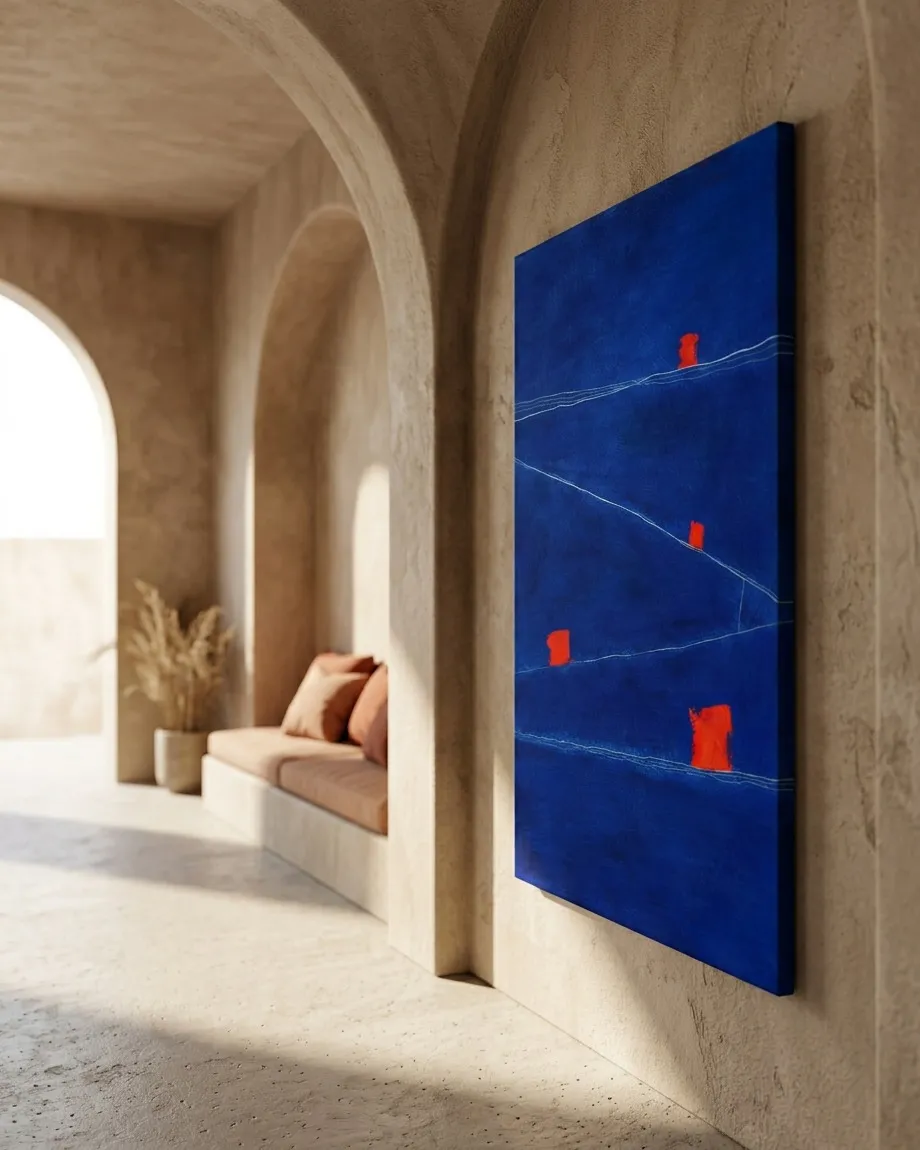
Context study / SUBMERSA
SUBMERSA by Maurizio Valch in Minimalist Hallway | Wall Art
Before this vertical blue, breath takes a moment to find its height. One does not look at it the way one looks at a wall: you enter with your eyes and, almost immediately, lose any reference point to straighten the body. The field seems continuous, dense, silent; yet silence has pressure. It could cool the skin even if no water is depicted, even if no waves can be named without disobeying the painting.
A first white line, almost horizontal, offers a place to pause. It barely trembles. It seems like a thread suspended in a depth that cannot decide whether it lies in front or behind. Then another duplicates it, brushes against it, moves away. Further down, a long curve inclines the gaze and forces the neck to follow: it does not descend completely, it does not ascend completely, it crosses through. Within this movement, the reds appear. Four small, unequal, obstinate intrusions. They do not fill the blue: they tense it. How can a red form so small prevent an immense blue space from becoming empty?
The eye draws near to verify whether the lines are edges, currents, or scars. Up close they do not become more obedient. One seems stitched to the blue; another seems to have been left by something that passed by without wanting to leave a trace. The blue, which from afar promised to be a smooth expanse, begins to behave like a surface harboring folds. Each white line introduces a slight doubt in orientation. Each red seems to know this.
I look at the blue and discover that it refuses to be a background. It forces me to wait, not to complete too quickly what I think I recognize. At first, the lines seemed a way of ordering the expanse, but now they are what shifts my attention, making it unstable. I do not know if they separate zones, join them, or are merely seeking an exit that the painting denies them.
In this search, Nikola Tesla appears. He was an inventor and thinker of electricity who imagined invisible forces, fields, waves, and transmissions before they could be seen. Faced with these white lines, his gaze would want to read variations in tension: fine registers of a current crossing the plane, minimal diagrams of an energy forced to make itself visible. The upper line could be a stabilized frequency; the undulating ones, an interference; the great diagonal, the deflection of an impulse encountering a resistance.
For a moment, the reds also enter his calculations. They are local anomalies. Points where the field concentrates, foreign bodies altering the distribution of a force. The highest seems to interrupt a wave without breaking it; another, suspended on the diagonal, can be imagined as a small charge trapped between two tensions. Tesla seeks a measurement: distance, intensity, direction. But the lines do not cooperate. They are too thin to become instruments and too capricious to accept a stable law. Sometimes they seem to tremble from some cause; sometimes they seem to have changed their minds.
The central curve descends and prose must bend with it. Where the white becomes a slope, the painting loses its appearance of a calm surface. It is not sea, though it lets in the possibility of immersion. It is not an electrical schematic, though the temptation of the diagram persists. It is not a score, though each line forces us to read a different duration: a sustained note at the top, a brief fugue in the center, a vibration reappearing near the edge.
Then Quino enters. He was an Argentine cartoonist capable of making a child's question, a minimal line, or an absurd gesture reveal the strangeness of the world of adults. He looks at the four reds and immediately distrusts the solemnity of calculation. He does not ask what energy they contain, but something worse for any theory: who gave them permission to stand upright on such a tilted blue? The question has the lightness of mischief, but it changes the entire scale. The reds cease to be anomalies: they look like tiny characters who have occupied an immensity without asking for proportion. The lowest one, wide and somewhat irregular, almost seems to have arrived late and pretended that this was the plan. The small one in the center seems unaware that a great curve is passing beneath it.
Tesla cannot answer with physics. He can speak of equilibrium, compensated forces, possible trajectories; but the question is not about falling. It is about audacity. Quino perceives that those small reds might be playing a colossal prank: they do not merely interrupt the blue, they prevent it from becoming an absolute authority. Where the blue seemed vast, the reds introduce a domestic, almost ridiculous scale, and for that very reason, disquieting. An immense space can no longer pretend to be alone when four minimal presences behave as if they had unfinished business.
Tesla wants to know what the lines transmit. Quino suspects the lines are trying to escape the reds. Neither convinces the other. The lines indeed pass close, move away, fork, brush again against areas where the red seems to concentrate attention. But they do not form cages or clear routes. If they try to flee, they do so with a strange elegance: they do not run, they undulate. If they transmit something, they deliver no message; they merely retain the evidence of having been subjected to pressure.
I cannot accept that those red forms remain fixed as signs of something. Every time they seem to say one thing, their edge, their size, or their distance from a line returns them to another condition. Sometimes I see them as presence, sometimes as interruption, sometimes as a small insolence within an order that never quite establishes itself. I do not feel they are available to be conquered by an explanation; they resist even when they seem still.
After this resistance, Tesla abandons part of his desire for measurement. He does not renounce invisible forces; he learns that a force can manifest without offering a unit to calculate it. The fragility of the lines is not a lack of precision: it is another kind of precision, one that includes hesitation, deviation, a kind of breathing. Quino, meanwhile, stops considering his question a simple joke. Humor, before this blue, becomes a serious form of orientation: it prevents us from drowning in the grandeur of the surface, it allows us to notice that a small thing can alter the behavior of everything else.
The almost horizontal line reappears at the top, but it no longer rests. Now it seems to contain a held back oscillation, as if it had just received news from the highest red. The great diagonal curve no longer guides the gaze: it deflects it. Near the bottom edge, the blue retains a region that no line quite crosses. There, one of the reds seems to have moved slightly, not toward any place, but toward a possibility that does not yet have a name.
- Original artwork
- SUBMERSA
- Actual dimensions
- 31.5 × 47.2 in / 80 × 120 cm
- Presentation
- Digital contextual visualization
Context references
minimalist interior design · modern blue hallway painting · mediterranean style wall art · entryway painting ideas · vertical abstract living room painting
About this visualization
This visualization places the artwork within an architectural context to help collectors and viewers imagine its presence in a real space. It is an interpretive reference, not an exact reproduction: the original work remains the sole authority for scale, color, surface and material presence.