Context study / SUBMERSA
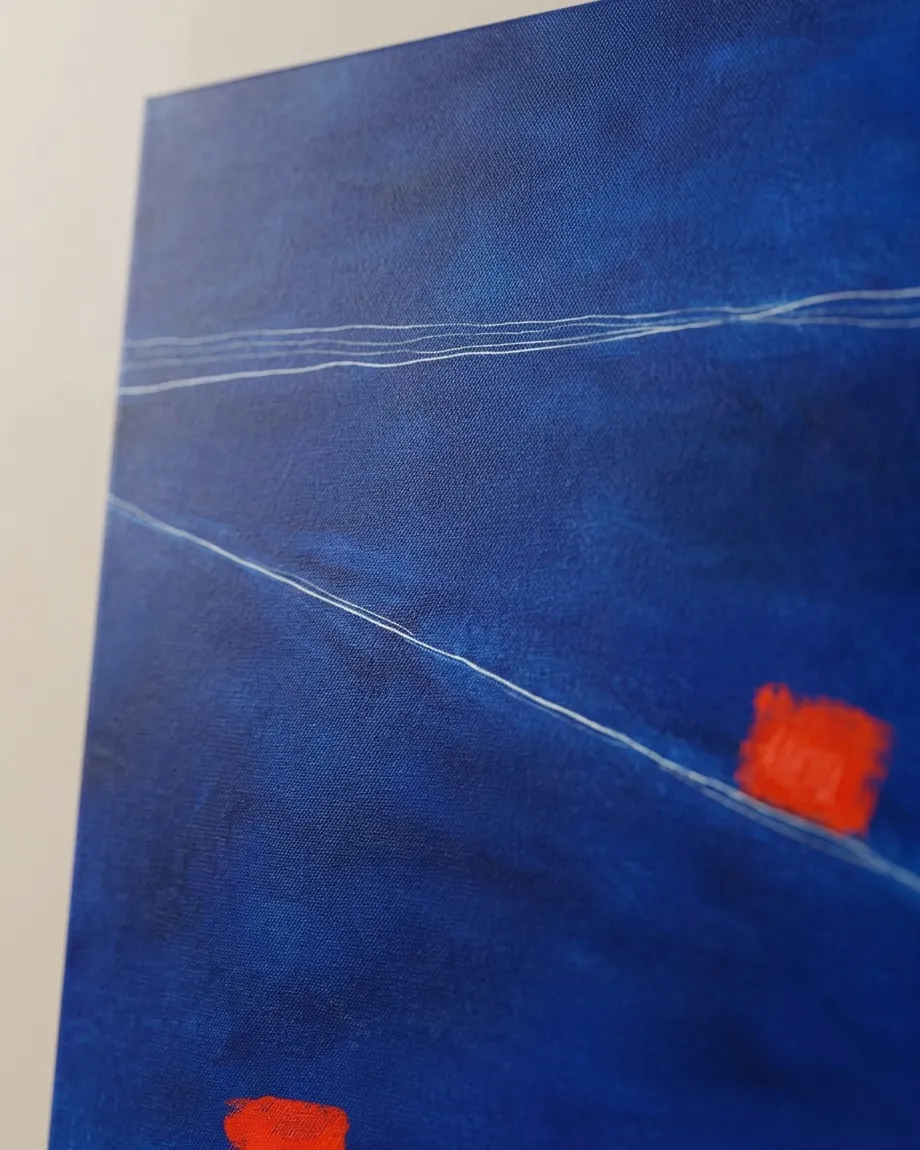
Detail of SUBMERSA by Maurizio Valch | Abstract Blue Painting
The blue first meets the gaze as a bodily condition: it expands the chest and, at the same time, withdraws the floor. It does not offer a shore on which to rest; it maintains a distance that is not emptiness, but thickness. Before the lines appear, even the rectangle seems to have forgotten it has edges. The vertical surface does not let itself be read from top to bottom: it forces one to breathe within it.
A pale strip crosses this field and alters the pressure. What seemed like an horizon does not divide sky and water, nor does it establish a reassuring measure; it barely trembles, multiplies, deviates. It has the fragility of something that would wish to order an extension too large with an almost ridiculous authority. It could be a seam, a wave, a thread stretched between two zones that refuse to separate. In crossing it, the blue is no longer a single surface: it acquires layers, delays, depths that do not coincide.
I stand before the painting and feel that the blue has moved away from me without leaving. I look at the lines and cannot decide whether they pass along the surface or come from behind, as if the painting had kept a distance that does not belong to me. The red shapes do not quite become things for me: they appear with a presence too concrete and yet they do not let themselves be reached. I do not know if they are stopped, if they have just arrived, or if they have been waiting a long time for someone to look at them.
Baruch Spinoza was a philosopher who imagined beings not as separate islands but as modes of a single, infinite nature. His thought forces us to look at the four reds not as visitors deposited upon the blue, but as local variations of its very extension: concentrations, changes of intensity, points where a continuous matter suddenly becomes denser. It also makes the line suspicious: perhaps it cuts nothing, perhaps it only makes visible that the blue does not possess a uniform intensity.
But the red resists that continuity. It does not melt; it insists. One of the small reds seems to be playing a role too dramatic for its size, and this slight insolence prevents everything from becoming a single blue breath. It does not fall, though it could. It does not float, though it seems to have learned something from water. A child's question remains trapped under the first pale strip: if the painting is turned, do the reds have to cross the lines like fish through a net, or do the lines turn over with them?
Further down, the diagonal changes the scale. It no longer seems like an horizontal border, but an inclination that pushes the entire field toward a lateral depth. The former horizon-line then becomes a poorly closed seam: it does not separate two worlds, but lets a pressure escape between them. The blue tenses on both sides; the reds seem to approach that tension without entirely obeying it.
Cindy Sherman is an artist who has used her own appearance to show that every image can be a staging, a mask, and a question about who is looking. Under this suspicion, the reds begin to behave differently: are they posing? Are they acting for someone? Are they characters refusing to show their faces? Are they proof that even the landscape can disguise itself? Where continuity wanted to absorb them as modulations of the blue, a scene appears: four irruptions rehearsing their entrance and their exit, perhaps with no audience, perhaps sustained precisely by the gaze that seeks to recognize them.
I cannot entirely accept that those reds are only the same altered matter, but neither can I say that they are characters waiting for a name. When the painting stands before me, both possibilities get in each other's way, and that discomfort matters more to me than an answer. I feel that the lines could sustain them, though they could also be losing them; I feel that the blue contains them, though at times it seems it is they who force the blue to deepen. What I did no longer fits entirely into what I can assert about it.
The diagonal continues to descend, making the very act of looking uncertain. If there is a map, it does not indicate a route. If there is a score, it does not establish a tempo that can be followed. If there is a wound, it does not offer a single body to which to attribute it. The pale lines graze each other, depart, reappear as edges that fail in their task of containing. The blue does not surround the red shapes: it learns from their interruptions a new way of extending.
In the end, the four appearances are neither above nor below, near nor far. They seem like small performances of color against a surface that would wish to be impersonal, moments in which a matter rehearses having a face without coming to possess it. The lines no longer cross the painting: they keep it suspended, as if the entire blue depended on those pale strokes in order not to finish falling toward a depth that still has no name.
- Original artwork
- SUBMERSA
- Actual dimensions
- 31.5 × 47.2 in / 80 × 120 cm
- Presentation
- Digital contextual visualization
Context references
abstract painting close up · acrylic and oil texture · blue and red artwork · maurizio valch artist · contemporary art textures · abstract detail shot
About this visualization
This visualization places the artwork within an architectural context to help collectors and viewers imagine its presence in a real space. It is an interpretive reference, not an exact reproduction: the original work remains the sole authority for scale, color, surface and material presence.