Context study / SUBMERSA
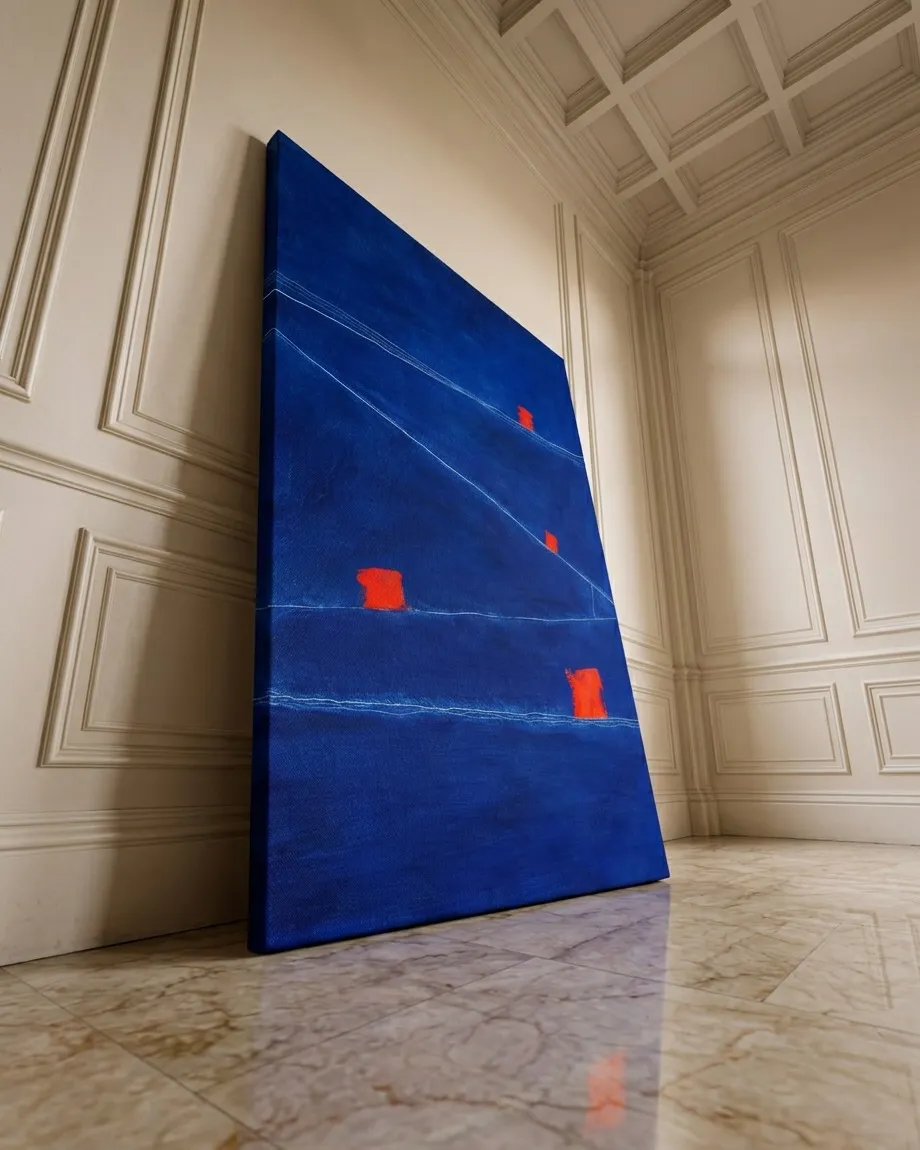
SUBMERSA Blue Abstract Painting - Decoration in Classic Living Room
High line: signal from a distance
The first red shape appears far away, suspended toward the upper part of the blue field, near a line that cannot quite decide whether it is rising, retreating, or falling very slowly. It does not arrive like a flag. Nor as a warning. It is too small to govern the blue and, yet, forces us to measure it again. Until then, the field might have seemed a continuous surface, a vertical extension where pale lines essay horizons that separate nothing. With that red, the extension acquires scale: there is a here, a further up, a further down, a distance that is perhaps not traversable.
Luis Buñuel was a filmmaker capable of making ordinary logic unsettling through unexpected images, cuts, desires, and associations.
Anna Halprin was a dance and performance artist who turned the body, improvisation, and the environment into forms of knowledge.
From the first sensibility, this is not offered as a landscape. It seems like a film shot that has lost its plot and preserved only its accidents: a large blue area, lines that could be the edges of a vehicle-less road, erased subtitles, trajectories of something that went out of frame. The first red invades that plane with an uncomfortable mixture of comedy and threat. It has something of an object that has arrived too late to a scene that no longer knows what it was prepared for. It could be a stumble of the image. It could be the seam through which another film enters.
But the other sensibility refuses to remain seated before the scene. The line is not just looked at: it is tested with the feet. The wide diagonal demands tilting one's weight to one side; the two high, nearly parallel lines seem to ask for a held breath, as if the torso had to remain between them without touching them. The distant red ceases to be a visual interruption and becomes a possible physical position: the exact point from which someone might stop before losing balance.
I expected the blue to organize a calmer surface, but it opened up as a distance that does not allow itself to be measured. The lines did not entirely obey either: every time they seemed to lead me in one direction, they made another depth visible. The red at the top remained apart from me, even though it was within the same painting; I do not know if I placed it there or if it was the one that began to mark me from afar.
The expedition does not advance toward that red to recover it. It advances because the red has already modified the conditions of rescue. A horizon, here, ceases to be the line dividing sky and earth. It becomes an incomplete instruction: do not lean too hard; keep going, but do not go straight; keep a minimal reserve of air.
Change of course, without a coast
The second red appearance is somewhat lower and to the right. It does not occupy a precise intersection, but it seems to disturb the curve of a line shifting across the blue like a route that has forgotten its destination. If the first red was at a distance, this one creates a problem of orientation. The pale lines duplicate, separate slightly, approach each other again. There is one that continues almost horizontally; another tilts more decisively; another seems the edge of an enormous shape that never manages to close.
Which of those lines would be the safest route to approach the second red?
The question becomes absurd as soon as it is formulated, because no line protects. All promise conduction and, at the same time, make the depth of the blue more visible. The route is not a ground: it is that which makes it evident that ground is missing. The filmmaker might insist that this second red shape is a visual accident, a small montage intrusion placed to make the eye suspect continuity. The body artist would answer no: it is a necessary pause, a minimal station to avoid falling to the side of the image.
The painting contradicts both. The red does not seem to rest on the line nor float independently of it. It is in a stranger relationship: the line passes close, but does not support it; the red interrupts, but does not dominate. Neither explains the other.
It is worth doing a brief test. Mentally cover the four red shapes for a few seconds. Without them, the lines stop looking like routes toward something and begin to act as folds of unstable orientation: the diagonal becomes longer, the horizontals more uncertain, the bottom edge more distant. The blue is not left empty; it is occupied by a series of decisions that are not quite made.
Then, return the reds.
They can no longer be seen as mere chromatic accents. Each alters the reading of nearby lines. The second, above all, seems to have displaced the curve: it is not placed at the end of a path, but makes the path seem to have bent to avoid it.
Left pause: a thing that does not fall
The third red shape appears further to the left, roughly in the mid-lower band, next to a line that crosses the painting with a barely undulating obstinacy. It is the most difficult presence to look at from a distance because it disrupts the distribution of forces: until now, the high and right reds could organize a rise or an escape. This one introduces a counterweight, a small but sufficient weight for the painting to stop tilting in only one direction.
Who left that little red piece sitting on the line if there is nothing underneath?
That question suddenly shifts the adult vocabulary. "Composition," "tension," or "contrast" are no longer very useful. There is something more elemental: the suspicion that the shape does not fall because the line, though thin, has decided to take charge of it. Or because the blue is not a background, but a material of orientation capable of supporting that which seems to have no support.
Here dance has an advantage over the cinematic shot. To inhabit this zone, the body would have to perform a minimal movement: loosen the knees, shift the weight toward the side that seems least secure, not fix the gaze on the red but let the lateral line brush against it. The third red would not be an observed thing. It would be a position from which to begin again: a support that does not guarantee rest, but allows a change of direction.
The filmmaker, however, would remain suspicious. He would see a small insolent presence, almost a comic interruption: something that has slipped into a too-solemn scene and, precisely because of that, announces a threat. That red shape seems to say: the blue is not invulnerable. A minimal alteration is enough for the whole scene to lose its discipline.
I do not entirely recognize in those reds either an accident or a rest. After looking at them alongside those lines, they have acquired a will I do not know how to name. They do not seem to move forward, but neither do they accept staying still; they do not seem to look outward, though sometimes I feel the painting continues to look at something I cannot see.
The third object does not ask to be rescued. The expedition reaches it and discovers that the operation was poorly framed. There is no visible shipwreck, no victim, no shore from which to extract a shape. The red does not wait for a hand. Rather, it forces the hand to revise its own idea of help.
Under the last curve
The fourth red irruption is situated at the bottom, toward the right, next to the lower line that crosses the painting and seems to approach the edge without becoming a boundary. It is the red closest to the ground of the image and, therefore, the least stable. It could be a fragment detached from the previous ones. It could be a late response. It could be the first red seen after having crossed all the blue.
It is best not to decide.
The bottom line reappears transformed. At the beginning it seemed a light, almost horizontal mark, a possibility of support. Now it is recognized as a separation that does not separate: it delimits a band without isolating it, accompanies the red without receiving it, borders a depth that becomes more evident the closer it seems to be. The expedition descends to that point and no longer knows if it is advancing or retreating.
The blue does not allow itself to be converted into night, water, or distance either. It is a condition that forces an adjustment of body and gaze without offering a stable equivalence. In this condition, the reds do not save the blue field from its continuity; they make it more demanding. They make each line perceived as a postponed decision, as an instruction that begins to be erased while it is still being followed.
Next to the fourth red, the bottom line does not quite touch it. Between the two remains a minimal, active, almost imperceptible separation: a blue space where something has not yet chosen whether to support, to expel, or to curve once again.
- Original artwork
- SUBMERSA
- Actual dimensions
- 31.5 × 47.2 in / 80 × 120 cm
- Presentation
- Digital contextual visualization
Context references
elegant abstract paintings · contemporary art classic living room · luxury decoration with art · vertical format artworks · marble floor decoration ideas
About this visualization
This visualization places the artwork within an architectural context to help collectors and viewers imagine its presence in a real space. It is an interpretive reference, not an exact reproduction: the original work remains the sole authority for scale, color, surface and material presence.