Context study / SUBMERSA
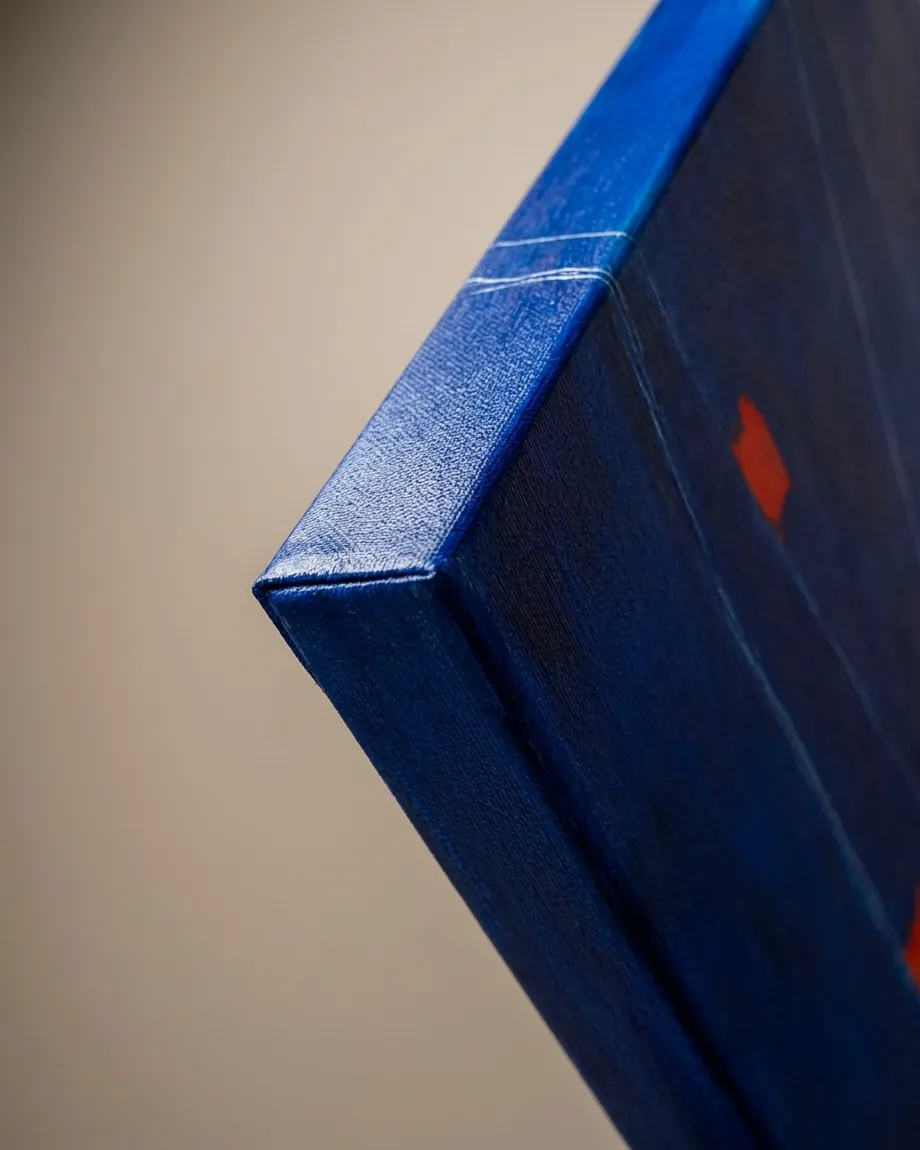
SUBMERSA Blue Abstract Canvas Detail - Texture and Edge
Blue first occupies the capacity to orient oneself. It offers neither horizon nor ground with certainty: it seems to expand, but also to draw near until it acquires weight, like a matter that cools distance. A pale line attempts to cross it. Then another. They are thin, undulating, insufficient to establish a stable route. Each seems to promise a shore and, upon bending, leaves the promise suspended.
Louis Kahn was an architect who thought of buildings as conversations between light, matter, silence, and space. In SUBMERSA, I would like to read those white lines as the floor plan of an architecture that has not yet decided to rise: walls without an enclosure, corridors leading to no room, levels capable of sustaining a liquid building. But the blue does not permit this division. It does not behave like the void between two walls. It weighs. It presses. It makes each line seem less like a division than a precaution taken within a mass.
The lines continue, though not exactly. One becomes a coastline; the next instant it looks like a seam. Another flattens and could be the mark of a held breath. If they were wounds, there would be no visible body to bear them. If they were evacuation routes, the place fled from would be missing. If they were water levels, there is no height to order them. Cartography has lost its legends and retains only the detours.
I, Maurizio Valch, discover that a painting can continue to shift after having seemed still. I cannot fix a route in that blue without another curve contradicting it, nor maintain a distance without the surface making it resistant. I see that small presences, at first almost dispensable, end up imposing a direction I had not foreseen.
Then a red appears. Small. Compact. It does not enter as an explanatory sign; it interrupts the tranquility with which the eye wished to measure the blue. There are four, but each modifies the amount of space surrounding it. The field is not reduced: it becomes more difficult. A red can seem a stationary object, a body without scale, a too-silent warning, or a measurement error left within the plane.
A child’s question alters the journey: why do those four reds not leave a blue shadow beneath them? The question forces us to abandon the idea that they simply float. Perhaps they are not on the blue. Perhaps the blue is not underneath. Perhaps that absence of shadow is precisely what keeps them separate from any recognizable landscape. Since then, each white line must check if it passes near them, if it avoids them, if it attempts to hold them, or if it arrives too late.
Take a physical test: take a step back from the image, tilt your head slightly to one side, and release your breath slowly while following a white line with your eyes. Do not allow your gaze to jump to the nearest red. The detour will arrive anyway. You will notice that the eye tries to descend through the blue, while the reds, without falling or rising, force a correction of breath and distance.
Rembrandt was a painter capable of making light reveal not only faces but doubts, intimacies, and zones of human shadow. Here he approaches the reds as events of bodily light: not symbols of passion, nor figures available for a story, but apparitions that seem illuminated from within or survivors of an excessive darkness. However, the surface does not grant him the relief of a face. The red preserves its distance. It does not blink. It does not yield an expression.
Kahn attempts to give them architectural scale. He converts them, for an instant, into minimal towers, sealed chambers, access points to a sunken structure. Rembrandt does not accept that stability: they are too vulnerable to be buildings. They have an exposure that no construction should tolerate. Kahn replies that perhaps they possess no interior and that their function remains unknown. That possibility is harder: something can order an entire space without keeping anything inside.
The blue opens again.
Halfway through the journey, Kahn stops measuring. One of the red shapes makes him fear losing a presence if he converts it too quickly into a module, volume, or threshold. He counts the gaps between line and red like someone listening to a breath that might stop. Rembrandt, on the other hand, needs to measure. He no longer seeks intimacy in those interruptions: he calculates how much blue each requires, how much space must remain free so that it does not become a character, how much distance an apparition can sustain without dissolving.
I, Maurizio Valch, recognize that the painting has acquired a logic I do not control. I do not entirely share the desire to turn the reds into bodies or buildings, because a zone of them remains unknown even to me. I remain apart from that insistence: the blue receives them and, at the same time, does not fully admit them.
Only late does the title appear: SUBMERSA. Not as an answer, but as a crack opened beneath the reading. What is submerged here? Perhaps the reds, though they resist sinking. Perhaps the routes, which continue without finding a surface. Perhaps Kahn's architecture, unable to raise walls against that density. Perhaps the interiority Rembrandt sought and which the plane keeps at a distance. The viewer, too, may be submerged: not within identifiable water, but within a blue that has ceased to be a background.
The four interruptions no longer fit the category of details. They alter the weight of the lines, shift the edges, disrupt the proportion of the 80 by 120 centimeters. The minuscule does not defeat the vast: it forces it to redistribute itself. A red does not occupy much space, but it turns its surroundings into an extension that must justify why it remains blue.
There remains, near one of those interruptions, a white line that at first seemed only a lateral stroke. Now it does not quite encircle the red nor move away from it: it curves at a minimal distance, as if it were still learning what kind of thing it cannot leave behind.
- Original artwork
- SUBMERSA
- Actual dimensions
- 31.5 × 47.2 in / 80 × 120 cm
- Presentation
- Digital contextual visualization
Context references
close-up of oil on canvas · blue abstract painting texture · decorative painting edge · painting technique details · maurizio valch strata
About this visualization
This visualization places the artwork within an architectural context to help collectors and viewers imagine its presence in a real space. It is an interpretive reference, not an exact reproduction: the original work remains the sole authority for scale, color, surface and material presence.