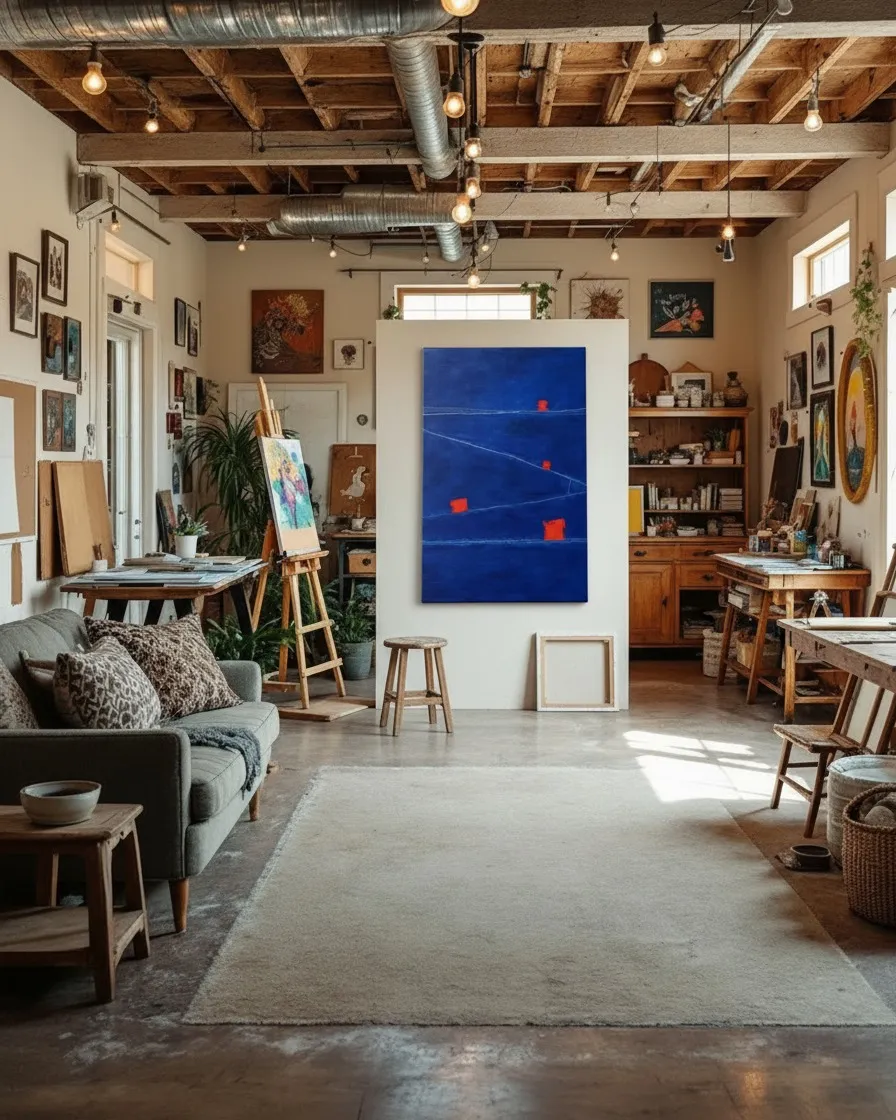
Context study / SUBMERSA
Maurizio Valch - SUBMERSA in Industrial Studio Living Room | Original Art
Cover one of the red marks with a finger—whichever you prefer—for a few seconds. Do not look at your finger: watch what the blue does around this temporary absence. Perhaps it will seem more continuous, more compliant, even larger; perhaps it will suddenly lose its strange depth and become a surface too self-assured. Remove your finger. The red returns, minimal and unapologetic. Now the distance has changed.
The surface yields no horizon. It offers itself as a vertical field of blue that oscillates between near layers and backgrounds that seem to recede without moving. There are areas where the color thickens, others where it thins, letting a lighter vibration pass through, as if the gaze encountered a held pressure instead of an open space. The upper horizontal line, nearly straight yet uneasy, introduces the suspicion of a limit. But it does not quite become a shore, an edge, or a ceiling. It vibrates too much to close anything off.
The first red mark appears near that limit. Small, somewhat late, like a note that arrives when the phrase had already decided to continue without it. It does not occupy much, yet it interrupts the proportion: the blue ceases to be merely large. It has to accommodate itself around something that does not fit its scale.
Thelonious Monk was a jazz pianist and composer who turned pauses, displacements, and unexpected notes into a form of musical thought.
Here he would not find a stable melody. The pale lines do not advance like docile staves: they waver, duplicate themselves, brush against one another, deviate slightly, and reappear at another level, as if each had forgotten the command it was meant to follow. Monk might hear in them a displaced beat, an insistence that never quite settles. And he would look at the first red with affectionate distrust: perhaps it is not a note, but a silence that has acquired a body; perhaps it is a note that refused to obey the blue staff.
But the painting contradicts him. The lines do not seem to improvise on a whim. There is a difficult discipline in their trembling, a depth that refuses to be called freedom. The blue does not open up for something to happen within it: it maintains the pressure, keeps its accidents, lets them survive without fully integrating them.
On the margin of this probing remains an inscription that does not seek to correct the image:
I look at the finished painting and feel that the lines no longer belong to me in the way I expected. They do not seem to traverse a surface: they seem to measure a distance that also measures me. Sometimes I breathe with them; at other times they force me to halt my gaze, as if they had found a direction exceeding any initial intention. The blue resists my desire to fix it, and the reds, so small, neither fully approach nor fully recede.
— approximate descent: where the line begins to tilt —
The thin central line loses its horizontality. It tilts the field.
Or it tilts the viewer.
For an instant, the eye tries to recover its balance. The painting is no longer read from top to bottom or from left to right: a slight torsion is felt, as if the surface were shifting its weight. The second red mark, situated near this displacement, does not arrive late like the first. It gets stuck. Or so it seems. It is a small geological sample that refuses to be dated: it is there, but refuses to occupy a "before" or "after" in relation to the lines.
Charles Lyell was a geologist who learned to read the Earth as a slow history written by small, persistent transformations.
Lyell would follow the lines as if they were strata, minute faults, records of prolonged pressures, or ancient shores displaced without spectacle. He would not seek a single event to explain the blue; he would attend to the almost imperceptible variations, the slight changes in density, the curves that barely depart from themselves. But the reds bewilder him. They do not behave like fossils; they do not establish a chronology; they do not reliably point to an earlier or later layer. They seem to have entered the time of the painting without accepting its rules.
Monk then forces him to listen to the discontinuity: a minimal irruption can shift the entire beat. Lyell returns something slower and heavier: a pause does not necessarily last an instant; it can last longer than a piece of music, longer than the impulse to call it a pause. Between the two, the lines cease to be merely strokes. They become intervals of pressure, silences that have learned to tilt.
Then a child's voice disarms the notebook: "Why don't those tiny reds sink if everything around them seems so deep?"
The question does not ask for representation. It forces one to look again at the physical tension of the painting. The eye leans toward the reds to check if they float, if they are held back, or if they have barely begun to fall. But the blue offers no bottom to fall into. It seems deep without becoming a vessel. The gaze tries to maintain its balance and discovers that it is the reds—not the vast expanses—that manage the weight.
The third mark, lower down, could be a child's signal: a brief gesture saying "here," even if there is no recognizable place to point to. Its imprecise edge confirms nothing. Perhaps it is an indication cast against the vastness; perhaps it is simply something blatantly small and decisive, like a crumb that forces an entire table to be reorganized. The nearby lines do not cross it with indifference. They approach, separate, and seem to reconsider their path.
After the question, the blue can no longer recover the innocence of a continuous surface. Each line seems to have acquired a different responsibility. One is a limit; another, a deviation; another, the trace of slow pressure; another, a way of lingering without stopping. None stabilizes into a single meaning.
I cannot decide whether the reds are freer than the blue or more stubborn. I see them resist any comfortable position: they do not illustrate a depth, nor do they let themselves be turned into domesticated accidents. I also suspect that the painting is not submerged; perhaps it looks from below, and that is why the lines seem to pass above without becoming sky or ground. If there is an orientation, it opens and loses itself at the same time.
— lower down, where the rhythm tears —
The lower-right mark is broader, more torn. It no longer behaves with discrete punctuality. It interrupts the rhythm with a presence that seems to have widened its own difficulty. Monk might hear it as a displaced strike that changes the breathing without resolving it. Lyell might view it as a fracture that does not immediately reveal what pressure produced it or how much time it needs to keep opening.
There is no need to decide whether it floats or weighs. Its strength lies in forcing the blue to surround it differently. Up to this point, the painting could suggest a patient depth, an extension that absorbed all difference. Down there, however, depth seems to meet resistance. Not a victory of red over blue: an alteration of the distance between them.
The initial test makes sense once more. Covering one of the marks was not hiding a detail; it was removing a force of orientation. Uncovering it again does not simply restore its shape: it returns the misalignment that allowed the field to be measured. Each red modifies the time of the blue. The upper one makes something arrive late. The central one suspends a chronology. The lowest one essays a signal without a fixed recipient. The last alters the rhythm as if the surface had made a beautiful mistake and refused to correct it.
The pale lines are still there, undecided whether to lead, separate, or barely brush the reds. Near the bottom, one of them approaches that torn mark and seems to stop before touching it: it remains unclear whether it is about to become a note, a stratum, a signal, a minimal creature, or an error of orientation.
- Original artwork
- SUBMERSA
- Actual dimensions
- 31.5 × 47.2 in / 80 × 120 cm
- Presentation
- Digital contextual visualization
Context references
abstract painting for modern living room · industrial loft style decor · decorative blue and red painting · Maurizio Valch STRATA series · vertical contemporary art piece
About this visualization
This visualization places the artwork within an architectural context to help collectors and viewers imagine its presence in a real space. It is an interpretive reference, not an exact reproduction: the original work remains the sole authority for scale, color, surface and material presence.