Context study / SOL DIVISUS
SOL DIVISUS — Context Study
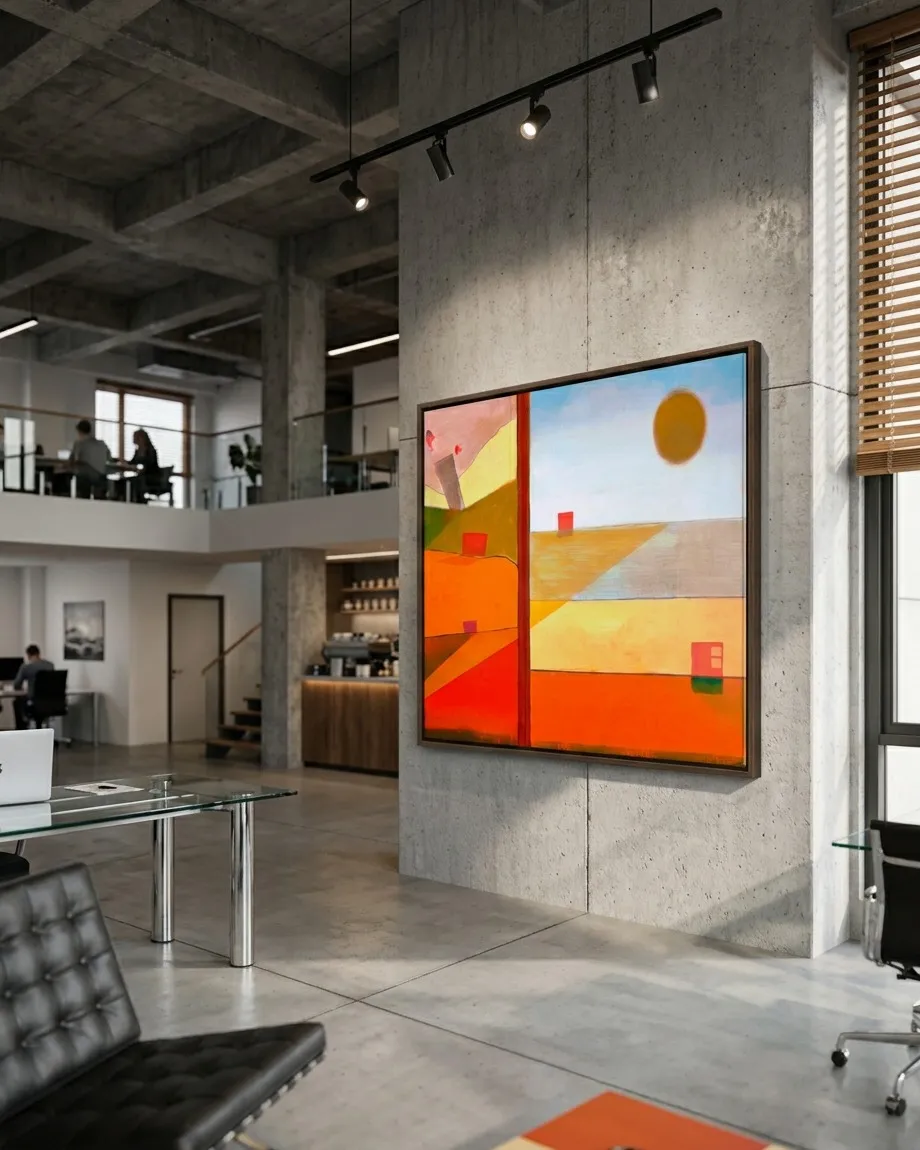
The bluish-grey area does more than break up the yellow: it shifts the weight of SOL DIVISUS towards the viewer. It begins near the right-hand horizon and slopes down towards the lower centre, without taking on the substance of a road or the function of an arrow. That ambiguity is decisive. Against the horizontal fields, which sustain an expansive calm beneath the ochre disc, the plane compels a lateral drift before returning the gaze upward. Maurizio Valch often works with divisions, horizons and elemental forms that hold order and fracture in tension; in this piece, that tension is concentrated in a surface that seems to advance without promising an arrival. The oblique view of the canvas, installed against the concrete of the loft, also makes its object-like thickness perceptible: the diagonal does not open onto an illusionistic background, but asserts itself as a directional cut within a physically close plane.
This direction without a destination finds a restrained resonance in the experience of movement that runs through Valch’s thinking. His travels and walks have distinguished between a route that can be traced on a map and an inner movement whose orientation remains uncertain. The painting does not translate that experience into biography or turn the grey into a psychological emblem; it does, however, allow a similar condition to be felt. The luminous expanse on the right could sustain still contemplation, but the slope introduces a small demand: to follow a deviation, to accept that the eye moves without knowing what it will resolve. The serenity of MARE SOMNIORUM is not undone; it acquires a minimal unease, that of a territory that already contains the possibility of moving away from its own stability.
In “The Keel in the Desert,” Valch imagines travel not as the conquest of a port, but as a suspended passage, freed from the obligation to reach a destination. The essay places SOL DIVISUS among landscapes where crimson blocks interrupt the horizon and safeguard that which should not be exhausted through explanation. From this perspective, the grey plane does not ask to be deciphered as a path. Its effectiveness lies precisely in sustaining an incomplete movement: it directs the gaze without controlling it. The small red block beside the horizon reinforces the suspension; it offers a point of measure and, at the same time, prevents the obliqueness from becoming an open vanishing line. Rather than leading out of the painting, the movement returns to the surface itself.
The affinity with Richard Diebenkorn helps reveal how abstraction can retain the memory of terrain through sloping planes, distances and horizons without describing a recognisable place. In SOL DIVISUS, too, the diagonal makes the chromatic field read as a traversable expanse. Valch departs, however, from a spatiality that can be traversed with relative continuity: the vertical red band divides the atmospheres, the blocks remain isolated, and the dense sun suspends any stable perspective. Within the workspace, amid deep, straight architectural lines, this difference is heightened: the painting does not replicate the functional order around it. It introduces a gentle slope, enough to recall that even stillness may already be shifting.
- Original artwork
- SOL DIVISUS
- Actual dimensions
- 47.2 × 31.5 in / 120 × 80 cm
- Presentation
- Digital contextual visualization
Context references
abstract painting leaning in a studio · framed painting on the floor · SOL DIVISUS side view
About this visualization
This visualization places the artwork within an architectural context to help collectors and viewers imagine its presence in a real space. It is an interpretive reference, not an exact reproduction: the original work remains the sole authority for scale, color, surface and material presence.