Context study / SOL DIVISUS
SOL DIVISUS — Context Study
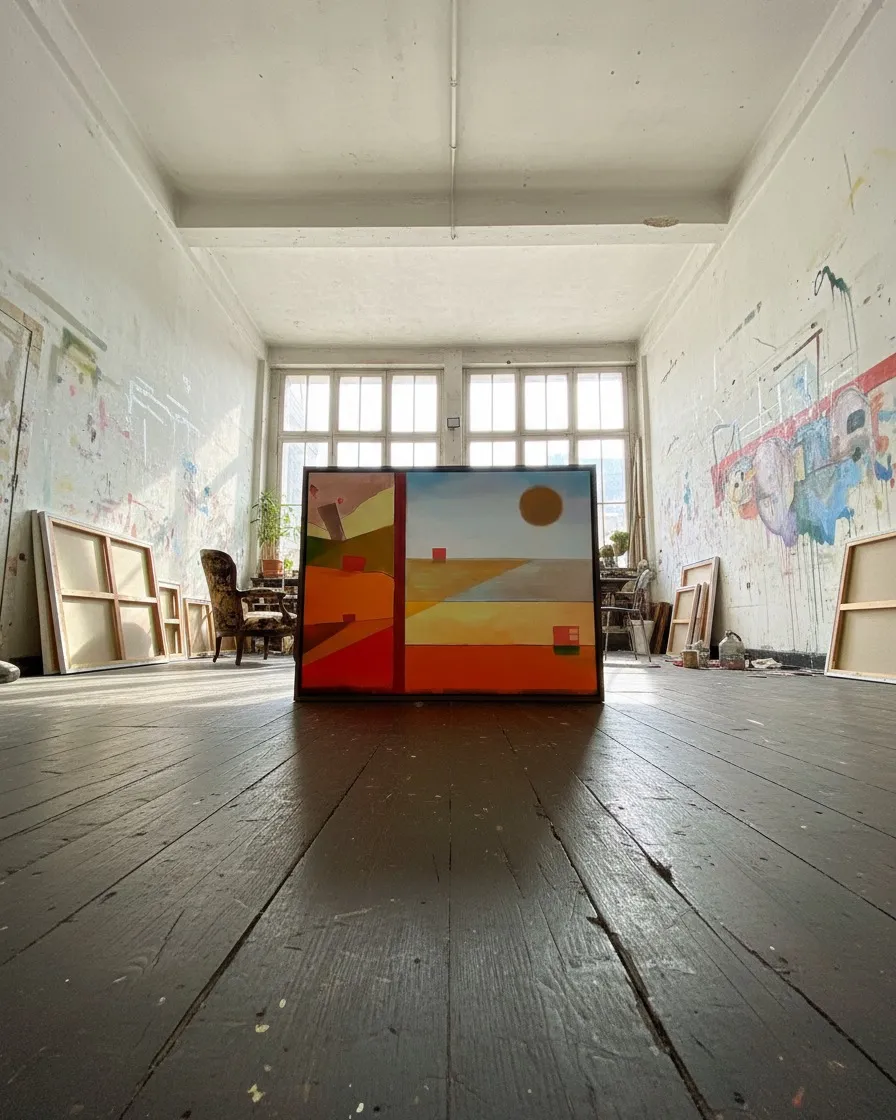
From the floor, the painting no longer offers a comfortable horizon line: the eye rises along the dark floorboards to meet a canvas resting directly on the ground, where the lower red takes on an almost physical density. This position reveals the dual condition of SOL DIVISUS with particular clarity. The pink and blue in the upper section retain an airy openness, yet do not dissolve into distance; they are held in by glazes and by the firm reddish division. In turn, the yellows, ochres and greys suggest ground, light across an expanse, or barely indicated architecture, though their transitions prevent them from becoming stable terrain. Maurizio Valch’s practice is recognisable in this economy of fields, blocks and divisions: it does not describe a place, but organises a territorial experience in which matter retains the memory of its own making.
The low vantage point brings another consequence: the painted ground is not below the viewer, but in front of them, almost at body height. For an artist who has distinguished between a path traceable on a map and an inner movement whose direction is unknown, this shift can be read as a way of suspending habitual orientation. The small red forms appearing on either side of the central band do not establish landmarks or indicate a route; they maintain an uncertain scale within a divided expanse. The distance opened up by the light area on the right could belong to an external landscape, but also to that region of experience in which thought has not yet managed to turn what it sees into a definitive explanation. The painting sustains both readings without requiring one to prevail over the other.
In “From Dream to Territory,” Valch describes MARE SOMNIORUM as a mental expanse in which memory, desire and distance alter the visible; the horizon, he says, both separates and connects. SOL DIVISUS makes this proposition perceptible without illustrating it. The dark vertical divides the two atmospheres, but red reappears on both sides, while the large diagonal plane on the right draws brightness towards a more corporeal zone. Sky and ground exchange their qualities: the upper section carries weight through the opaque presence of the ochre disc, while the lower section lightens through luminous layers. The series does not set dream and ground against one another as successive stages; it allows the dreamlike apparition to retain substance and the terrestrial surface to remain open to suspension.
The affinity with Richard Diebenkorn helps clarify this instability: in both cases, abstract planes can retain a memory of slope, horizon and passage without submitting to landscape description. Valch, however, concentrates the scene in a more severe frontality. The vertical division and isolated blocks do not extend a recognisable territory, but interrupt its continuity and return the gaze to the surface. In the loft, the perspective of the floor seems to extend the incline and the approach towards the canvas, but the painting does not confirm that any destination has been reached. It maintains a distance that may be atmospheric or terrestrial, external or intimate, and whose lack of resolution constitutes its mode of presence.
- Original artwork
- SOL DIVISUS
- Actual dimensions
- 47.2 × 31.5 in / 120 × 80 cm
- Presentation
- Digital contextual visualization
Context references
abstract art for an open-plan office · large painting for a modern office · abstract painting in an industrial interior
About this visualization
This visualization places the artwork within an architectural context to help collectors and viewers imagine its presence in a real space. It is an interpretive reference, not an exact reproduction: the original work remains the sole authority for scale, color, surface and material presence.