Context study / SOL DIVISUS
SOL DIVISUS — Context Study
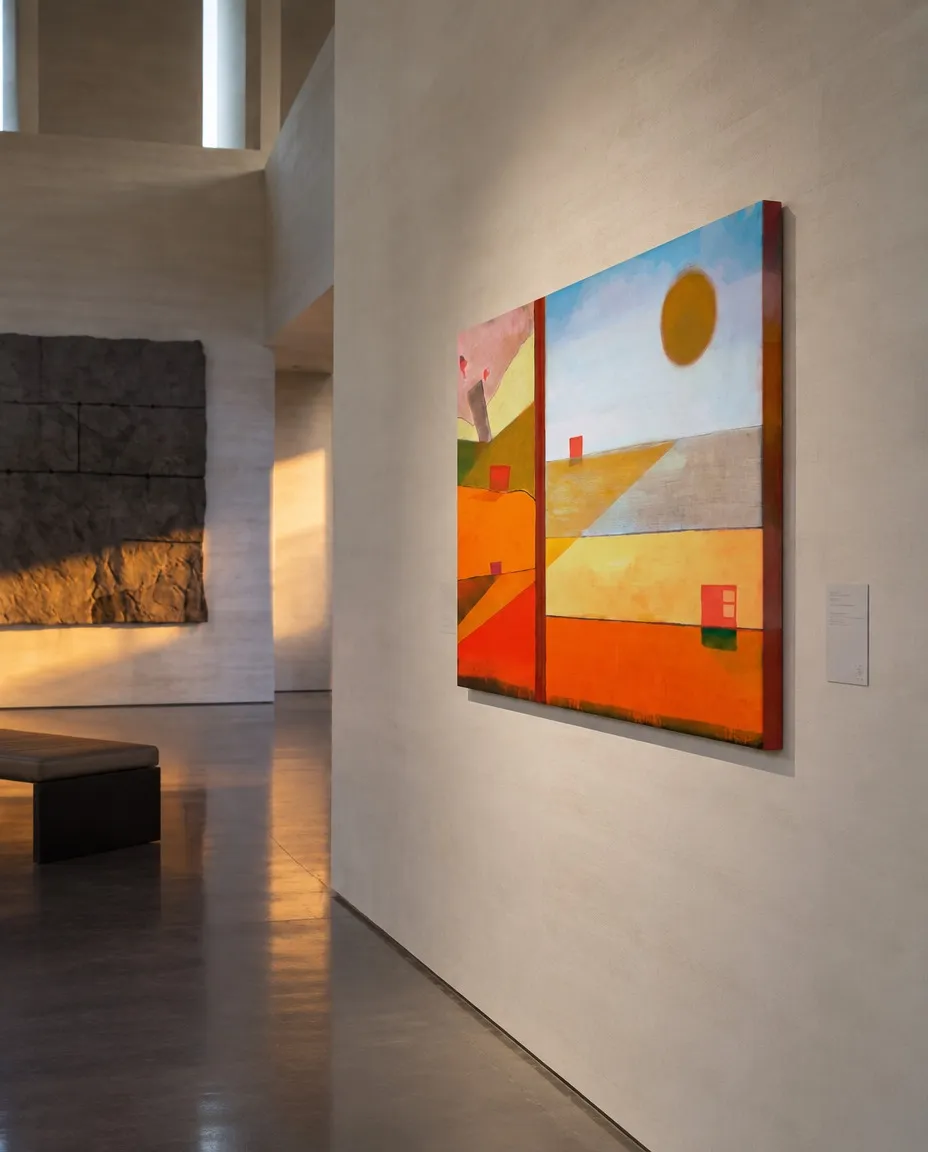
The brightness of SOL DIVISUS does not clarify the place; it makes its indeterminacy more precise. Seen from the right, the canvas retains its condition as an object three centimetres deep, and the reddish vertical band takes on an almost structural weight; it is not a stripe that orders an image, but a plane that keeps two regimes of distance apart. On one side, broken terrain, small volumes, and the oblique form concentrate the gaze; on the other, the watery sky, the extended yellow, and the ochre disc seem to offer immediate orientation. Yet the large diagonal plane and the blocks with no recognisable function frustrate that promise. In Maurizio Valch’s territorial language, fields, horizons, and elemental forms do not illustrate a geography: they establish presences whose relationship remains deliberately unresolved.
This reserve can be read alongside a documented concern of the artist: the tendency of thought to cover a fact with interpretations until it becomes a total problem. The painting does not compel us to decide whether its volumes are architecture, markers of passage, or remnants of a landscape; it first allows us to see their position, scale, and isolation. Nor does the sun provide a key. It illuminates the field without guaranteeing knowledge, just as an experience can become clear before it finds an adequate explanation. From this perspective, the central division does not necessarily describe a psychological fracture: it makes perceptible the distance between perceiving something and rushing to name it.
In “From Dream to Territory,” Valch writes that the horizon both separates and connects, and that light allows the territory to be distinguished without fully revealing it. SOL DIVISUS condenses this condition of MARE SOMNIORUM: the two sides share reds, a distant band, and the same frontality, though they never form a continuous view. “The Keel in the Desert” returns to this resistance to decipherment by considering the crimson blocks as shelters for the invisible, akin to the box in The Little Prince. Critical reading need not transfer that image to every form in the painting; it is enough to notice that the small cube on the horizon and the low architecture in the lower register retain information. Light shows where they are, but not what they are or where they might lead.
An affinity with Richard Diebenkorn helps us recognise how abstract planes can retain a memory of slope, horizon, and passage without becoming descriptive landscape. Yet Valch radicalises the suspension: where Diebenkorn’s territorial organisation often allows relatively continuous visual movement, this painting sets in place restrained obstacles—the vertical partition, the tilted slab, the isolated cubes—that interrupt any stable cartography. In the room, the oblique view confirms this refusal of transparency: the painted edge and the real shadow on the wall restore the canvas’s depth, while the inner sun remains inaccessible. Looking does not culminate in an answer; it may linger in a brightness that still keeps its silence.
- Original artwork
- SOL DIVISUS
- Actual dimensions
- 47.2 × 31.5 in / 120 × 80 cm
- Presentation
- Digital contextual visualization
Context references
large abstract painting in an office · wall art with human scale · abstract painting for an industrial office
About this visualization
This visualization places the artwork within an architectural context to help collectors and viewers imagine its presence in a real space. It is an interpretive reference, not an exact reproduction: the original work remains the sole authority for scale, color, surface and material presence.