Context study / SOL DIVISUS
SOL DIVISUS — Context Study
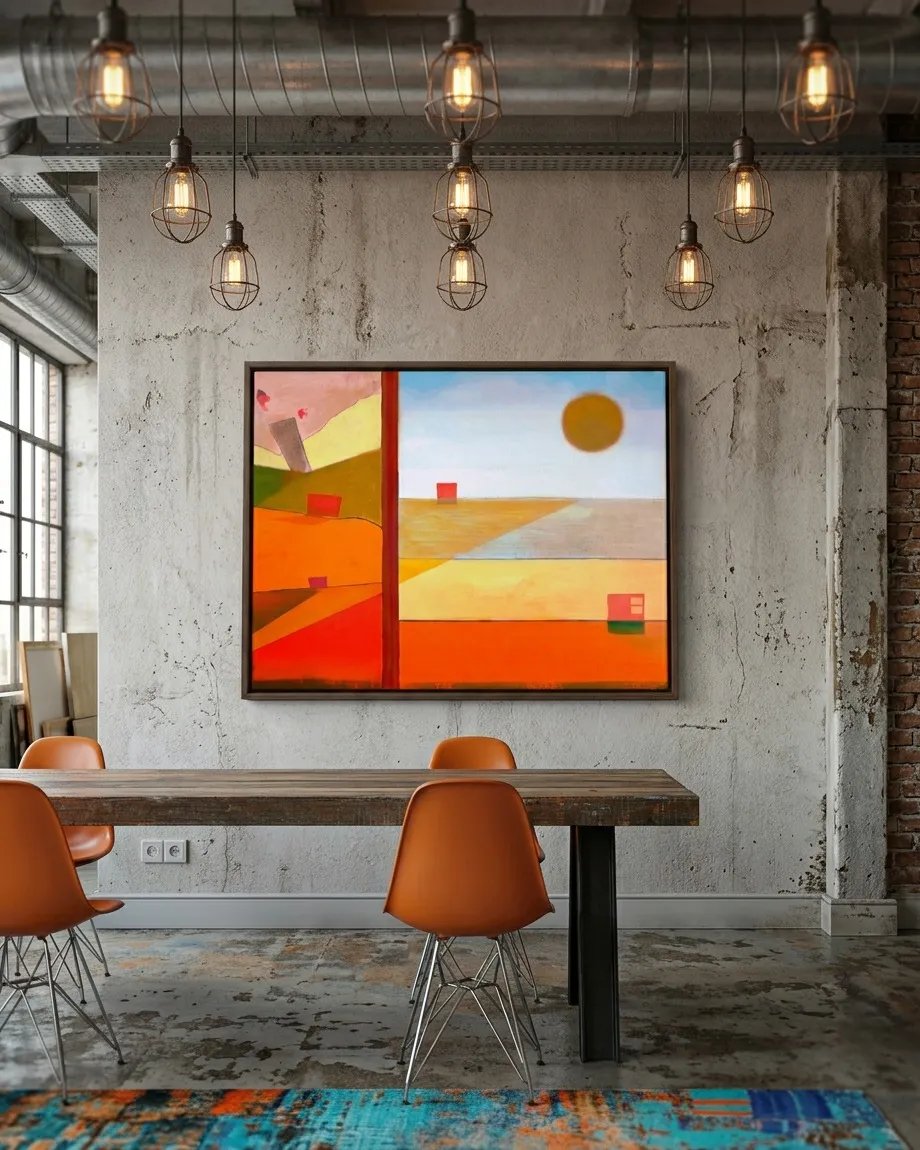
Suspended above the right half, the ochre circle does not open the sky: it makes it denser. Its compact edge and concentrated colour weigh against the pale blues and extended yellow, while the red volumes in the lower register sustain another kind of gravity, closer to the ground. This distribution makes visible a central feature of Maurizio Valch’s language: broad fields, contained horizons, and elementary forms capable of altering the scale of a territory on their own. The reddish vertical band that divides the canvas intensifies the effect; it does not enclose the disc, but prevents the brightness on the right from becoming an untroubled promise. Variations in layering and brushwork keep the planes open, like surfaces that have accumulated time rather than becoming decorative backdrops.
Before this elevated mass, the eye is given no reassuring direction. The artist has distinguished between the outer path, traceable on a map, and an inner movement whose direction is unknown; SOL DIVISUS makes that difference perceptible without illustrating it. The sun may be read as a presence that orients, but its opacity also holds back the need to explain everything. Below, the small red blocks seem neither to advance toward it nor to be illuminated by it in any conclusive way. The experience thus approaches one of the artist’s persistent questions: how much thought adds to the visible fact. The disc is there, suspended and dense; the painting allows attention to rest on that presence before turning it into an emblem, a destiny, or an answer.
In “From Dream to Territory,” Valch describes MARE SOMNIORUM as an expanse where memory, desire, and distance alter what is visible, specifying that suspended lights do not fully reveal what they touch. SOL DIVISUS carries this intuition into a particularly restrained organisation: the bright sky does not dissolve the strangeness of the ground, but makes it sharper. “The Keel in the Desert” explicitly links this work’s crimson blocks with a shelter for the invisible, resistant to the impulse to translate. From this writing, the ochre and reds do not form a closed allegory: they produce an economy of still presences. Between the weight above and the settled weight below, the territory is held in suspension, like a dry harbour where light has ceased to signify arrival.
The affinity with Nicolas de Staël helps identify how a chromatic mass can oscillate between architecture, landscape, and physical presence. Yet where De Staël’s colour often condenses a continuous spatial vibration, Valch introduces divisions and isolated blocks that interrupt that continuity. The presentation reinforces this singularity: installed at a domestic scale on the rough wall of the loft, the canvas becomes neither an encompassing landscape nor a window. The table and chairs establish an everyday distance from which the disc retains its improbable height; the room’s warm lamps do not illuminate it, but instead make clearer that its ochre belongs to another source and another gravity. Thus, the sphere measures the place without ever fully belonging to it.
- Original artwork
- SOL DIVISUS
- Actual dimensions
- 47.2 × 31.5 in / 120 × 80 cm
- Presentation
- Digital contextual visualization
Context references
abstract art for an industrial office · large painting for a concrete wall · abstract painting for a contemporary office
About this visualization
This visualization places the artwork within an architectural context to help collectors and viewers imagine its presence in a real space. It is an interpretive reference, not an exact reproduction: the original work remains the sole authority for scale, color, surface and material presence.