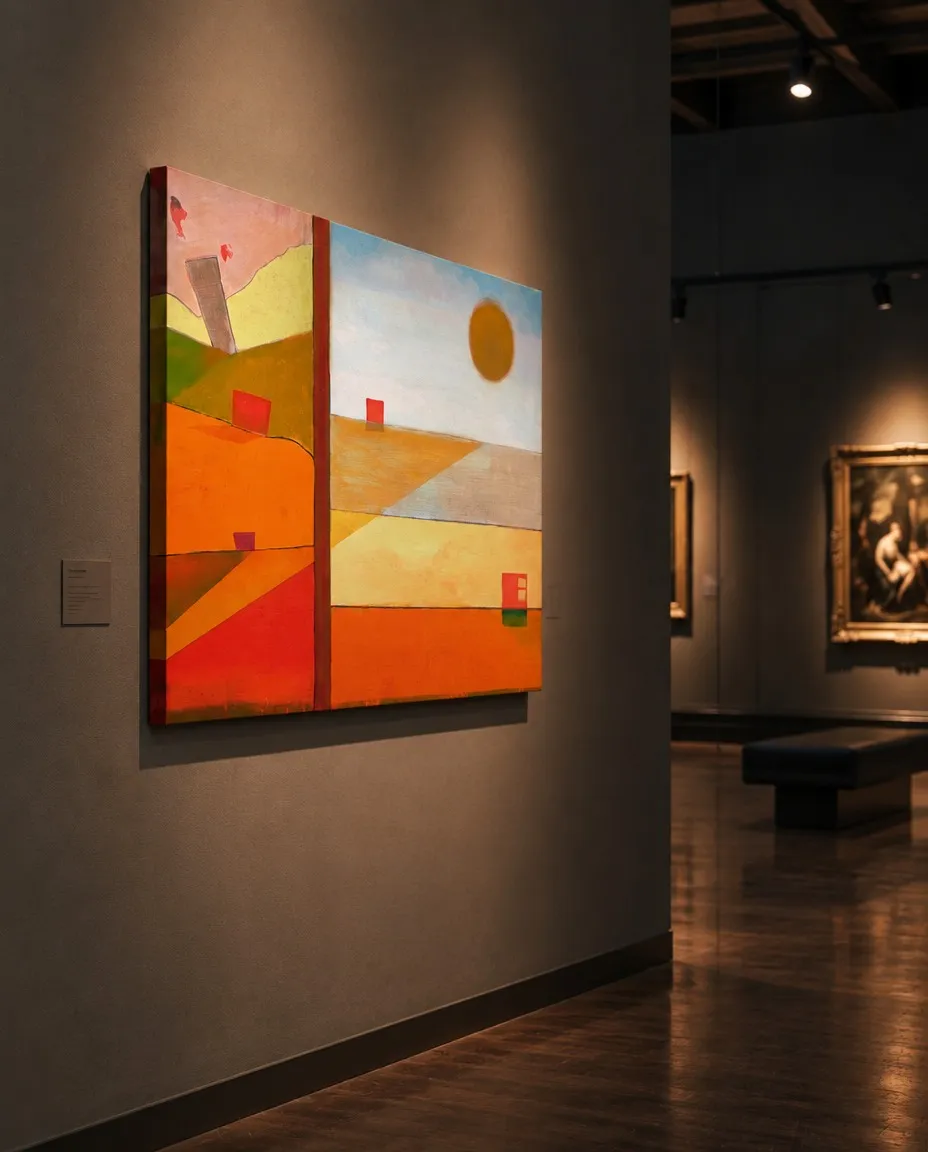
Context study / SOL DIVISUS
SOL DIVISUS — Context Study
In the upper-left quadrant, the eye catches on a grey form that never quite settles into the green and yellow slope. Set against the broadly distributed fields and the red blocks, whose geometry retains a certain stillness, this slab introduces a physical direction: it tilts the ground and concentrates the possibility of descent. It does not describe a recognisable structure; it acts as an elemental presence whose mass alters the reading of the entire left-hand side. This friction belongs to Maurizio Valch’s territorial language, made of divisions, horizons and monolithic forms that suspend the certainty of landscape. The oblique view of the presentation adds something decisive: the three-centimetre-thick canvas stands away from the wall, confirming that this pictorial incident belongs to an object with a body, rather than to a weightless image.
The incline may also be read through an experience of movement that runs through the artist’s thinking. His paths have distinguished between a route that can be traced on a map and an inner movement whose direction is not known in advance. In SOL DIVISUS, the slab offers neither an itinerary nor a destination; it makes palpable the moment before the body finds its footing, when a slope requires an adjustment of posture. This relationship is interpretative rather than allegorical: the form remains a grey patch set between planes of colour. Yet its position allows the dreamlike landscape of MARE SOMNIORUM to cease being merely a contemplated distance and to approach an experience of resistance, balance and attention.
In From Dream to Territory, Valch writes that the blocks and divisions in his early series are signals rather than closed symbols: elements that allow exterior space and inner dimension to coexist. The slab in SOL DIVISUS retains that ambiguity, although it neither rises like a stairway nor asserts itself as a vertical monolith. It veers aside. The defiance of the slope makes the scope of this gesture more precise: here, the incline appears as a refusal of the rectilinearity that orders and measures space, and as the bodily condition of all forward movement, made of controlled falls. The painting does not illustrate that later reflection; it nevertheless anticipates a related question. What happens to a territory when the slightest obliquity is enough to remove its apparent stability?
A specific affinity with Richard Serra helps explain why this small form may carry more weight than its size suggests. In certain works by the sculptor, an inclined mass compels us to sense space through gravity and the position of our own bodies. SOL DIVISUS transfers that pressure to the pictorial plane: there is no steel or autonomous volume, only a grey form inscribed within an expanse of colour. It is precisely in this that Valch departs from a literal sculptural experience. The slope does not invade the room; it remains held within the surface, while the lateral approach makes the canvas’s actual depth visible and returns to the viewer the sense that looking also means finding a point of support.
- Original artwork
- SOL DIVISUS
- Actual dimensions
- 47.2 × 31.5 in / 120 × 80 cm
- Presentation
- Digital contextual visualization
Context references
abstract painting in an exhibition space · abstract artwork in a gallery · contemporary art on a light wall
About this visualization
This visualization places the artwork within an architectural context to help collectors and viewers imagine its presence in a real space. It is an interpretive reference, not an exact reproduction: the original work remains the sole authority for scale, color, surface and material presence.