Context study / SOL DIVISUS
SOL DIVISUS — Context Study
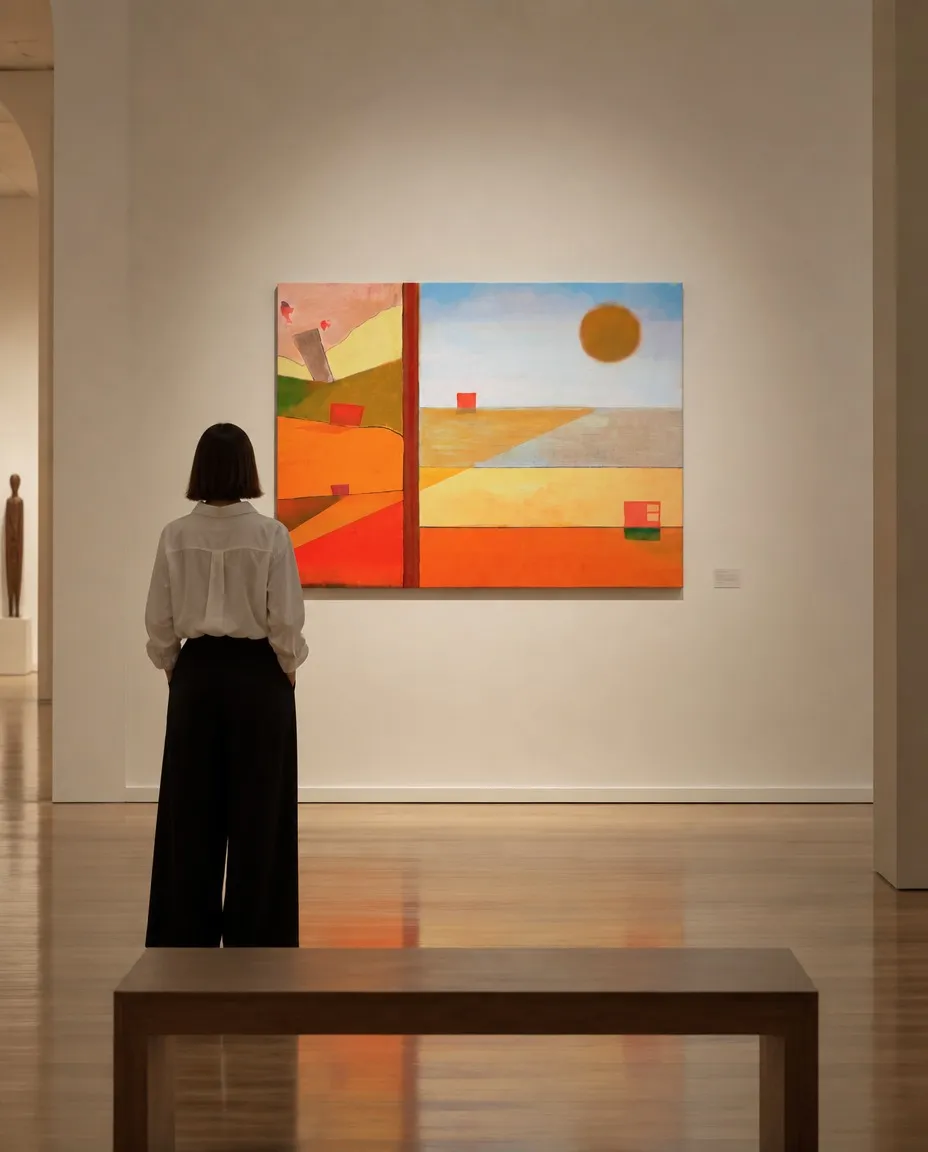
Its frontal presentation does not turn SOL DIVISUS into a grid; rather, it makes more evident how much adjustment, drift, and resistance its order contains. Before the canvas, the horizontal lines, the reddish vertical band, and the broad lateral planes can be clearly measured; the centred camera and uncluttered wall heighten this almost architectural condition. Yet the dividing column does not maintain an absolutely constant width, the horizon is interrupted, and the transitions between yellow, blue, and orange retain the pulse of layers and brushwork. This coexistence corresponds to Maurizio Valch’s documented language: expansive fields and territorial divisions constructed through a surface that also records overlays, reductions, and material variation. The structure does not conceal its making; it remains exposed as a decision that must coexist with what pigment never fully submits to.
This lack of obedience introduces a perceptual experience before it introduces a symbol. The viewer may follow the partitions as one tries to find one’s bearings in a territory, though every slight undulation returns the gaze to the physical fact of a worked surface. In Valch’s thinking, memory and experience do not constitute a smooth archive or a definitive explanation of the visible; his interest in distinguishing fact from interpretations offers a fruitful affinity with this painting. Geometry provides points of orientation, but it does not permit the place to be closed off by a single reading. Between the sloping ground on the left and the more open expanse on the right, the painting makes it possible to sense that ordering an experience may be necessary without thereby making it entirely manageable.
The essay “From Dream to Territory” places MARE SOMNIORUM in a space where the horizon separates and connects at once, and where forms do not fully belong to the landscape. SOL DIVISUS condenses this condition into a frontal organisation: the dark axis appears to distribute two registers, but the reds recurring on both sides—a low block, a distant cube, a small architectural form—deny any absolute separation. The text insists that the dream does not disappear when later series acquire greater structure; it remains sedimented. In this work, that superimposition can be read formally: the clarity of the fields on the right does not erase the glazes or the irregularity of the contours, and the order of the planes retains something provisional, like an architecture still traversed by distance and memory.
The affinity with Barnett Newman may clarify the decisive role of a vertical division within broad fields, but it also defines Valch’s singularity. In Newman, a linear intervention can intensify the tense unity of a chromatic field; in SOL DIVISUS, the reddish band has thickness, variation, and an almost earthly presence. It does not act as a pure sign set against a homogeneous expanse: it separates, absorbs layers, and allows itself to be affected by the edges it organises. Rather than the clean division of an ideal partition, Valch retains a measure vulnerable to matter. The gallery provides the distance needed to recognise the architecture of the whole; the painting, however, retains enough deviations to prevent that order from ever becoming a closed law.
- Original artwork
- SOL DIVISUS
- Actual dimensions
- 47.2 × 31.5 in / 120 × 80 cm
- Presentation
- Digital contextual visualization
Context references
large abstract painting in a museum · horizontal painting at human scale · contemporary art in a museum gallery
About this visualization
This visualization places the artwork within an architectural context to help collectors and viewers imagine its presence in a real space. It is an interpretive reference, not an exact reproduction: the original work remains the sole authority for scale, color, surface and material presence.