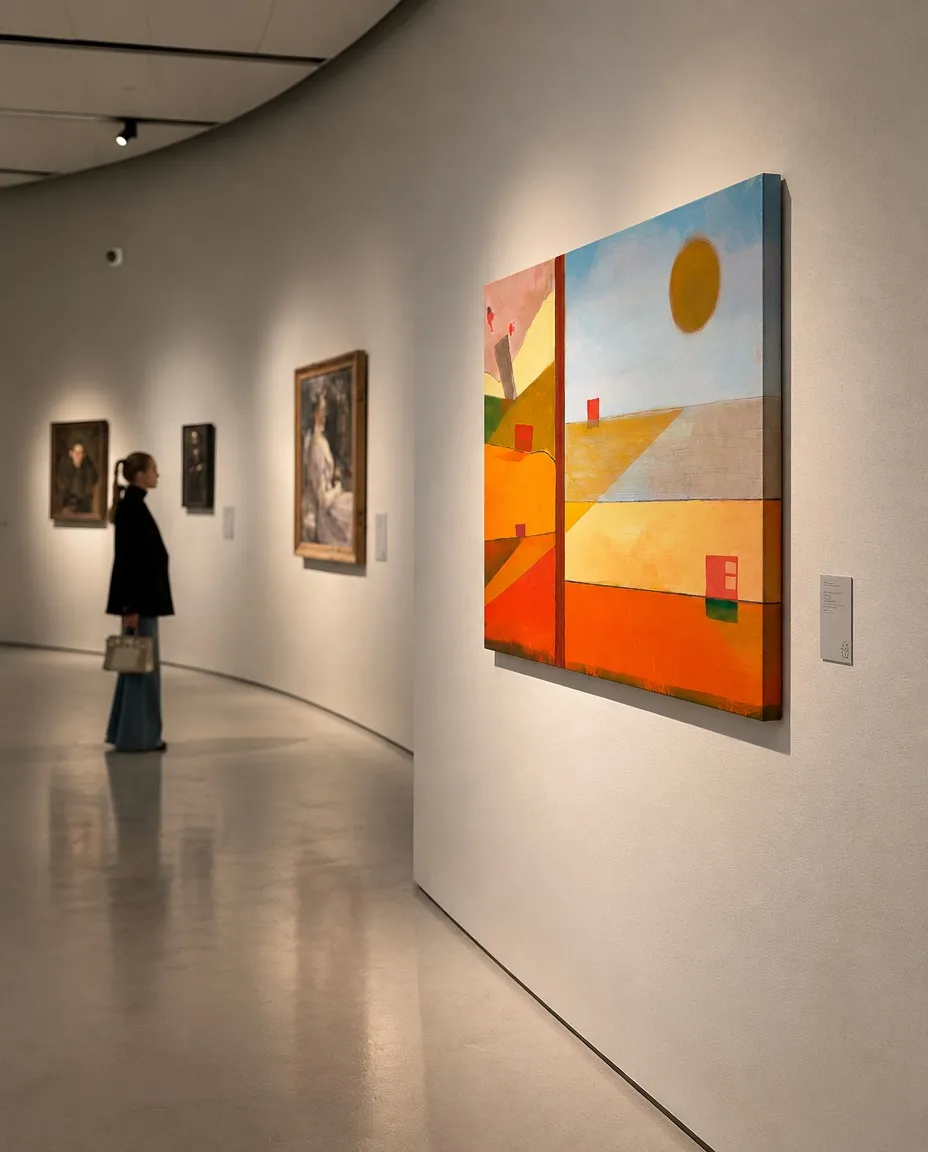
Context study / SOL DIVISUS
SOL DIVISUS — Context Study
Access to SOL DIVISUS begins with a detail that scarcely takes up any space: at the lower right edge, a small red form, with a green base and two pale openings, comes forward ahead of the rest of the territory. The view from the right reinforces that priority; before taking in the vertical division, the left slope or the ochre disc, one encounters this ambiguous construction. It may be read as a house, a sign or an isolated volume, yet none of these possibilities prevails. Its efficacy lies in offering a nearby scale without offering a route. From this minimal threshold, pale planes open towards the centre, while the more irregular mass on the left lies across a traverse that the painting does not organise.
The absence of an itinerary does not amount to stillness. In Valch’s thinking, external paths can be drawn on a map, while inner movement offers no guarantee of direction; this distinction makes the experience of entering the image without knowing which course to follow especially pertinent. The small architecture seems to offer the gaze shelter and, at the same time, to withdraw all certainty from it. There is no need to turn it into a psychological emblem: it is enough to note that the horizon, the blocks and the reddish band distribute proximities and distances without leading them towards a destination. Orientation remains deliberately incomplete, a condition consistent with MARE SOMNIORUM, where a territory may be exterior, mental and architectural without settling entirely into any of these categories.
In “From Dream to Territory,” Valch describes the early blocks and constructions as signs that do not fully belong to the landscape. SOL DIVISUS confirms this condition on a particularly contained scale: the volume in the lower corner does not establish an inhabitable place, but introduces the question of how an uncertain expanse may be inhabited. “The Keel in the Desert” also places this work alongside crimson forms that interrupt the horizon and resist the impulse to translate everything. The low presence at the right shares this reserve: its two openings promise an interior, but do not allow passage through it. The painting thus retains the quality of a dry harbour; one reaches a specific edge, yet the journey does not become a narrative of progress or a promise of resolution.
The affinity with Paul Klee helps to clarify the work of this tiny form. In Klee, certain geometric signs acquire the condition of elemental architecture and measure the vastness around them without fully describing it. The small volume in SOL DIVISUS serves a similar function: it makes the breadth of the pale fields and the weight of the central cut perceptible. Yet Valch departs from Klee’s more graphic rhythm by placing the sign within a topography of layers, diagonals and visible matter. Viewed obliquely in the gallery, the canvas even retains its physical depth against the wall; this lateral presence accompanies the logic of the image, in which entering does not mean possessing a complete view, but accepting that every threshold leaves part of the territory beyond reach.
- Original artwork
- SOL DIVISUS
- Actual dimensions
- 47.2 × 31.5 in / 120 × 80 cm
- Presentation
- Digital contextual visualization
Context references
abstract painting on a terracotta wall · painting for a coloured wall · contemporary art in a gallery
About this visualization
This visualization places the artwork within an architectural context to help collectors and viewers imagine its presence in a real space. It is an interpretive reference, not an exact reproduction: the original work remains the sole authority for scale, color, surface and material presence.