Context study / SOL DIVISUS
SOL DIVISUS — Context Study
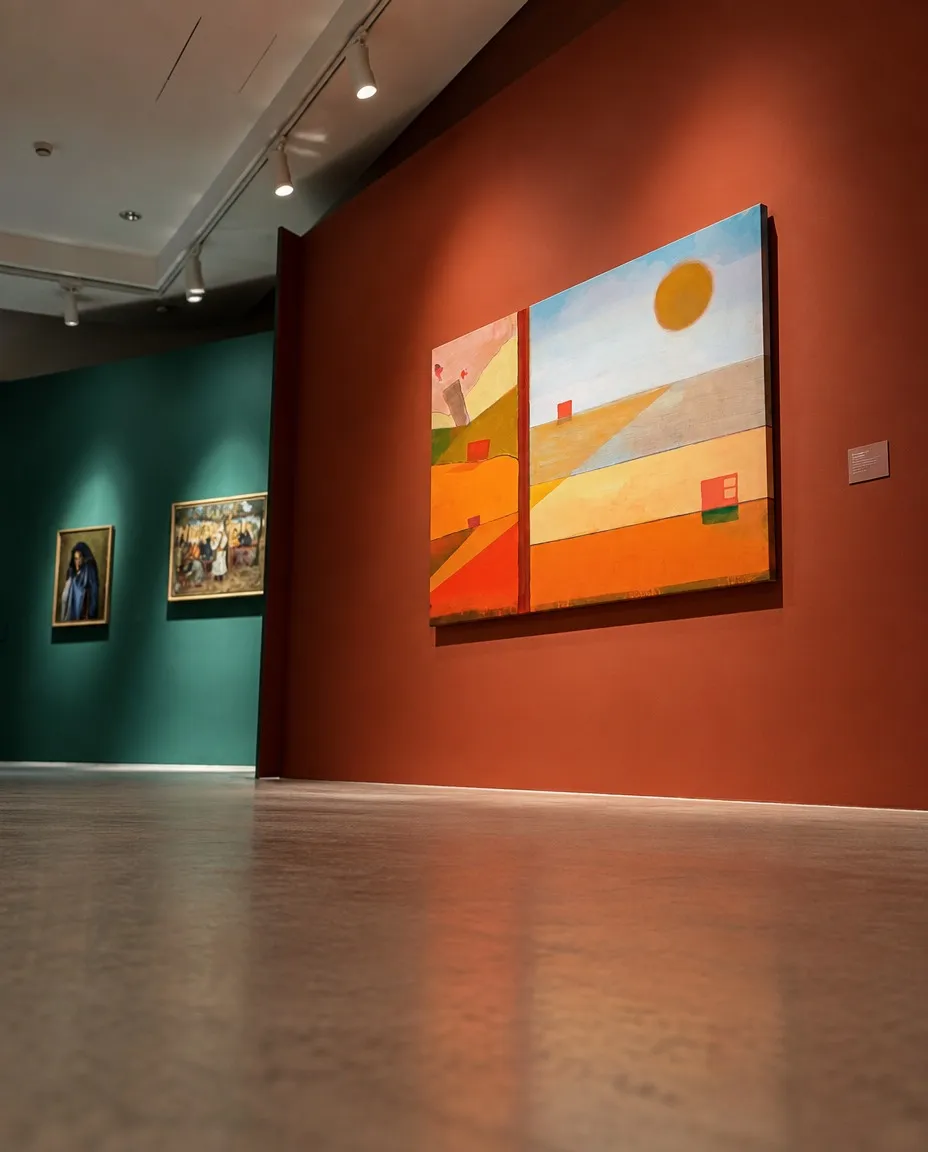
From this height, the orange at the base takes on the firmness of a foreground. With the camera almost resting on the floor, the grey surface of the corridor extends towards the canvas, bringing that warm band forward before any other area of SOL DIVISUS. Above it, yellows and greys rise in layers towards a less graspable distance; the pale blue receives the ochre disc without allowing it to dominate the whole. The presentation makes particularly visible a procedure characteristic of Maurizio Valch’s language: organising chromatic fields and territorial divisions so that an austere image retains depth, fracture and passage. The lower band does not depict recognisable land, yet it physically supports the rest of the painting; the reddish vertical dividing the canvas does not cancel that continuity, but subjects it to interruption.
This priority of what is near allows the scene to be related to an attention that runs through the artist’s thinking: before the mind orders a journey into a story, there is the fact of being situated. His experience of paths has distinguished between a route that can be drawn on a map and an inner movement whose direction is not assured. Reading this painting does not require turning the orange into autobiography in order to perceive something akin to this: the gaze begins below, in an available expanse, and only then attempts its ascent towards what is suspended. The ochre sun remains distant, promising neither arrival nor explanation. Between ground and sky, the composition holds a distance that can be traversed without being resolved.
In “From Dream to Territory,” Valch describes MARE SOMNIORUM as a region where horizon, memory and desire alter the stability of the visible; the horizon separates and connects at once. SOL DIVISUS condenses this double operation in an arrangement intensified by the low angle: the lower register offers support, while the upper planes withdraw one after another. “The Keel in the Desert” proposes for these paintings the image of a dry harbour, a journey interrupted without thereby failing. Seen in this way, the orange band would not be the starting point for a heroic march, but the modest condition from which the gaze may linger: an immediate ground that does not yet demand knowledge of where the horizon leads.
The affinity with Richard Diebenkorn illuminates the capacity of certain abstract planes to retain a memory of slope, expanse and passage without becoming descriptive landscape. In SOL DIVISUS, the pale diagonal in the right half and the overlapping bands produce this sense of traversable territory; the low viewpoint reinforces their gradual recession. Valch departs, however, from a spatiality that might open fluidly into the background. His small red blocks, the central partition and the suspended disc introduce pauses: distance is not a view available all at once, but something that begins beneath one’s feet and becomes more complex as the gaze rises.
- Original artwork
- SOL DIVISUS
- Actual dimensions
- 47.2 × 31.5 in / 120 × 80 cm
- Presentation
- Digital contextual visualization
Context references
abstract painting in a gallery with a visitor · horizontal painting shown to scale · contemporary art in an exhibition space
About this visualization
This visualization places the artwork within an architectural context to help collectors and viewers imagine its presence in a real space. It is an interpretive reference, not an exact reproduction: the original work remains the sole authority for scale, color, surface and material presence.