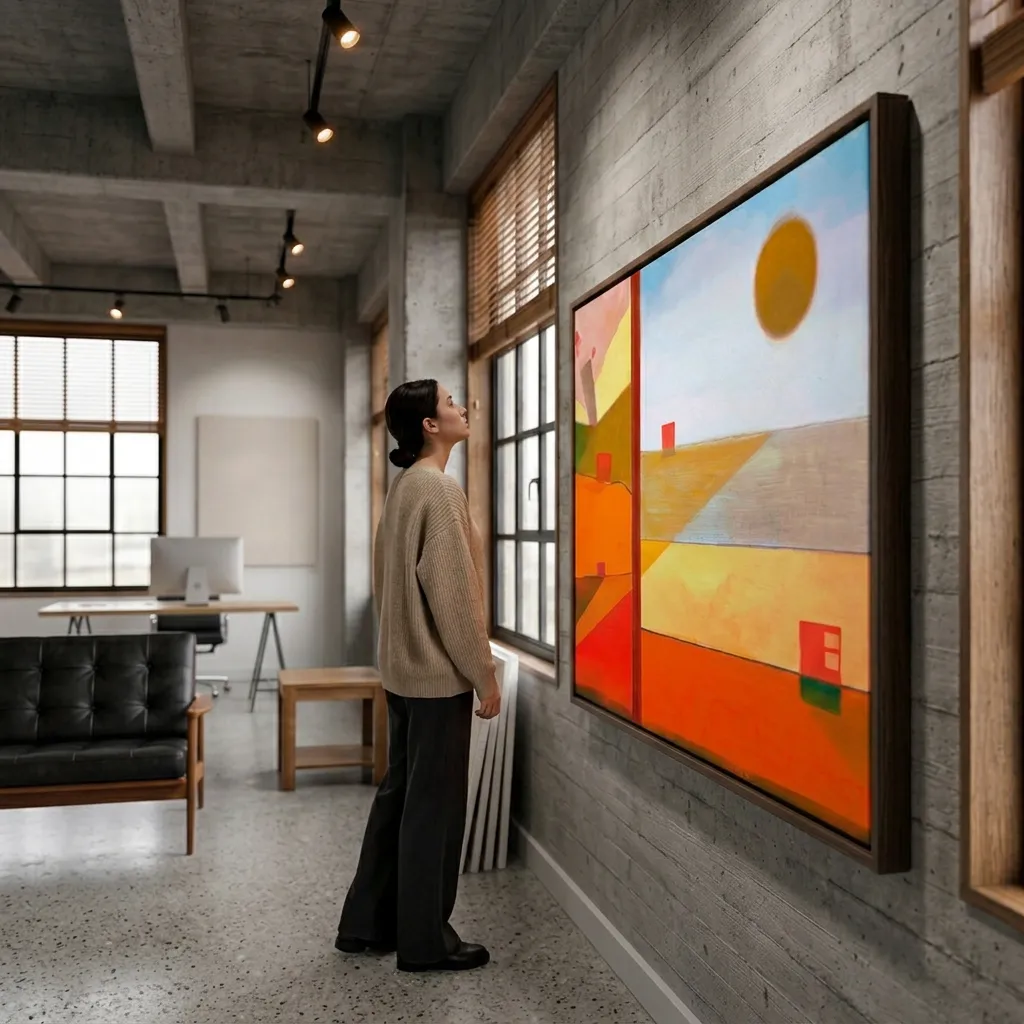
Context study / SOL DIVISUS
SOL DIVISUS — Context Study
Close lateral viewing unsettles the promise of distance: the horizon in SOL DIVISUS still organises the gaze, but it can no longer be received as the continuous background of a view. The reddish band rising almost vertically cuts across the canvas; the orange and green fields on the left fold back in short directions, while the pale area on the right opens onto an expanse that a diagonal plane tilts once more. In Maurizio Valch’s language, horizons and territorial divisions do not necessarily describe a geography; rather, they construct a place where surface, distance, and memory operate at once. The presentation underscores this condition: at bodily scale and seen up close, the painting asserts itself as a frontal plane on the wall, not as a window one might pass through.
This impossibility of settling into a single point of view finds a cautious echo in the experience of movement that runs through the artist’s thinking. He is interested in paths not as routes towards a conclusion, but as moments in which one no longer fully belongs either to the place left behind or to the one not yet reached. The partition in SOL DIVISUS can be read through this suspension: the two sides remain connected by the recurring reds, although neither absorbs the other into a shared scene. There is no need to turn them into opposing psychological states. It is enough to notice that the painting retains the fertile unease of a distance that never quite settles into a map, a memory, or an exterior landscape.
In “From Dream to Territory,” Valch writes that MARE SOMNIORUM presents landscape as a mental expanse in which memory, desire, and distance alter what is visible; he also notes that the horizon separates and connects at the same time. SOL DIVISUS makes this double function concrete without illustrating the argument. The ochre disc, suspended above the broad brightness on the right, offers an uncertain measure; the small red blocks introduce an almost architectural scale, yet they do not stabilise the field. Light makes the territory visible without resolving it, just as the essay describes traversed geographies which, upon returning to painting, lose date and reference to become structures. The division in the title does not close off two worlds: it keeps active the difficulty of seeing both from within the same memory.
The affinity with Richard Diebenkorn is precise when one attends to this territorial persistence of the planes: the diagonals, the distant line, and the expanses of colour retain the possibility of slope, passage, and horizon even within abstraction. Yet Valch departs from panoramic continuity. Rather than allowing the gaze to glide across a landscape viewed from a certain height, he arranges a frontal red band and isolated blocks that halt the passage and return the eye to the surface. The comparison does not reduce SOL DIVISUS to a variant of landscape; it makes its singularity clearer: a remembered, interrupted territory set before the viewer with the firmness of a scene that offers no stable place from which to master it.
- Original artwork
- SOL DIVISUS
- Actual dimensions
- 47.2 × 31.5 in / 120 × 80 cm
- Presentation
- Digital contextual visualization
Context references
abstract painting for a large dining room · wall art for an industrial dining room · horizontal painting for a wide wall
About this visualization
This visualization places the artwork within an architectural context to help collectors and viewers imagine its presence in a real space. It is an interpretive reference, not an exact reproduction: the original work remains the sole authority for scale, color, surface and material presence.