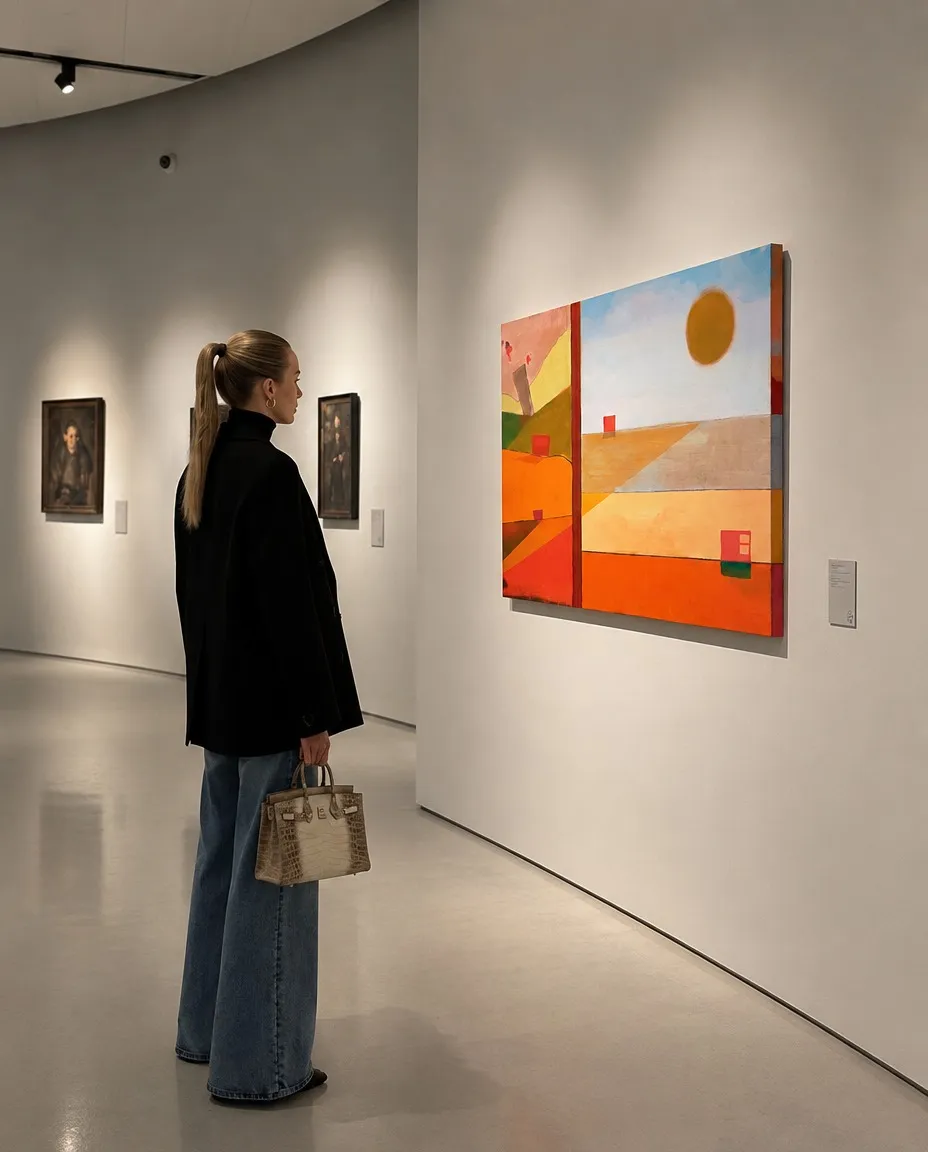
Context study / SOL DIVISUS
SOL DIVISUS — Context Study
Two tiny red interruptions sustain a disproportionate unease in the pink sky of SOL DIVISUS. They describe neither a figure nor an identifiable event; they merely divert the continuity of a field that, without them, might be received as a calm atmosphere. This deviation matters because Maurizio Valch’s practice is articulated precisely through large expanses, divisions and elemental presences whose stability is never complete. In this work, the broad planes and the vertical reddish band establish a recognisable territorial organisation, yet these two marks, made at an almost incidental scale, retain the trace of an action that never fully integrates. Seen from the right-hand side of the room, the surface also preserves its status as an object: the sky does not become a distant view, but a material zone exposed to close approach.
The resistance of these patches to being read may be linked, as an interpretation, to a caution that runs through the artist’s thinking: a mistrust of explanations that turn a minor fact into an exhaustive theory. Nothing requires us to translate them psychologically. Their value lies instead in interrupting the rush to understand. Against the clear expanse occupying the right half and the ochre disc that concentrates the gaze, the eye returns to that upper edge where something has happened without leaving a narrative behind. The painting allows attention to settle on a specific irregularity before it is absorbed into the general idea of landscape, dream or calm.
In “From Dream to Territory,” Valch writes that MARE SOMNIORUM preserves a suspended world, where memory, desire and distance alter the visible without fixing it within a stable geography. He also states that his early elements act as signals rather than closed symbols. The two red patches bring this condition to a particularly discreet limit: they neither direct a route nor offer a key, but prevent the sky from becoming mere background. Within an orderly museum gallery, surrounded by figurative paintings that seem to promise scenes and characters, their indeterminacy becomes clearer. SOL DIVISUS thus proposes an image that remains open not for lack of structure, but because it reserves an area where structure does not fully prevail.
The affinity with Paul Klee is relevant because of the role a minimal presence can play in establishing the scale of space. In Klee, certain small forms acquire the weight of sign, architecture or rhythm; in Valch, these red marks do not attain that geometric clarity, nor can they be stabilised as language. They function less as units that order the territory than as a slight insubordination within it. Their smallness makes the scale of the fields surrounding them more visible, but it also introduces a quiet question: how much incident is enough for an expanse to cease presenting itself as fully reconciled?
- Original artwork
- SOL DIVISUS
- Actual dimensions
- 47.2 × 31.5 in / 120 × 80 cm
- Presentation
- Digital contextual visualization
Context references
abstract painting in a dark-walled gallery · orange and blue painting on display · contemporary art with focused lighting
About this visualization
This visualization places the artwork within an architectural context to help collectors and viewers imagine its presence in a real space. It is an interpretive reference, not an exact reproduction: the original work remains the sole authority for scale, color, surface and material presence.