Context study / SOL DIVISUS
SOL DIVISUS — Context Study
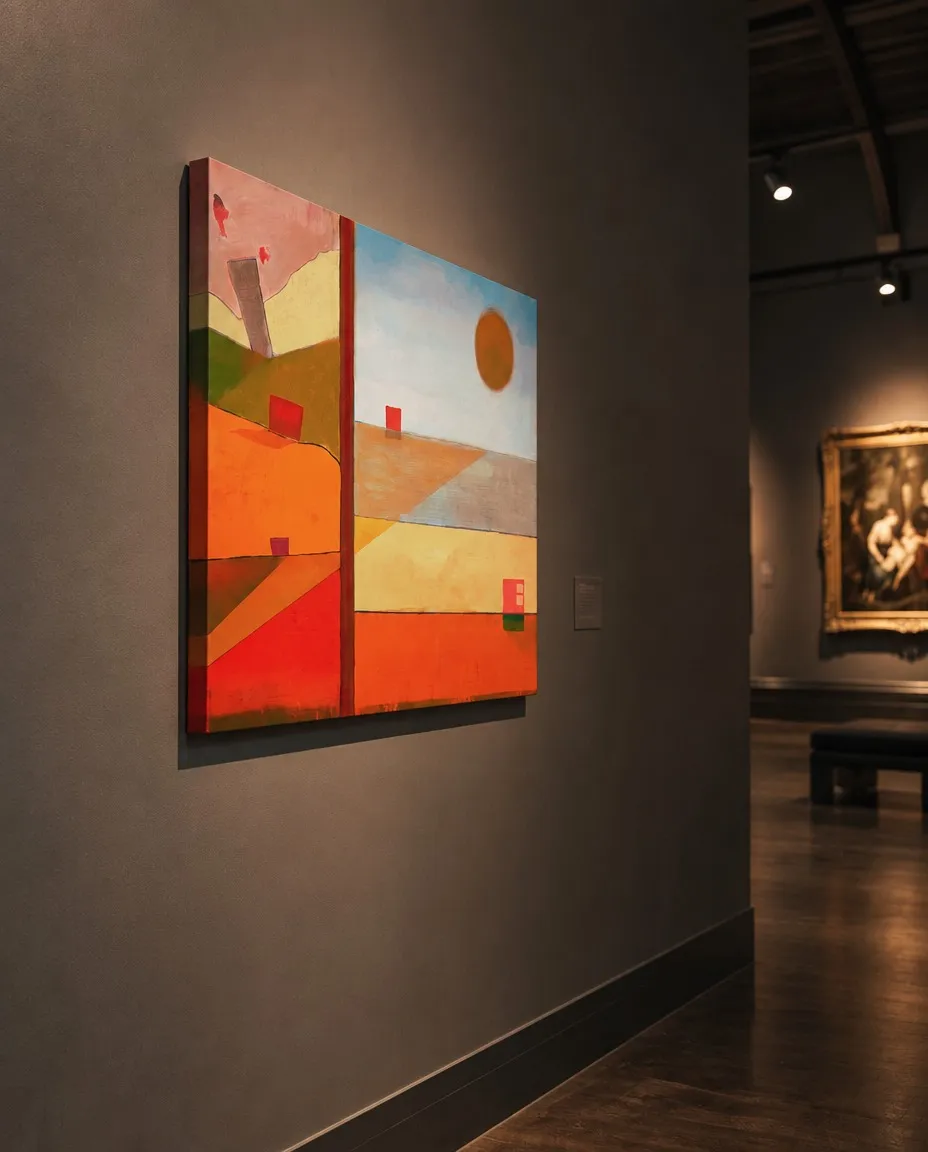
The half-light does not extinguish the painting: it delays it. From the side angle of this room, the oranges and reds of the lower register retain an immediate, almost compact presence, while the veiled blue, yellow and pale expanse on the right take a few moments to emerge from the dark wall. This difference makes perceptible a central procedure in Maurizio Valch’s language: organising territories through colour fields, divisions and elementary forms without enclosing them within a fixed geography. In SOL DIVISUS, the vertical reddish band keeps two regimes of light close together; the installation makes it possible to see that they do not reach the eye at the same speed.
The darkness, which in his imagery may hold silence, distance and melancholy rather than threat, offers a pertinent resonance without explaining the painting psychologically. The eye must adjust and allow the light to gradually take shape; it is not immediately given an ordered scene. This waiting is close to an enduring concern for the artist: attending to what is happening before covering it with a conclusive interpretation. The small red blocks and ochre disc remain visible, but they do not offer a key for resolving the separation. Between the warm slope and the pale field, a distance persists that is perceived rather than translated.
In El latido que falta, Valch writes about the active force of a rhythmic interruption: the omitted beat does not leave a passive void; it compels the body to sustain inwardly what it expected to receive. The situation of SOL DIVISUS in this restrained light works in a similar way. The light areas do not disappear, but their appearance is held back; attention gradually completes their washed tones, greyish diagonal and the blue atmosphere surrounding the sun. Light then acquires a temporal quality. It is not equivalent to a sudden revelation, but rather to an interval in which the gaze participates, adjusts its expectation and discovers that brightness can be fragile without losing its weight.
The affinity with Richard Diebenkorn helps us recognise how seemingly abstract planes still retain a memory of terrain, horizon and passage. In Valch, however, the central division does not organise a tranquil landscape continuity: it compresses the passage between two ways of perceiving distance and lets the small geometric bodies interrupt any naturalistic reading. Under the gallery’s low lighting, this difference becomes even more precise. The earthy red asserts a material proximity; the pale light on the right does not simply oppose it, but arrives later. SOL DIVISUS turns this delay into a form of attention.
- Original artwork
- SOL DIVISUS
- Actual dimensions
- 47.2 × 31.5 in / 120 × 80 cm
- Presentation
- Digital contextual visualization
Context references
abstract painting in a contemporary gallery · framed painting on a light-coloured wall · side view of artwork on display
About this visualization
This visualization places the artwork within an architectural context to help collectors and viewers imagine its presence in a real space. It is an interpretive reference, not an exact reproduction: the original work remains the sole authority for scale, color, surface and material presence.