Context study / SOL DIVISUS
SOL DIVISUS - Original Contemporary Abstract Artwork
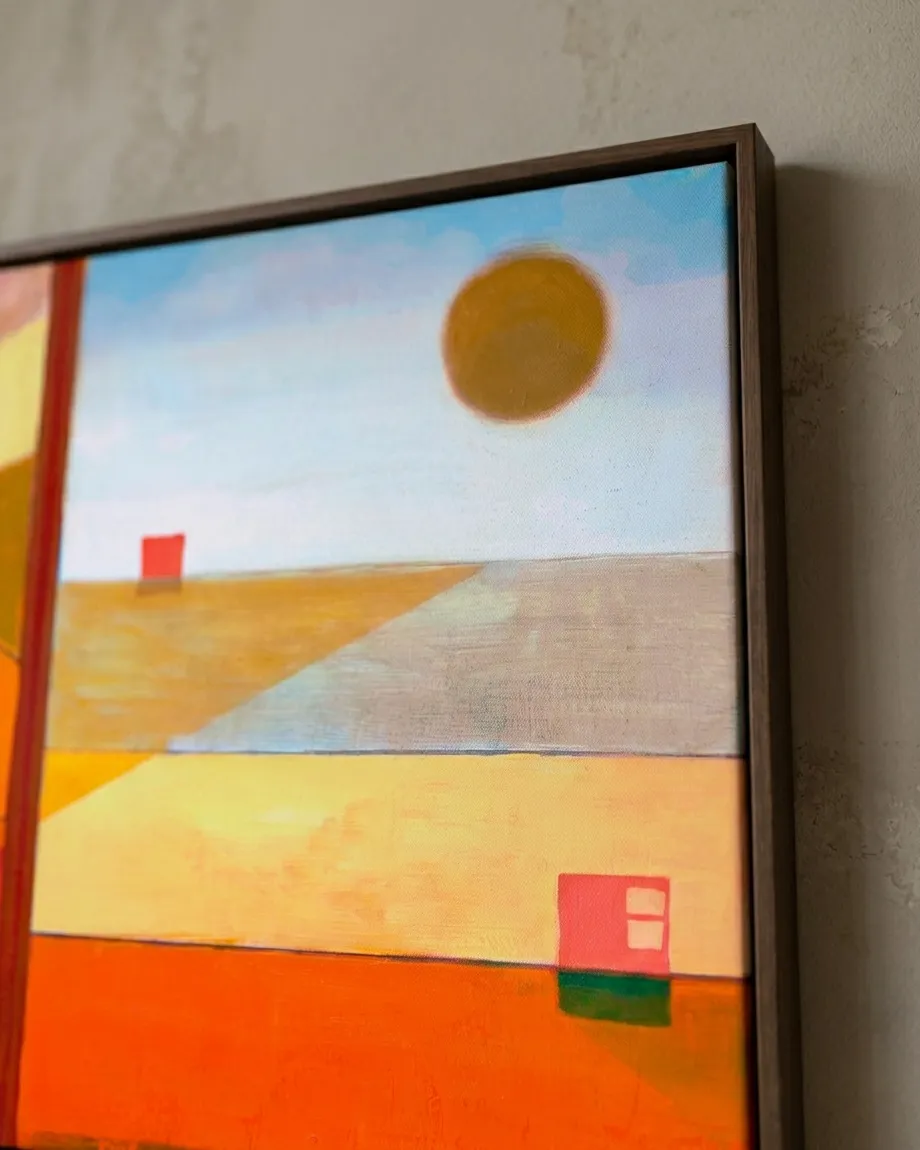
As it approaches the right-hand edge, the luminous expanse of SOL DIVISUS meets a stop not contained within its own planes: the dark wood of the frame. The pale blue sky, the ochre disc, and the bands of ground continue to suggest distances the eye can mentally extend, while the straight edge returns them to an object measuring 120 by 80 centimetres. The oblique view reveals the canvas edge and its separation from the wall; thus, the limit ceases to be a merely compositional decision. In Maurizio Valch’s language of fields, horizons, and divisions that do not fully close off territory, this material encounter is decisive: it sustains the openness of the image without allowing it to merge with the surrounding space.
The reddish division crossing the canvas had already proposed an incomplete separation. The smaller reds that reappear on either side—the small block on the horizon and the low form in the lower register—prevent the two areas from settling into independent worlds. This may be read as being close to a persistent question in the artist’s thinking: to what extent does a demarcation organise experience, and to what extent does it render it rigid? Without turning these elements into allegories of an inner biography, the painting conveys this difficulty: it establishes cuts, directs perception, yet always retains a continuity that exceeds the categories through which one seeks to fix it.
In “The Tactile Shore,” Valch questions the habit of confusing the conceptual map with the territory and proposes thinking of the natural boundary as a place of contact rather than a trench. This particular presentation makes that idea tangible without abolishing physical separation. The wall does not enter the painting, nor does the canvas dissolve into the wall; between them, the frame defines a clear boundary. Yet this clarity activates the relationship: it makes the minimal interval between the painted surface, its thickness, and the immediate air more perceptible. The boundary does not resolve the image; it gives it a shore from which its open planes can retain their indeterminacy.
The affinity with Barnett Newman may illuminate the spatial role of a minimal vertical intervention, although in SOL DIVISUS the red band does not act as a self-sufficient sign on a homogeneous field. It organises a territory that retains horizon, inclinations, variations in materiality, and small architectural presences. The dark frame also shifts this question towards the painting’s actual edge: in contrast with the internal division, mobile and permeable, it offers a firm interruption. The singularity of the scene arises from this contrast. The painting does not need to escape its limits in order to suggest expanse; it needs the edge to remain visible so that the expanse may continue to open in perception.
- Original artwork
- SOL DIVISUS
- Actual dimensions
- 47.2 × 31.5 in / 120 × 80 cm
- Presentation
- Digital contextual visualization
Context references
framed SOL DIVISUS Maurizio Valch · horizontal abstract painting with wooden frame · framed orange and blue abstract painting
About this visualization
This visualization places the artwork within an architectural context to help collectors and viewers imagine its presence in a real space. It is an interpretive reference, not an exact reproduction: the original work remains the sole authority for scale, color, surface and material presence.