Context study / SIGNUM
SIGNUM by Maurizio Valch in a Rustic Mediterranean Ambience
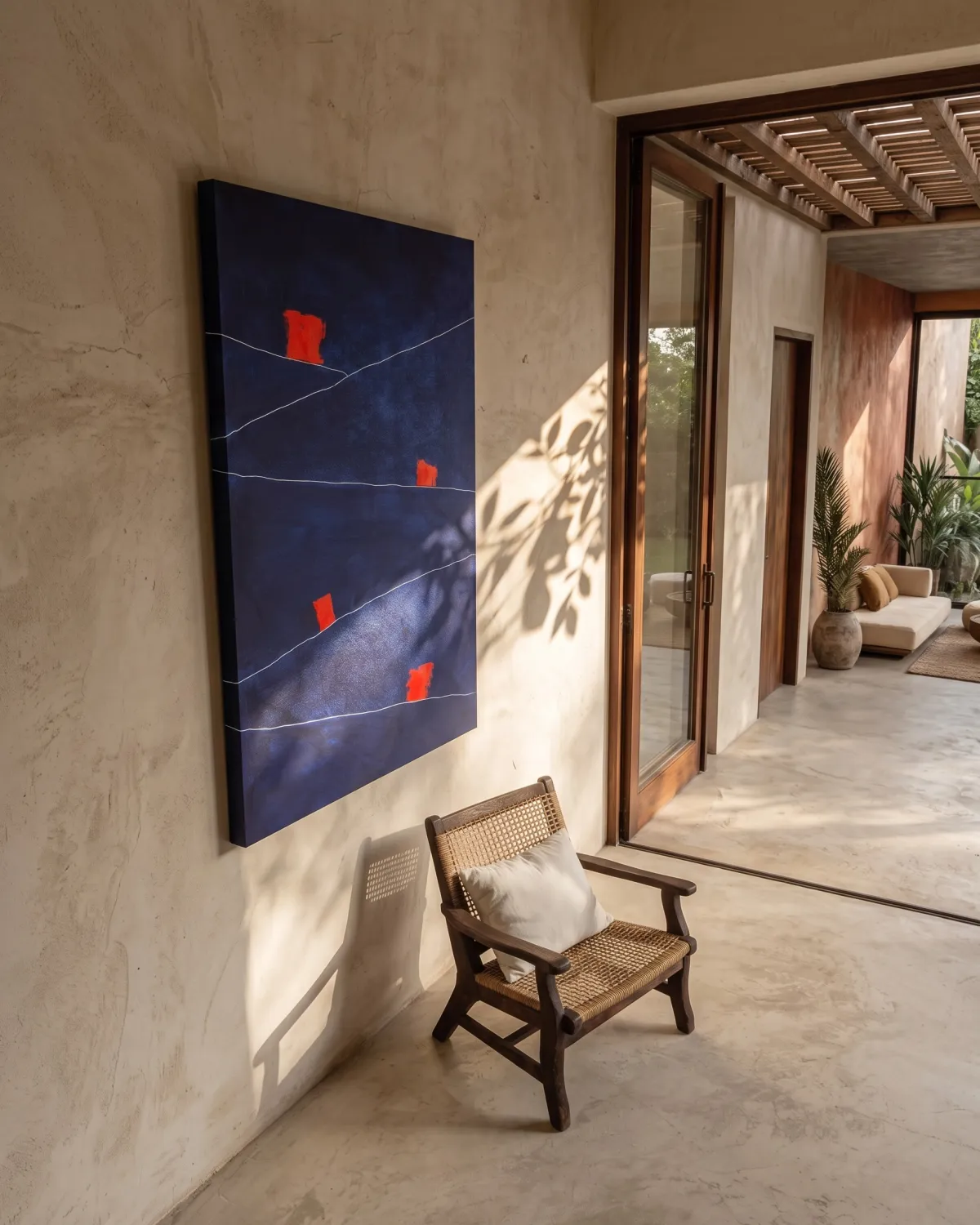
The gaze immediately encounters the verticality of a nocturnal territory, a blue of mineral density that absorbs light and establishes its own gravity upon the canvas. Four thin strokes, incised marks precisely made upon the surface, break the monotony of the plane in a zigzag ascent evoking tectonic faults or paths carved into an inaccessible cliff. Upon each of these incised marks, like a sentinel or a station on an ascending route, rests a block of thick crimson color, whose pasty and rough matter stands out against the smooth plain of the background. There are no concessions to ornamentation; the arrangement of these elements generates a rhythmic tension, an order that seems to swing between architectural planning and teluric accident.
When facing the canvas, my first gesture is destructive: I need to cleave the uniformity of the blue with a metal needle, leaving incised marks that reveal the vulnerability of the base, a white slash that is at once boundary and path. I feel in my arm the physical resistance of the fabric as it is furrowed, a vibration that interrupts the silence of the flat color. Then, I deposit the red matter with the palette knife, not to paint, but to establish a presence; I place the pure pigment, impasted and dense, seeking for its own physical weight to settle upon the incision like a body claiming its place on a cliff. It is a constant struggle between the thin line attempting to channel space and the mass of color threatening to overflow it, an attempt to trap the vibration of the object before it becomes mere representation.
This friction between the incised line and the material block places the work at a conceptual crossroads regarding the behavior of consciousness. Following the ideas of George Gurdjieff, who warned of the mechanical nature of human existence and the urgency of an awakening against slumbering automatism, one wonders if this stepped trajectory represents the map of a conscious ascent or if, on the contrary, it stages the repetition of a blind mechanism where the red blocks advance like gears caught on predetermined rails. Faced with this suspicion of domestication, the philosophy of Osho pushes us to see in the vibrant crimson an untamed energy, an impulse of free life and desire resisting being assimilated by the rigid order and institutionalized structures embodied by the incised marks. However, arquetypal psychologist James Hillman warns us of the danger of reducing these forms to mere symptoms or moral dilemmas to resolve; for him, these images of the psyche are autonomous presences that do not demand a psychological translation, but the recognition of their material mystery as signs, or signum, of a soul geography that simply is.
In my memory, the rocky slopes of the Mediterranean coasts persist, the aridity of those landscapes where human intervention is reduced to precarious paths and watchposts carved into stone. I do not conceive these shapes as symbols loaded with psychological explanations or devised narratives; they are testaments of a transit, residues of a physical experience with the territory where space is experienced as resistance. When painting, I am suspicious of any reading attempting to domesticate the rawness of the crimson block by turning it into a metaphor for personal evolution. I prefer to think that these red blocks are accidents, material landmarks of a journey that has no definitive end, but only provisional points of support on a cliff refusing to be tamed.
In the end, the gaze remains suspended in the immobility of that unfinished transit, caught in the paradox of a movement announced but not occurring. The blocks of red matter remain there, fixed in their respective incised marks, without revealing whether they are ascending toward an invisible peak or if they are permanently suspended in an order condemning them to stillness. We face a structure that questions our own need to find destination and meaning in every line. Perhaps the true strength of the painting resides in that unresolved tension, forcing us to return to the blue to discover whether the path is a road of liberation or a beautiful cage of lines engraved in stone.
- Original artwork
- SIGNUM
- Actual dimensions
- 31.5 × 47.2 in / 80 × 120 cm
- Presentation
- Digital contextual visualization
Context references
modern living room paintings · art wall decor · blue and red abstract painting · minimalist art for living room · contemporary rustic settings
About this visualization
This visualization places the artwork within an architectural context to help collectors and viewers imagine its presence in a real space. It is an interpretive reference, not an exact reproduction: the original work remains the sole authority for scale, color, surface and material presence.