Context study / SIGNUM
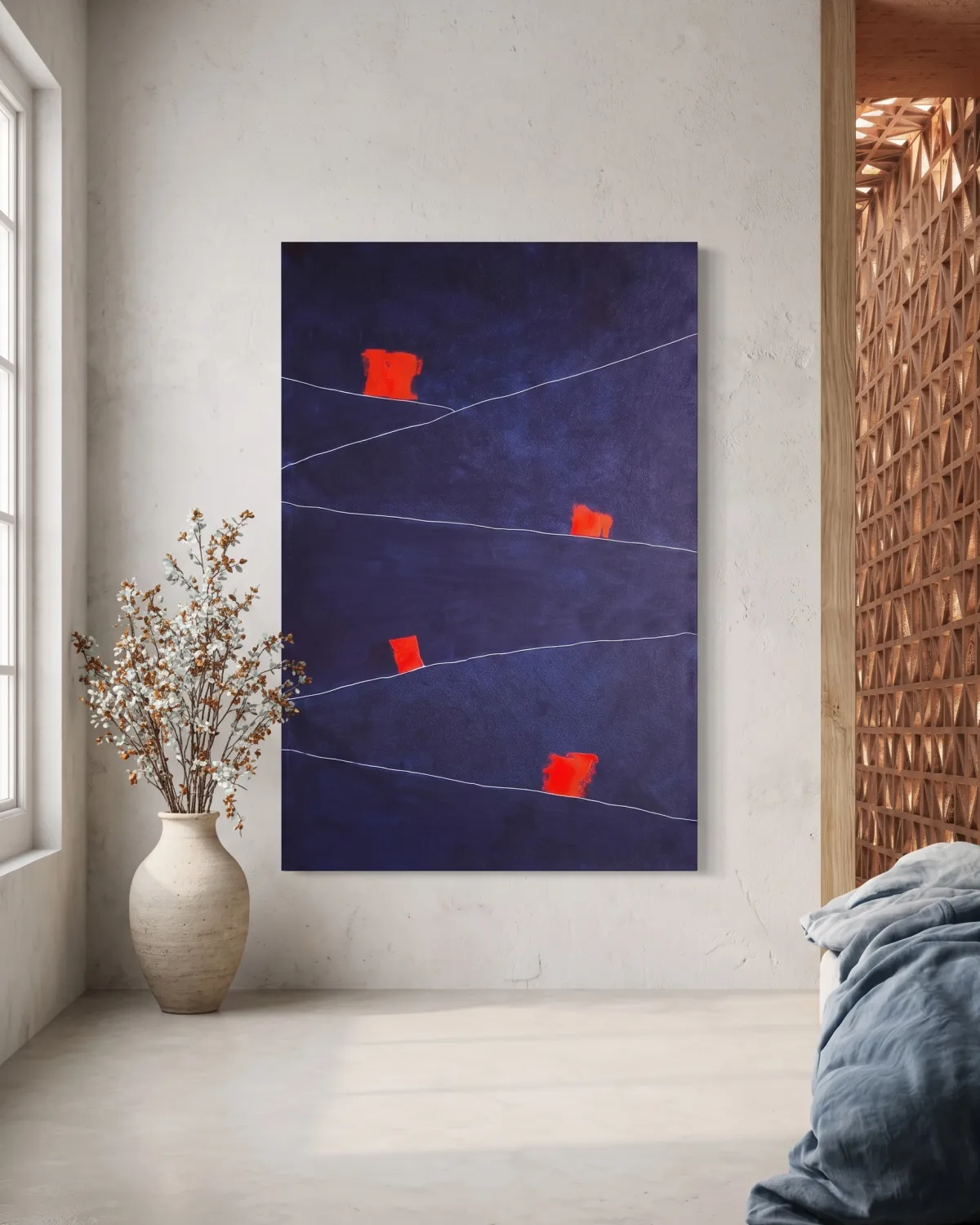
SIGNUM by Maurizio Valch in a Minimalist Design Bedroom
The ultramarine blue field that dominates the surface asserts itself not as a passive background, but as an active presence, a dense and magnetic abyss that seems to swallow the light of the room. Over this immensity, which evokes both the Mediterranean night and an unfathomable void, thin white lines zigzag from one edge to the other, precariously supporting four blocks of thick red matter. The composition establishes an immediate tension between emptiness and boundary, a friction directly recalling the investigations of Carl Gustav Jung, the Swiss psychiatrist who analyzed how the human psyche projects archetypes of order and logical structures to contain the untamed chaos of the collective unconscious. At the same time, this linear flow evokes the thought of G. I. Gurdjieff, the spiritual master who exposed the human tendency to cling to mechanical, predictable paths to evade awakening and the overwhelming weight of authentic freedom. Thus, the incisions in the canvas do not function as an external map, but as the mind's desperate attempt to domesticate a territory that resists being cartographed.
When making these incisions on the canvas, I experience a physical resistance that goes beyond matter; each white furrow I open upon the color plane is an assertion of will against the silence of the support. With the palette knife, I accumulate the crimson red, depositing it with a specific weight upon these fragile lines of transit, searching for a point of support that always feels provisional. Painting this picture has been an exercise in containment, an impulse to trace boundaries where before there only existed a dark and indifferent plain threatening to devour everything. I do not seek to decorate or illustrate a theory, but to register the constant suspicion that these marks of mine, these cuts and blocks of color, perhaps do not order external space, but only evidence our irremediable human need to construct mental scaffolding so as not to get lost in the immensity of the night.
The four red blocks, suspended at different heights, lack perspective volume or references that identify them with everyday objects; they are neither geographical landmarks nor warning signs, but pure pictorial accumulation that seems to be learning to hold its ground on slippery slopes. Their formal instability generates a visual vibration where the weight of the pigment challenges the apparent fragility of the lines crossing them. From the perspective of the awakening of consciousness proposed by Gurdjieff, each of these blocks could be interpreted as a shock of friction, a point of resistance that interrupts the mechanical nature of the path to force a moment of real self-observation. From the perspective of Jungian psychology, conversely, these crimson nuclei function as totems or provisional masks that the individuation process erects on the surface of the mind, necessary anchor points to prevent the self from being dissolved by the deep currents of the unconscious ocean pulsing underneath.
The indigo blue I have chosen for this work requires a very particular physical distance, as its density varies depending on how natural light strikes the textured surface of the canvas. Working in the 120 by 80 centimeter format, my intention has been for the painting to behave like an architectural block, a fragment of wall, or a portion of territory that holds its ground firmly before the body of the observer. The crimson red is not placed to please the eye, but to strike the retina with an opaque and material quality that contrasts with the spatial depth of the background. Positioned in the exhibition space, the work does not act as a window onto a distant landscape, but as a solid object that interrupts the white wall, forcing viewers to measure their own scale and gravity against the physical presence of the painting.
In the silence of a minimalist, architecturally austere space, the painting breathes and projects its scale with a quiet authority that transforms the perception of the surroundings. Light entering from the side highlights the rough texture of the wall and the sobriety of the cement floor, turning contemplation into an act of quiet retreat where every decorative element has been stripped away to let the matter speak. It is in this direct, bare confrontation that the dialogue between imposed order and latent void acquires its true weight. At the end of the visual journey, the viewer faces an unresolved paradox: determining whether this system of lines and red blocks represents a victory of consciousness managing to define its own sacred space, or if it is the confession of our radical fragility before a blue abyss that, sooner or later, will end up absorbing our ephemeral marks.
- Original artwork
- SIGNUM
- Actual dimensions
- 31.5 × 47.2 in / 80 × 120 cm
- Presentation
- Digital contextual visualization
Context references
wabi sabi bedroom paintings · minimalist wood decor · original ultramarine blue painting · living room zen art · maurizio valch original work
About this visualization
This visualization places the artwork within an architectural context to help collectors and viewers imagine its presence in a real space. It is an interpretive reference, not an exact reproduction: the original work remains the sole authority for scale, color, surface and material presence.