Context study / SIGNUM
SIGNUM — Context Study
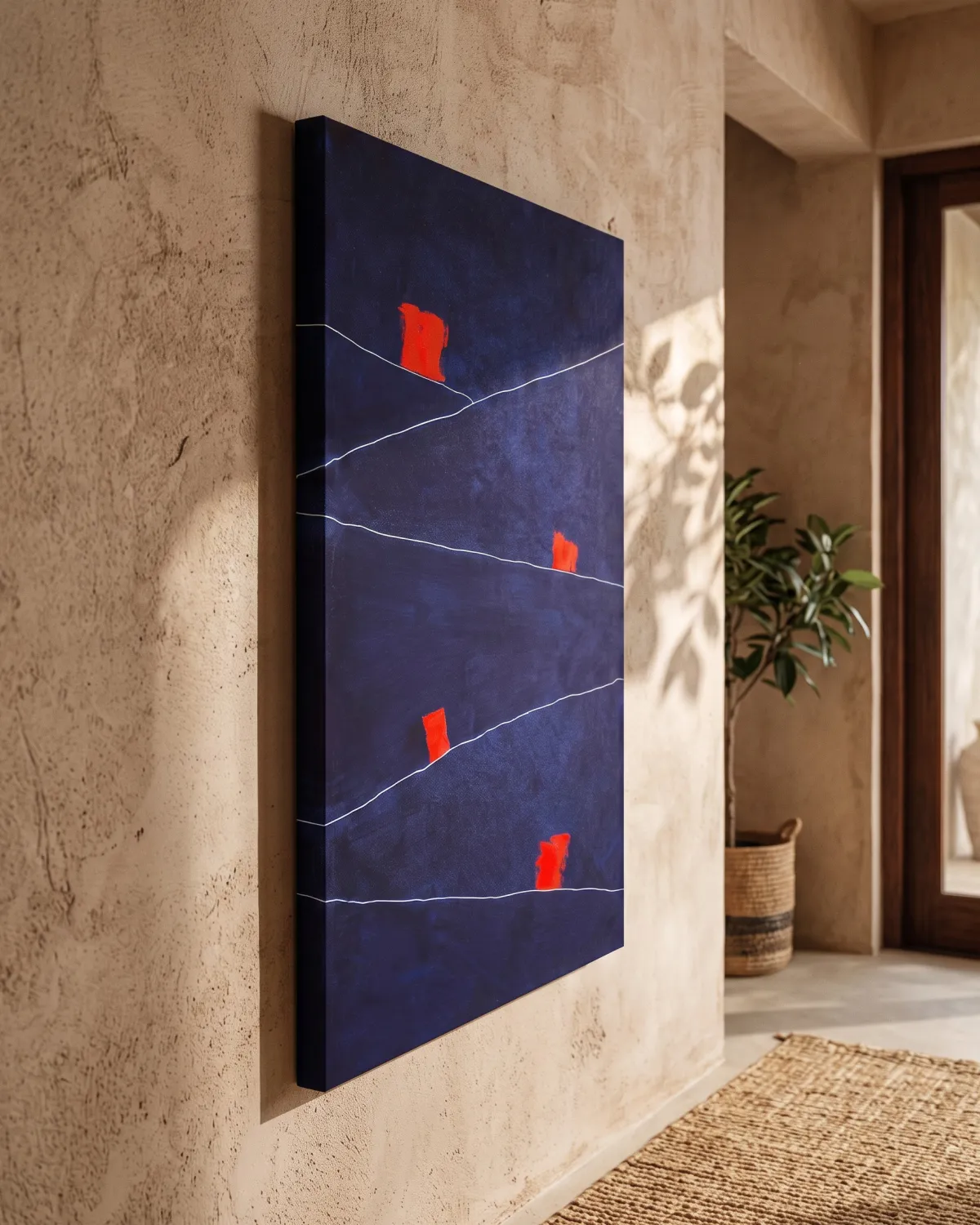
Crossing the visual threshold of this composition requires plunging into a cobalt abyss, a chromatic stratification where blue does not operate as a mere background, but as a dense, dark territory that seems to absorb all sound. Four sharp, whitish incisions slash this liquid twilight in a geometric zigzag that ascends laboriously, serving as an unstable ledge for four crimson red masses that burn with solitary obstinacy. It is impossible to contemplate this linear rigidity without summoning the thought of G. I. Gurdjieff, the philosopher and mystic who dissected human existence under the premise that we traverse the world deep in a hypnotic sleep, reduced to mere biological automatons reacting mechanically to external stimuli. These thin incisions structuring the canvas thus reveal themselves as the graphic representation of the laws of habit: invisible yet implacable rails tracing our daily routine, conceptual handrails promising a safe, orderly ascent toward personal evolution when, in reality, they only guarantee the perpetuation of a comfortable and predictable lethargy.
When I sink the tip of the tool into the fresh oil, I know I am not drawing a route, but inflicting a wound upon the density of that blue silence I have patiently built. My hand trembles under the tension of seeking straightness on a plane that resists being mapped; each incision is a desperate attempt to impose a geometric order, a rational architecture over an fathomless abyss that threatens to swallow any trace of will. There is a deep paradox in this physical gesture, because by opening this fissure to guide the gaze, I do nothing but confirm the extreme fragility of our containment systems, revealing that the traced boundary is barely an exposed, vulnerable seam. I wonder constantly, as I observe the furrow dividing the matter, whether these lines I have incised so insistently represent true escape routes toward liberation or if, on the contrary, they are the self-promoted bars of our own existential confinement.
As the body approaches the pictorial surface, the apparent stability of the zigzag crumbles before the violent vibration of the crimson blocks, whose dense, rough matter seems to throb with an urgency that overflows the boundary of the incision. These flashes of fire do not fit submissively into the metric system of the painting; they settle on the lines but with an almost defiant autonomy, like biological accidents in the middle of a mathematical equation. This vital irruption resonates with the perspective of Osho, the provocative mystic who defended the value of creative chaos, the celebration of the moment, and the inherent danger of allowing rational structures to domesticate the force of desire and spontaneity. At this point, the work becomes a philosophical battlefield: while Gurdjieff's gaze would interpret these red nodes as shock points of conscious awareness—necessary arrests where the sleeper must make a titanic effort of self-remembering so as not to slip down the slope of oblivion—Osho's vitality would celebrate in them the sovereignty of the inner fire, an untamed energy that uses the line only as a temporary pretext and threatens to melt the logical path to surrender to the pure becoming of the present.
For me, applying crimson on the canvas is not an act of decoration, but a brutalist imposition, a dry blow of the spatula that deposits a crust of pure matter tasked with resisting the dissolution of the nocturnal space. Each of these red blocks is a seal, an existential exclamation mark—a Signum—screaming its presence against the devouring immensity of the blue, a tactile testimony that something breathes and insists on not being erased. In the studio, a precise moment arrives when I lose control of the painting and it is the density of the pigment that claims its own weight and orientation on the canvas, reminding me that painting possesses an organic will escaping my mental plans of territorial ordering. In the end, I must step back and accept that the color has decided its own volume, transforming my analytical intention into an indomitable topography that no longer belongs to me.
Contemplating this piece of 120 x 80 centimeters today, suspended in the mute severity of a minimalist wall, transfers this formal crossroads directly into the three-dimensional space we inhabit as observers. The vertical scale of the painting forces us to measure our own physical posture against the tension of its forces: on one hand, the incised line functioning as the schematic map of a predetermined journey; on the other, the red mark embodying the untamed drive of the conscious mind awake here and now. As we leave the room, with our retinas still bearing the friction between the cobalt abyss and the wounded crimson, the painting ceases to be an aesthetic object to become a mirror of our own daily journey. An unease remains suspended in the air, admitting no easy answers: are these milestones marking our existence authentic signs of awakening returning the sovereignty of presence to us, or do they constitute merely the elegant choreography that embellishes our own captivity?
- Original artwork
- SIGNUM
- Actual dimensions
- 31.5 × 47.2 in / 80 × 120 cm
- Presentation
- Digital contextual visualization
Context references
abstract painting mediterranean texture · warm rustic wall decor · cobalt blue contemporary art · abstract painting with incisions · maurizio valch strata
About this visualization
This visualization places the artwork within an architectural context to help collectors and viewers imagine its presence in a real space. It is an interpretive reference, not an exact reproduction: the original work remains the sole authority for scale, color, surface and material presence.