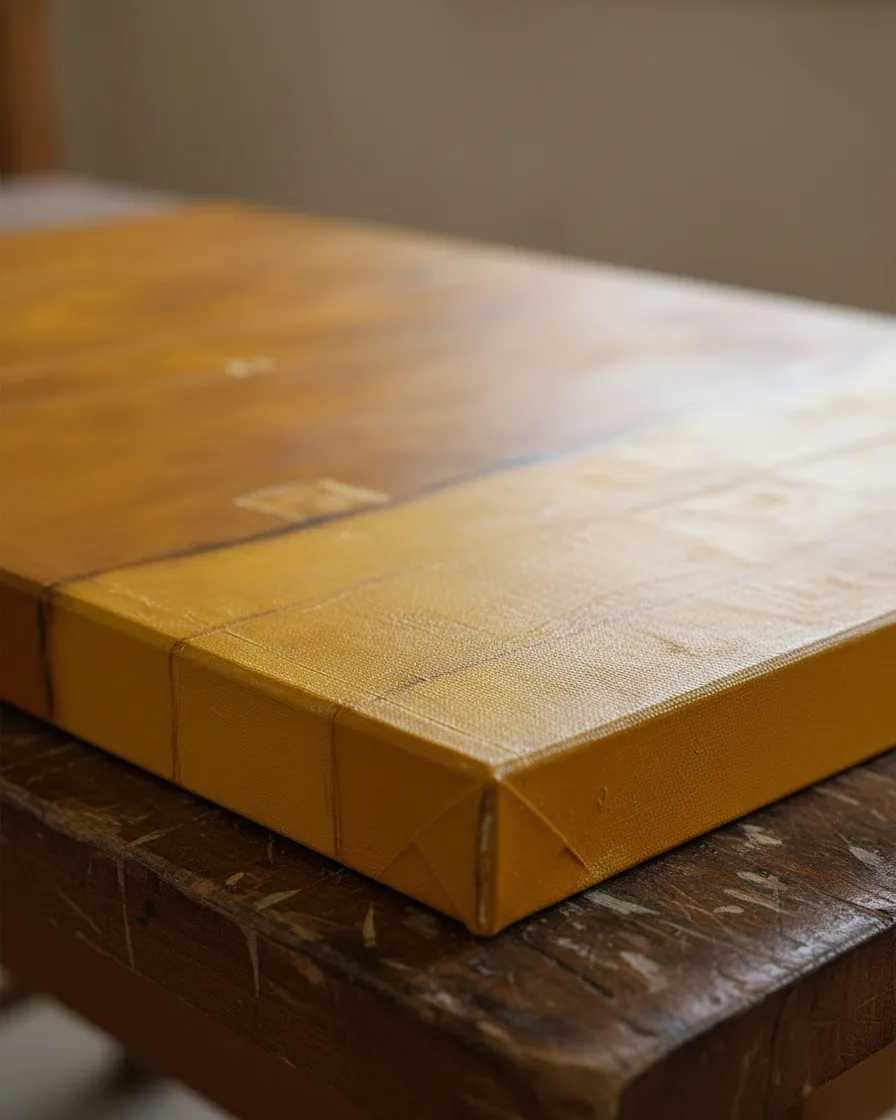
Context study / QUINQUE
Texture Detail of QUINQUE - Painting by Maurizio Valch
The oblique perspective with which this canvas rests on the worn wood of the workshop alters the usual order of contemplation: the eye does not enter through the center of the image, but through the boldness of its yellow corner. The work's visual organization is imposed from its very matter, guiding the gaze along a three-centimeter edge that reveals itself as a three-dimensional body rather than a flat boundary. Under the raking light of the space, the textured surface of the lower yellow acts as an immediate magnet, a plane of rising warmth that pushes the viewer's attention toward the scar of the horizon, where two dark blocks contain the first transition of the visual journey.\n\nBy building up those two oil blocks directly on the dividing border, my intention was to create a customs post for the eye, a point of friction where the movement of the gaze is forced to halt before continuing toward the density of the ochre. I did not want the transition between the expansive yellow and the upper earth to be an easy slide; I needed that dark wound to function as a physical restraint. For me, painting is an attempt to govern the other's time, forcing the observer to measure the weight of the matter and to experience the boundary not as an abstract separation, but as a zone of close contact and tactile shelter.\n\nBehind that first chromatic wall, however, lies the true event of the painting, that which remains hidden from anyone satisfied with a quick reading. The vast upper field of earthy ochre, which at first glance feigns to be a static and silent plain, demands a physical approach and a slowing down of the gaze to reveal its secrets. It is there that the viewer discovers the three thin incised lines traversing the void; subtractive fissures that do not add drawing, but rather excavate the surface to offer an almost imperceptible foothold to three tiny blocks that seem to float against all physical laws of gravity.\n\nWhen I dragged the spatula to wound the oil and trace those three upper lines, I sought to create a space of pure trust, a furrow where the minimal could hold itself up without the need for large defensive structures. Those small blocks resting on the incised lines are prone to go unnoticed, hidden by the immensity of the ochre surrounding them; they demand the same kind of silent attention required to walk at night through an unknown territory. In the lightness of that suspended fall, the tearing of the matter becomes the only possible refuge, proving that the vulnerability of the incision is also a form of belonging.\n\nUltimately, the composition of this work acts as a device of slow revelation that connects with the material sensibility of Antoni Tàpies, where the canvas behaves like a wall or skin retaining the marks of its own wear. The spatial organization dictates that we first discover the dense and the obvious, and only then educate the eye to perceive the subtle. What remains hidden in the upper ochre is not an absence of information, but an invitation to inhabit the painting from its most intimate dimension, where the silence of the surface begins to reveal its true thickness.
- Original artwork
- QUINQUE
- Actual dimensions
- 31.5 × 47.2 in / 80 × 120 cm
- Presentation
- Digital contextual visualization
Context references
detailed textured oil painting · contemporary abstract painting textures · painted canvas edge maurizio valch · oil and acrylic on canvas palette knife technique
About this visualization
This visualization places the artwork within an architectural context to help collectors and viewers imagine its presence in a real space. It is an interpretive reference, not an exact reproduction: the original work remains the sole authority for scale, color, surface and material presence.