Context study / QUINQUE
Artwork QUINQUE - STRATA Collection by Maurizio Valch
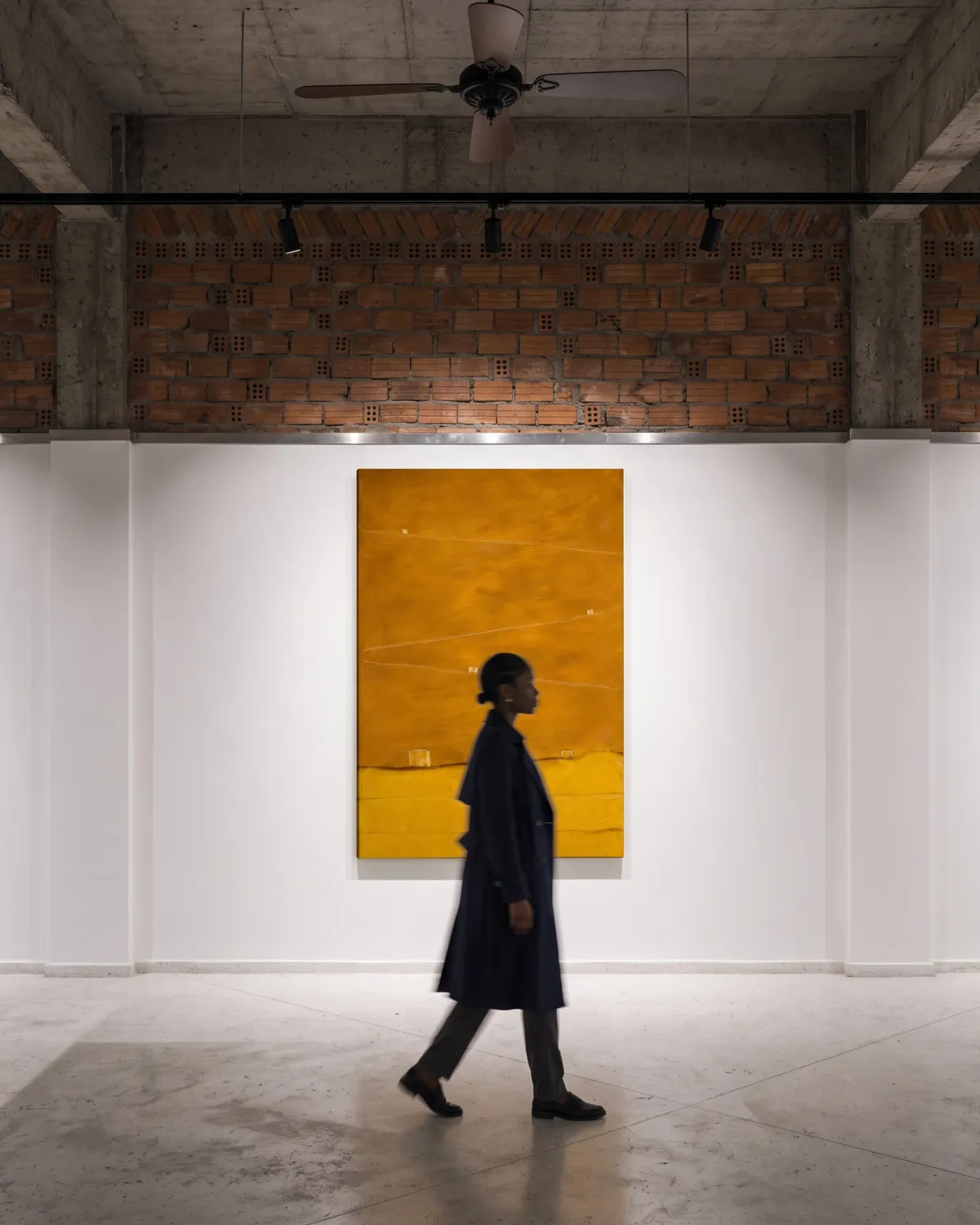
The surface of QUINQUE presents itself to the gaze as a stage of silent tensions, where a dense strip of terrestrial yellow supports the weightlessness of a vast ochre-golden field. Three fine horizontal incisions cross this upper atmosphere, holding three small suspended blocks of light, while two others rest on the horizon line, like coordinates of a forgotten cartography. To decipher these lines, it is revealing to evoke G. I. Gurdjieff, a mystic who questioned human automatism and advocated for a spiritual awakening of consciousness, whose perspective invites us to see these strokes not as ornaments, but as high-voltage wires that imprison matter in predetermined and mechanical pathways. Facing this iron rigidity, the thought of Osho, a philosopher who celebrated individual freedom against the repressive structures of society, allows us to interpret the light vibration of the yellows as a rebellion of desire and color vitality against the geometric domestication imposed by those spatial boundaries that seek to partition the fluidity of existence.
When I sink the palette knife into the still-wet canvas, I do not seek to draw upon the surface, but to open a direct channel into the very flesh of the accumulated matter. As I cut through the successive layers of acrylic and oil, I feel the fragility of the pigment resisting the incision, exposing a wound that desperately seeks an order within the chromatic chaos. This action evokes the rigor of the Mediterranean landscape, a dry and scorched environment where light defines boundaries with an implacable geometric violence. In that moment of physical tension, I pursue the notion of situs, that exact place a body must occupy in space to claim its own existence. The number five did not emerge as a preconceived symbol in my mind, but as an inevitable structural response; a physical need for balance that forced those five coordinates to find their exact place on the canvas to halt the collapse of the plane.
The title of the work, QUINQUE, introduces a numerical tension that alters the apparent serenity of its spatial distribution, divided between the three blocks suspended in the air and the two resting firmly on the ground. This configuration can be analyzed from the theory of Carl Gustav Jung, the psychiatrist who mapped the unconscious through universal symbols and archetypes, who postulated that the number five acts as a rupture of the stable quaternity and the traditional geometric order of the four corners. By introducing this fifth element, the perfect symmetry is broken, releasing an anomalous force that disorganizes the established map and opens the way to a process of individuation. The blocks are no longer mere weights on a static scale, but units of a territorialized psyche that resists being assimilated by the horizontal tracks of the composition, seeking an outlet that transcends the mere Cartesian division.
I understand that the external gaze seeks sacred correspondences in my numbers, but for me the mystery resides entirely in the temperature of that ochre that insists on evoking the warmth of a Mediterranean wall worn down by the sun and time. There is no abstract mysticism in my studio, but a constant physical struggle with the strata of paint, where color accumulates like dust on dry earth until it finds its own weight. The silence emanating from the painting does not come from a prefabricated spiritual revelation, but from the millimetric distance separating one block from another, from the exact interval that allows light to vibrate between the incisions. In the end, I paint to find that material silence, a stillness that is not the absence of sound, but the perfect tuning of forms coexisting under an implacable light.
In this way, the contemplation of QUINQUE places us on a threshold where the conceptual and physical tensions of the work resolve into a magnetic silence. It remains suspended whether we are contemplating a landscape posterior to human colonization, where the territory has been irrevocably partitioned and subdued by high-voltage lines of the mind, or whether we find ourselves before a primordial space where the first orientation marks attempt, with a touching fragility, to found a habitable place upon the immensity of color. Facing the canvas of eighty by one hundred and twenty-one centimeters, the viewer is returned to the absolute materiality of the painting, where the incisions and the yellow blocks sustain a dynamic balance. Under its apparent monumental stillness, the work pulses with a contained vibration, like a wasteland under the midday sun that promises to transform at the exact moment we decide to cross the limit of its border.
- Original artwork
- QUINQUE
- Actual dimensions
- 31.5 × 47.2 in / 80 × 120 cm
- Presentation
- Digital contextual visualization
Context references
minimalist abstract ochre painting · contemporary art maurizio valch quinque · abstract paintings with relief and texture · interior design with minimalist art
About this visualization
This visualization places the artwork within an architectural context to help collectors and viewers imagine its presence in a real space. It is an interpretive reference, not an exact reproduction: the original work remains the sole authority for scale, color, surface and material presence.