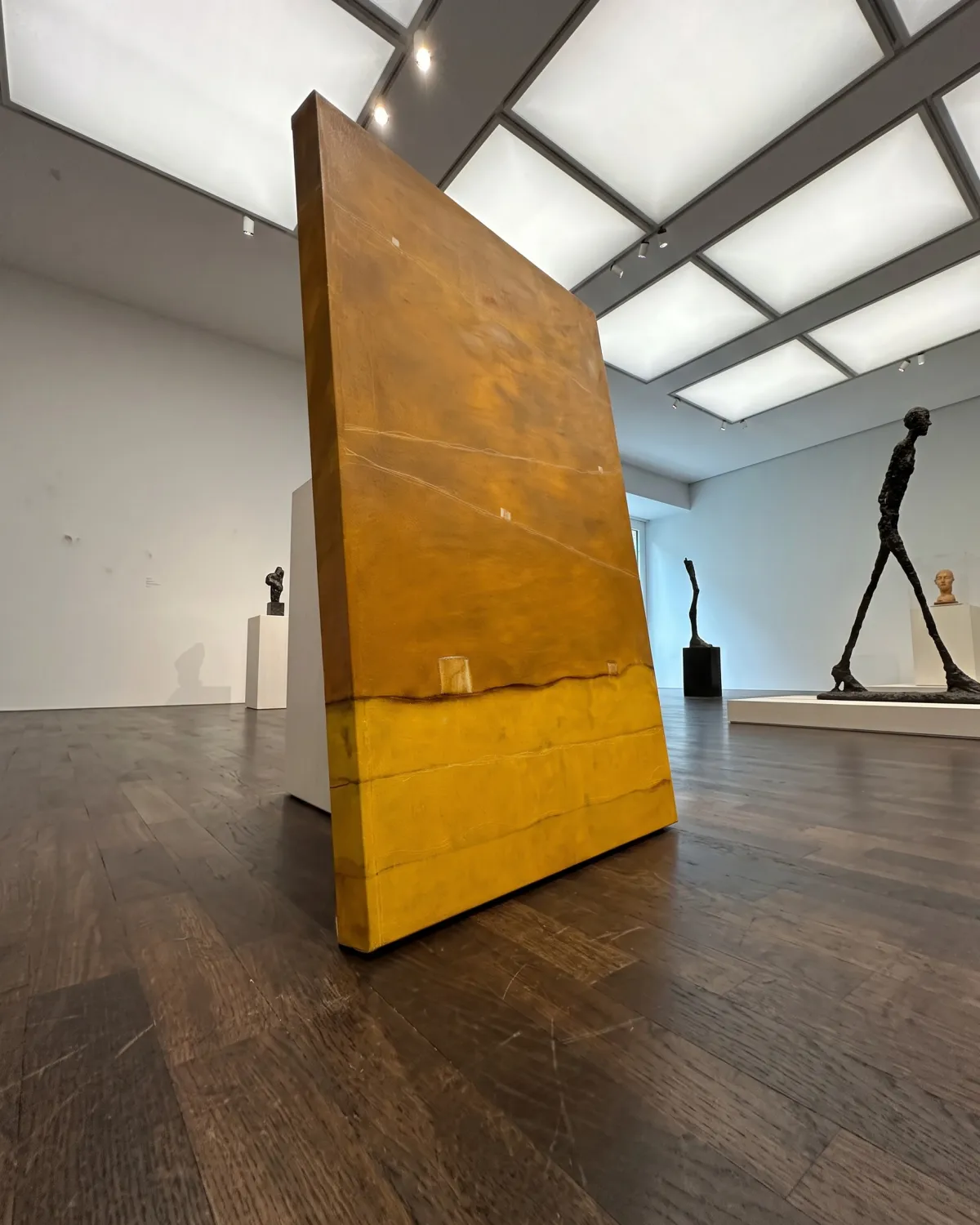
Context study / QUINQUE
QUINQUE by Maurizio Valch - STRATA Series | Abstract Painting
First notice: up there, there is no sky, yet
Look at QUINQUE first from a distance, like someone arriving late at a station where no trains run. At that distance, the amber seems to stretch out without asking for company; the yellow strip below could be ground, edge, cut, or simply a temperature that has decided to stay lower. Up above, a small white presence interrupts the expanse. It is too minimal to dominate it, and yet the entire field seems to have lowered its voice around it.
How can such a small thing demand that everything else fall silent?
Perhaps it is a house seen from very high up. Perhaps a token that someone left on an immense table. Perhaps a window that looks onto no interior. The strange thing is that it does not present itself as a central figure: it appears almost with modesty, as if it knew that calling too much attention to itself would ruin its task.
**Lewis Carroll**, the writer and mathematician who turned logic, play, and the child's gaze into machines to make the apparently normal seem strange. Carroll looks at that first sign and suspects a rule: if there are five, none can be exactly where they want to be. He does not ask what it represents. He asks something more uncomfortable: which of the five arrived first and stayed waiting for the others?
The question seems childish. It also seems precise. Because in this ochre there is no crowd, but a delay. A white presence up above does not illustrate a landscape: it makes the landscape seem to have been prepared to receive it and then forgotten by the one who was supposed to arrive.
Second notice: below, a light that does not console
Now lower your gaze without following a straight line. The lower yellow strip has a denser, closer luminosity, but not necessarily a warmer one. The upper amber expands like a held breath; the yellow below accumulates, weighs, seems to sustain something and at the same time push it outward. Between both zones there is a dark and irregular edge: it is not quite a horizon, nor a crack, nor a shore. Perhaps it is a visible seam between two decisions that have not reached an agreement.
There, another small white construction appears. It could be a glass without water. It could be a folded animal that has decided not to move. It could be a musical note that fell too low and can no longer find the melody.
What kind of silence does a small sign produce when it is near an edge that could cut it off?
From a distance, the body orients itself with ease: up seems distant, down seems firm. As you bring your gaze closer, that security changes. The pale threads begin to hint at the surface and breathing becomes less wide, a little more cautious. There is no longer a great quiet expanse; there is an expanse crossed by trajectories that almost erase themselves before reaching anywhere.
The five presences do not form a line. They seem to have rehearsed an organization and abandoned the rehearsal halfway through. One of them, below, could be marking an exit. Another could be the error that forced the invention of the map.
Third notice: the lines know something, but they do not say it
Now approach the pale threads. Not too quickly. From a certain distance they barely seem like wandering lines, scratches, paths that do not commit to their own direction. Close up, they cross the ochre with a stubborn fragility. They approach the small forms, move away, pass under them or next to them again, as if they knew a geography that the five figures still cannot read.
Here the landscape stops being a view and becomes a suspicion.
Can such a faint line force five tiny bodies to keep a distance from each other?
I do not know where a line ends when I look at this work again. Sometimes it seems to get lost within the amber; other times I feel it has continued to exist even if I can no longer see it. The white presences occupy very little space, but the space around them changes in density. The painting retains a decision that I recognize and that, nevertheless, no longer belongs entirely to me.
Carroll believes that lines are playing instructions. Perhaps each one indicates where a token can advance, where it must not, at what point it must stop so as not to disappear. But the game is flawed: there is no visible board, no dice, no turn. Only those marks that seem to know a path that the small figures ignore.
Then Carroll formulates another question, more exact than an explanation: if one of the five signs could follow one of those lines to the end, would it return as the same sign or would it arrive turned into something else?
The answer does not appear. A line swerves with an almost comical lightness, as if avoiding commitment.
Fourth notice: no one is alone if the void measures so much
**Gordon Parks**, the photographer and filmmaker who learned to look at the dignity, distance, and social life hidden inside an image. Parks does not accept so quickly that the five forms are playing. He looks at the separation between them, the exposure of their light edges, the vastness surrounding them. He asks who remains far from whom when the territory is so vast that even a minimal difference in position can become abandonment.
He does not say they are houses. He does not say they are bodies. He does not say they are distress signals. Precisely because of this, the unease remains: any of those possibilities would modify the ethical scale of the image.
What happens when something small cannot hide in such a large expanse?
Parks observes that the amber does not fully protect. Its variation in tones offers depth, distance, a kind of climate; but it also leaves each presence exposed. The whiteness does not shine like a victory. Sometimes it seems vulnerable, other times insistent. One of the figures, slightly displaced from another, seems to have been left out of the conversation.
Carroll protests: perhaps it is not left out, perhaps that is the rule. Parks responds, without raising his voice, that a rule can also leave someone far away.
The disagreement changes the painting. The forms are no longer just pieces of a puzzle nor just possible inhabitants of a geography. They are intervals. They are small places where the gaze has to decide how much weight a separation can have.
I am not sure the game is enough. Nor am I sure that distance must become a proof of harm. When I look at the five presences, I discover that one can seem suspended and, at the same time, support the others without touching them. What disconcerts me most is not what remains: it is what insists on escaping even when the eye finds it again.
Parks listens to that doubt and modifies his demand: an image can care for a reality without forcing it to declare itself a document. Carroll, for his part, stops laughing at the possibility of a token having weight. The game, he discovers, can have gravity without losing its rarity.
Fifth notice: the sign that seemed minor
There remains a small presence, almost secondary, near the lower zone: a white shape that at the beginning could be mistaken for a touch of light, an error, a tiny door closed too soon. Now it is not easy to leave it behind.
Perhaps it is the most silent of the five. It does not seem to command, it does not seem to ask for help, it does not seem to occupy a privileged place. But the yellow surrounding it changes around its edge. The nearby line does not fully connect it to anything; it barely passes, as if doubting whether to recognize it. The upper amber remains far, though not as far as before.
How can such a small sign make an entire territory seem to hold its breath?
Look at it again from a distance. Then approach it again, until the balance between the white, the yellow, and the pale line begins to gently disorient the eye. Do not try to decide if that shape is arriving, falling, waiting, or finding itself in the wrong place.
Let it stay there: minimal, clear, slightly apart, like a note that no one has played yet.
- Original artwork
- QUINQUE
- Actual dimensions
- 31.5 × 47.2 in / 80 × 120 cm
- Presentation
- Digital contextual visualization
Context references
ochre yellow abstract paintings · original artwork by maurizio valch · abstract painting with incised marks · contemporary abstract art collector
About this visualization
This visualization places the artwork within an architectural context to help collectors and viewers imagine its presence in a real space. It is an interpretive reference, not an exact reproduction: the original work remains the sole authority for scale, color, surface and material presence.